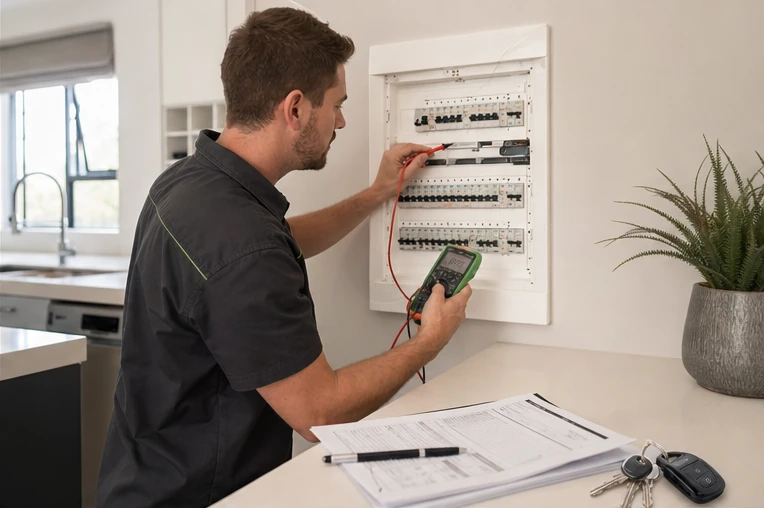
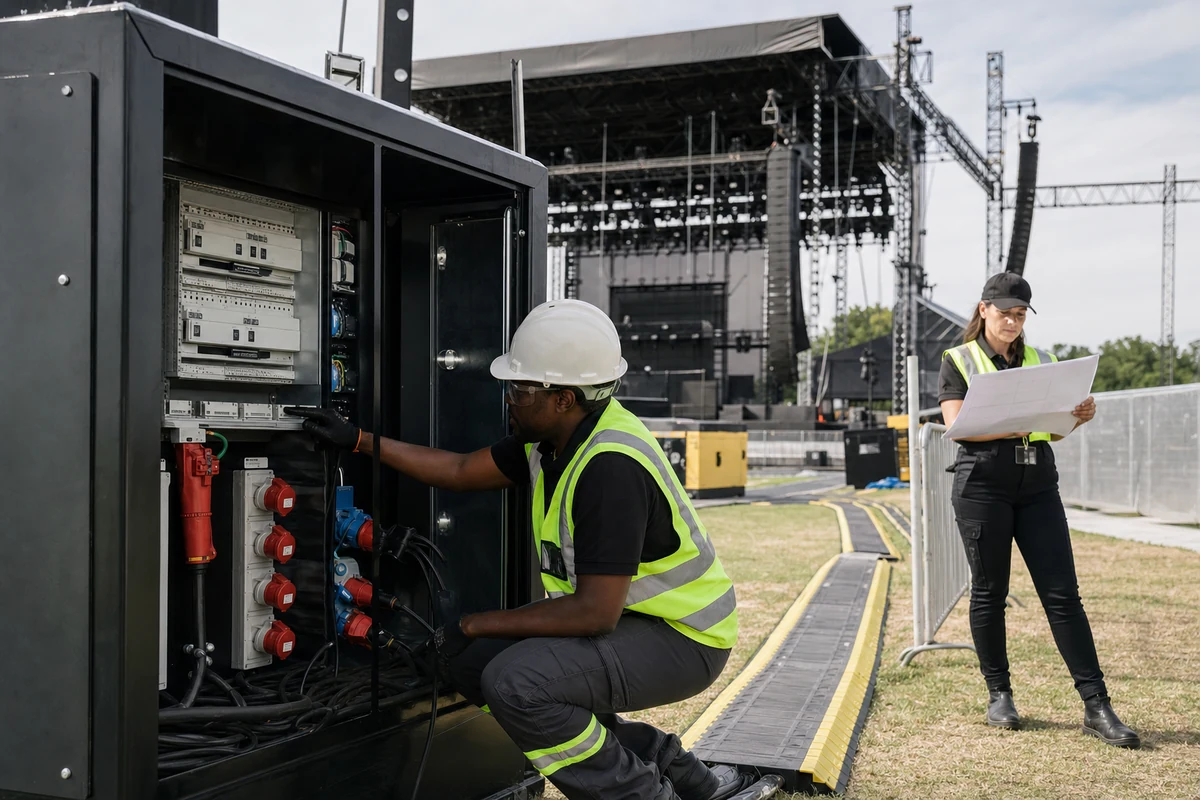
Festivals, markets, exhibitions, weddings, sports events and film activations can build a small electrical network in a matter of days. That network may combine a venue supply, generators, temporary distribution boards, stage equipment, caterers, traders, refrigeration, lighting and public-facing cable routes.
The phrase “temporary COC” does not mean a provisional certificate that permits incomplete or unsafe work. A temporary electrical installation can still require design, inspection, testing and certification for the exact configuration that will be energised. If the configuration changes, the evidence must be reassessed rather than stretched to cover untested additions.
A strong compliance plan starts early, assigns responsibility and creates one controlled power schedule before suppliers arrive.
01
What a temporary event COC should—and should not—mean
The Electrical Installation Regulations require a valid COC and test report for a qualifying electrical installation, and additions or alterations require certification for the changed work. The certificate should describe the installation actually inspected and tested. It is not a general approval of the event, crowd plan, tent, stage, fire system or generator fuel arrangements.
Authorities and venues may request the COC within a wider event-approval file. In Johannesburg, the Joint Operations Committee requirements expressly include certificates of approval and compliance documentation, while City Power and Emergency Management Services have separate roles in temporary supply and event safety.
- City of Johannesburg JOC requirements — Official event-document requirements, including certificates and plans.
- Roles of Johannesburg JOC stakeholders — Official guidance on City Power, EMS and organiser responsibilities.
02
Assign one person to control the event power scope
An event can have several electricians, generator vendors, production crews and exhibitors. Without one approved power plan, suppliers may connect equipment that was never included in the load schedule or inspection.
Name the organiser, venue representative, electrical contractor, responsible registered person, generator supplier and production power lead. Define who may authorise a change, who isolates an unsafe circuit and who holds the final documents before the public enters.
- The fixed venue supply and its responsible user or lessor.
- Every generator, changeover arrangement and distribution owner.
- The point where each vendor or production department takes responsibility.
- The registered person responsible for applicable inspection, testing and COC work.
- The person authorised to approve changes after the initial test.
- The emergency isolation and escalation contacts for event day.
03
Create a source, load and distribution plan before installation
Start with a site plan showing supply points, generators, boards, cable routes, stages, tents, kitchens, stalls and public areas. Add a load schedule that records the realistic demand and operating pattern of each user.
Consider starting currents, heating loads, simultaneous catering demand, sensitive equipment, three-phase balancing, voltage drop and future additions. Provide separate circuits where a single fault should not black out safety-critical areas, payment systems or refrigeration.
- Supply source, voltage, phases and available current.
- Generator rating, earthing strategy, neutral arrangement and fuel operating plan.
- Distribution-board locations and circuit schedules.
- Cable type, size, length, route and mechanical protection.
- Weather and public-access exposure.
- Emergency lighting, medical, security and other critical loads.
- A list of all trader, caterer, stage and production equipment.
04
Generator power needs engineered isolation and protection
A generator should not be treated as a self-contained answer to every electrical question. The earthing and neutral arrangement, protective-device operation, source isolation, cable ratings and changeover method must suit the actual installation.
Where City Power or another municipal supply is present, backfeeding must be prevented. Johannesburg’s JOC guidance says City Power should be notified when a generator is used and that applications may be needed for additional temporary power. Confirm local lead times rather than assuming approval can be completed on event day.
- Generator and inverter changeover guide — Practical guidance on source isolation, backfeeding and handover records.
05
Control cables, water, public access and temporary structures
The public should not be able to touch live parts, open distribution equipment or trip over unprotected leads. Boards and connections need suitable environmental protection and secure placement. Cable ramps and routes must be appropriate to foot traffic, vehicles, ramps, doors, water and sharp edges.
Do not run cabling where tent pegs, structural components, stage movement or vehicle access can damage it. Reassess after rain, wind, load-in activity and any relocation of stalls or equipment.
- Domestic multiplugs or daisy-chained extensions in wet or public areas.
- Distribution boards resting on the ground or accessible to the public.
- Cables crossing vehicle routes without suitable protection.
- Connectors exposed to water, heat, grease or strain.
- Unlabelled circuits, undocumented adaptors or improvised repairs.
- Protection that trips repeatedly and is reset without investigation.
06
Test before energising—and control every later change
Inspection and testing should occur with enough time to correct defects before opening. The final documentation must match the energised configuration, not an early drawing that no longer reflects the site.
A late food vendor, extra light, relocated board or replacement generator can change loading, protection and cable routes. Log the change, obtain approval, inspect and test the affected scope, and revise the documentation where required. Official temporary-power specifications used by South African municipalities demonstrate the same principle: alterations require updated certification and ongoing inspection.
- Electrical Installation Regulations, 2009 — Official COC, alteration and registered-person requirements.
07
Build one event electrical file for approval and handover
The event file should allow an organiser, venue, authority and electrician to understand the system without reconstructing it from WhatsApp messages. Keep signed, dated versions and record which drawing matches the final site.
- Final site plan, single-line diagram and board schedules.
- Source and load schedules, including generators and critical loads.
- Applicable COCs and test reports for the temporary and fixed-installation scopes.
- Generator, cable and distribution equipment details.
- Change register and revised evidence for approved alterations.
- Pre-opening, daily and weather-event inspection records.
- Emergency isolation plan and responsible contact list.
- JOC, venue and municipal electrical conditions applicable to the event.
- Contact Wesslink Electrical — Request event power planning, inspection, fault finding or applicable COC support.
- Commercial electrical services — Electrical support for venues, organisers and commercial properties.
FAQ
Questions readers also ask
What is a temporary electrical COC for an event?
It is not an informal provisional pass. It is a certificate for the qualifying temporary electrical-installation scope actually inspected and tested, accompanied by the relevant test report and accurate description of the configuration.
Do festivals and markets need an electrical COC?
Requirements depend on the installation, venue and authority, but qualifying temporary electrical work can require inspection, testing and a COC. Municipal or JOC processes may also expressly request compliance documentation.
Does every trader need a separate COC?
The responsibility boundary must be defined. The main event network, fixed venue supply and vendor equipment may be separate scopes. The organiser and responsible electrical professional should determine the correct documentation structure.
Must the COC be updated if the temporary layout changes?
Changes can affect the tested scope. Added loads, boards, sources or cable routes should be authorised, inspected and tested, with revised documentation where required.
Is a generator automatically safe because it is hired from a supplier?
No. The generator must be suitable for the connected installation, with appropriate isolation, earthing, neutral arrangements, protection, cabling and operating controls.
When should the final test happen?
After the installation is substantially complete and before public opening, with enough time for defects to be corrected. Any subsequent material change must be controlled and reassessed.