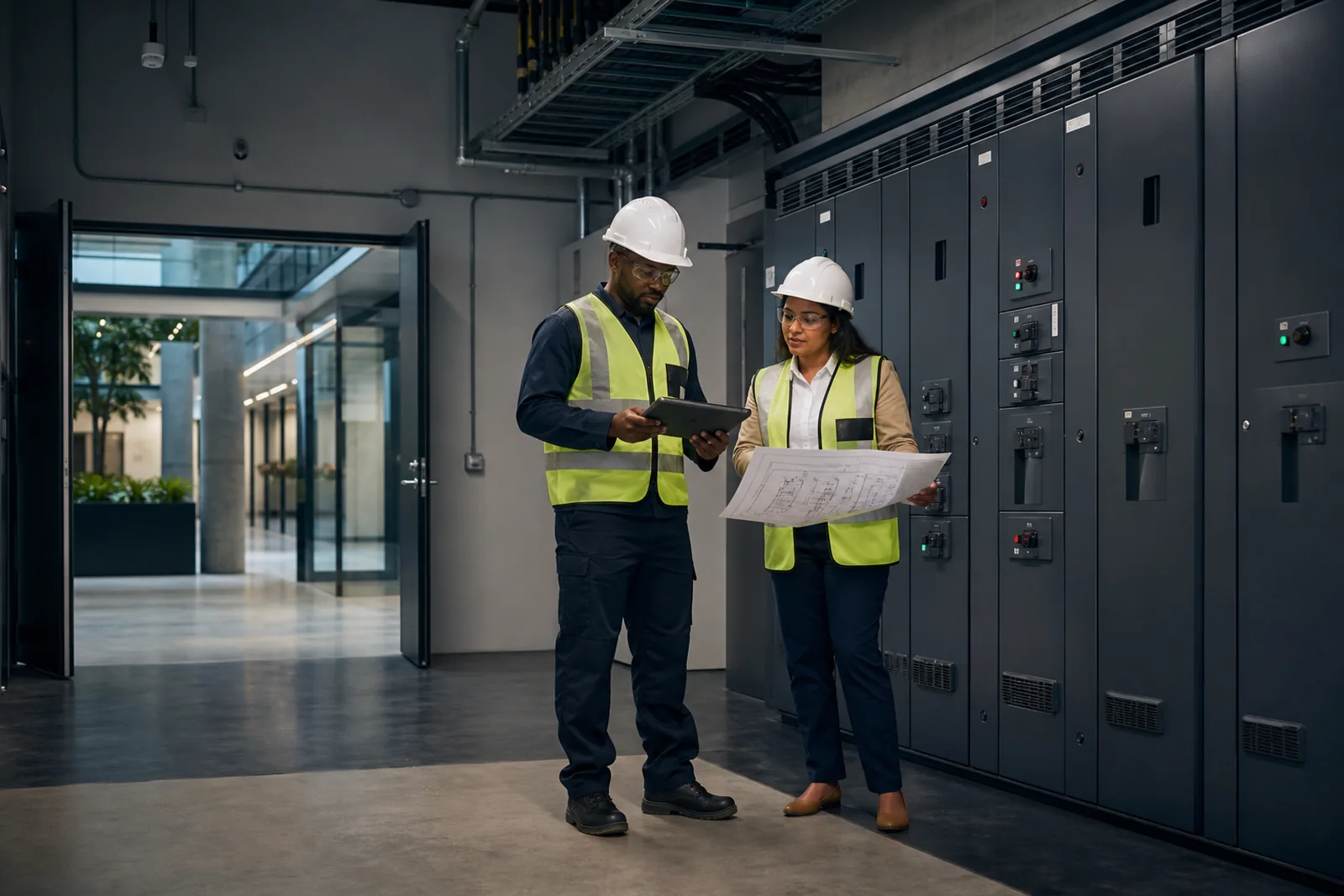
Commercial electrician and facilities manager reviewing a closed office-building distribution board

Waterfall City · Commercial asset operations

Commercial Electrical Operations for Waterfall City Offices

A facilities-first route for office distribution, planned isolations, continuity faults, backup-power interfaces and accountable handovers across Waterfall City's mixed-use commercial environment.

Offices & corporate campusesFacilities teamsPlanned & reactive work

01 · Operating boundary

Start with the building system, not the suburb keyword.

Waterfall City is not one electrical installation. It is a connected mixed-use district of offices, commercial buildings, residential areas, hotels, retail destinations and logistics facilities. A useful electrical brief therefore starts with the actual asset: building name, tenancy, floor, plant area, distribution boundary, supply arrangement and person authorised to approve access. The location helps route the team; it does not define the fault.

For an office or multi-tenant commercial building, identify whether the affected equipment sits inside a tenant installation, a landlord-controlled floor board, a common-property distribution system or an upstream supply. Record what remains powered, what changed before the fault and whether a generator, UPS or inverter changes the symptom. This prevents a vague “no power in Waterfall” enquiry from becoming an unsafe or poorly scoped attendance.

The page is deliberately focused on corporate offices, mixed-use buildings and facilities operations. It does not attempt to rank for generic “electrician Midrand” searches, and it does not take ownership of shop fit-out or mall handback intent.

District context was checked against Waterfall City's official Waterfall City business-district overview and work precinct information. Development names describe the operating area only; Wesslink does not claim appointment by or work completed for those properties.
02 · Commercial operating needs

Four scopes that facilities teams can define before a site visit.

Clear scope ownership reduces disruption and makes quotations, approvals and close-out records easier to compare.

01

Office distribution and floor boards

Trace the path from main distribution through risers, floor boards and tenant boards. Confirm circuit identity, protective devices, load information and the boundary between common property and leased space before proposing repair or alteration.

02

Planned isolation and restoration

Define the equipment to be isolated, affected occupants, access window, authorised switching party, verification method and restoration checks. Planned isolation is an operational event, not simply switching off a breaker.

03

Backup power and essential loads

Map the normal source, alternative source, changeover path, UPS or inverter boundary and essential-load boards. Record what must remain operational and how each state is tested without confusing equipment support with fixed-installation work.

04

Recurring tripping and thermal risk

Build a timeline of trips, load changes, weather, tenant activity and previous resets. The right response may require load measurement, circuit testing, connection inspection or equipment coordination—not a larger breaker.

05

Alterations and tenant interfaces

Before adding workstations, kitchens, air-conditioning interfaces or specialist equipment, confirm available capacity, circuit segregation, containment routes, drawings, labelling and the records required when the change is handed back.

06

Maintenance evidence

Close out with findings, work completed, test results appropriate to the scope, outstanding risks, updated labels or drawings where required, and a clear owner for the next action. An invoice alone is not a facilities record.

03 · Planned isolation workflow

Protect continuity on both sides of the switch.

A controlled outage needs a before, during and after plan.

Define the electrical boundary

Name the board, incomer, circuit or equipment interface and identify every downstream area believed to be affected. Treat old or incomplete labels as hypotheses until verified.

Confirm operational dependencies

Ask about access control, server rooms, pumps, lifts, fire systems, refrigeration, security, medical or process loads and other services that may not be visible from the distribution board.

Approve the access window

The responsible facilities contact should confirm security access, permits, tenant communication, switching authority and any specialist contractor who must be present for connected systems.

Isolate, verify and control the work area

Only competent authorised people should operate or work on the relevant installation. Isolation and verification must suit the real sources of supply, including alternative or back-fed sources.

Restore in a defined sequence

Check protective devices, normal and alternative supply states, critical loads, alarms and affected occupancies. Capture exceptions immediately rather than assuming that “power is back” closes the job.

Search-intent routing

Office operations here. Retail tenant work has its own owner.

Premises inside Mall of Africa have centre access, trading-hour, tenant, landlord and handback requirements that deserve a dedicated route. Keeping that intent separate protects both pages from competing for the same retail searches.

04 · Fault boundary

Partial power is evidence, not a diagnosis.

One dark floor can originate in tenant equipment, a tenant distribution board, landlord floor distribution, a riser, a main board, an alternative-supply state or the external supply. A tripped device shows that a protective operation occurred; it does not prove which component caused the condition. Repeated resetting can hide timing evidence and may expose the installation to further damage.

Facilities teams should record the exact time, affected areas, breaker or indicator state if visible without opening a panel, recent work, unusual smell or sound, weather, generator status and whether neighbouring areas are affected. Do not remove covers, touch damaged enclosures or approach exposed conductors for a photograph. Where there is heat, smoke, arcing, exposed live material or immediate danger, keep people away and contact emergency services or the relevant supply authority as appropriate.

For diagnostic support, use Wesslink's electrical fault-finding service. For fixed-board corrective work, the distribution-board repair route explains the appropriate owner. These links keep this location page focused on Waterfall commercial operations rather than trying to own every service query.

05 · A useful facilities brief

Send evidence that changes the decision.

A good brief helps determine urgency, people, test equipment, access and the likely first diagnostic boundary. It does not attempt to diagnose live electrical equipment remotely.

Waterfall City commercial FAQ

Questions facilities teams ask before attendance.

What should a Waterfall City facilities team send before attendance?

Send the building and access contact, affected floor or tenancy, symptoms, time pattern, critical loads, available drawings, safe photos and the required operational outcome. Do not open panels to obtain photographs.

Can office electrical work be planned outside occupancy hours?

Where building management permits it, isolation, testing and corrective work can be planned around approved access windows. Confirm permits, security, affected occupants and restoration checks before the visit.

How do you separate a tenant fault from landlord distribution?

The investigation follows the supply boundary from the affected load toward the tenant board, floor distribution, landlord board and upstream supply. Test results, not assumptions, determine responsibility.

Does this page cover retail tenant work inside Mall of Africa?

No. Retail tenant, restaurant and landlord handback work inside the mall precinct is routed to the dedicated Mall of Africa page so office and retail intent remain separate.

Can backup power be assessed as part of a commercial fault?

Yes. Identify UPS, inverter or generator interfaces, essential-load boards, changeover arrangements and what failed under each state. Specialist equipment faults may also require the equipment provider.

Waterfall City commercial electrical support

Start with the building, boundary and operational outcome.

Send Wesslink the facilities brief and we will help route the next safe, accountable step.

WhatsApp the commercial brief