Boat owners are often asked for an “electrical COC”, but the phrase can hide three different scopes: the electrical systems onboard the vessel, the shore-power lead and interface, and the fixed installation at the marina, yacht club, workshop or private jetty. Those scopes are connected in use, yet they do not automatically fall under one certificate.
South Africa’s Electrical Installation Regulations, 2009 expressly exclude an electrical installation on a vessel from the definition of an electrical installation. That means an ordinary property-style COC should not be presented as if it certifies every AC and DC circuit onboard a boat. Marine safety and survey requirements remain relevant, while the fixed shore installation has its own electrical-installation obligations.
The useful question is therefore not simply “Does the boat have a COC?” It is: what system was inspected, against which requirement, by whom, under which operating conditions, and what evidence accompanies the conclusion?
01
Start by drawing three electrical boundaries
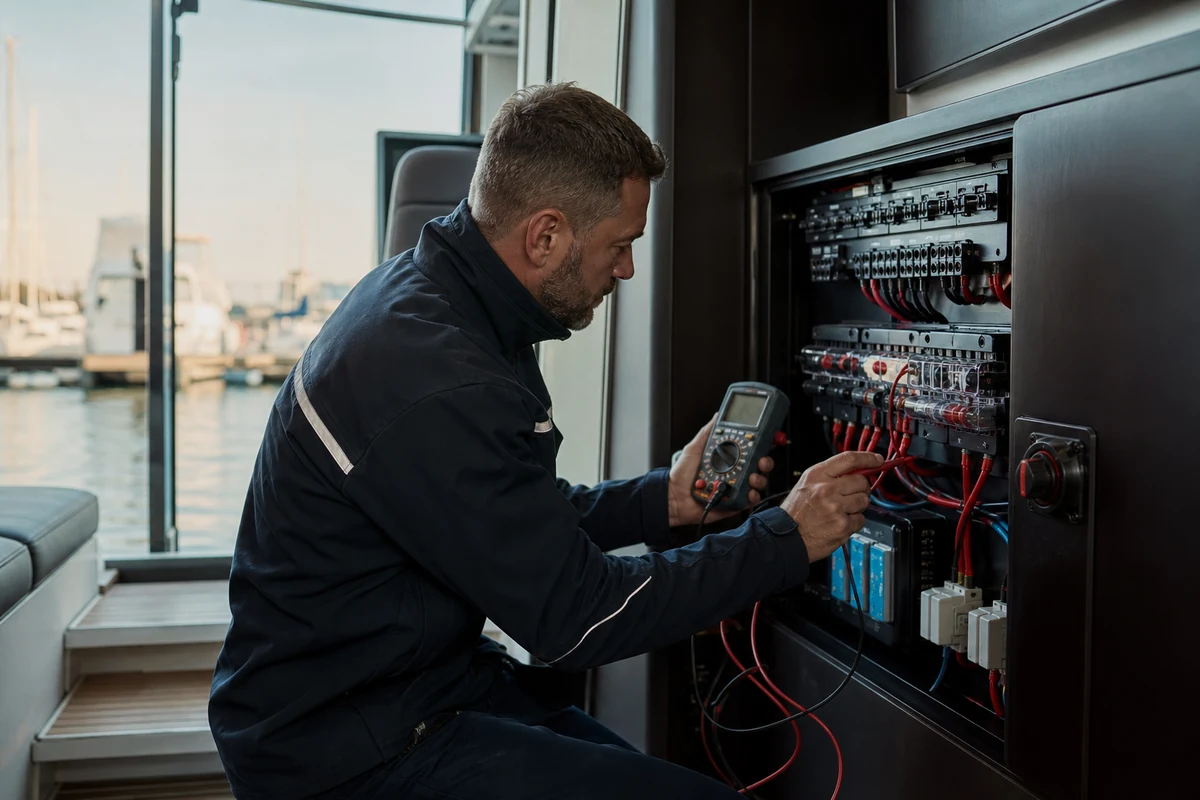
The onboard system includes the vessel distribution panels, batteries, chargers, inverters, cabling, protection, bonding arrangements, outlets and installed equipment. The shore interface includes the flexible lead, plugs, couplers and inlet. The fixed shore installation begins at the marina or premises point of control and supplies the outlet or connection point used by the vessel.
A competent inspection brief names all three boundaries. This avoids the dangerous assumption that a document for the marina outlet automatically certifies the boat, or that a vessel survey proves the fixed premises supply is compliant.
- Vessel name or identification, category of use and operating area.
- Nominal AC and DC voltages and every available source of power.
- Shore inlet and lead ratings, connector types and polarity arrangements.
- Battery chemistry, bank voltage, isolation, charging and ventilation arrangements.
- Generator, inverter and changeover operating modes.
- The exact circuits, equipment and shore connection included in the inspection.
02
Why a boat is not covered by an ordinary property COC
The Electrical Installation Regulations define an electrical installation in relation to machinery on premises, then exclude installations on vehicles, vessels, trains and aircraft. This exclusion does not declare boat wiring safe, and it does not remove the need for competent marine design, installation, inspection, testing or survey evidence. It identifies a different regulatory and technical context.
The fixed marina, workshop or jetty installation is different. Where it meets the statutory definition, the user or lessor must hold the applicable electrical COC and test report, and additions or alterations must be inspected and certified for the work performed.
- Electrical Installation Regulations, 2009 — Official definitions and COC responsibilities from the Department of Employment and Labour.
- Electrical COC services — Wesslink inspection and testing for applicable fixed electrical-installation scopes.
03
SAMSA and vessel survey requirements still matter
The South African Maritime Safety Authority explains that the National Small Vessel Safety Regulations apply to defined commercial and pleasure vessels at sea and to vessels on inland waters. The applicable survey, inspection and safety-certificate route depends on the vessel’s size, use, category and operating area.
SAMSA guidance addresses electrical matters such as electrical installations, battery banks, charging, auxiliary power and accepted marine standards. The owner should establish whether SAMSA, an authorised agency, a surveyor, an insurer, a marina or another authority requires specific evidence for the vessel.
- SAMSA vessel services overview — Official overview of vessel categories, surveys and applicable small-vessel regulations.
- National Small Vessel Safety Regulations — Official regulations published on the South African Government website.
04
What a useful marine electrical inspection should examine
Marine systems work in a harsh environment. Moisture, salt, vibration, confined spaces, fuel vapour, repeated movement and dissimilar metals can turn a minor defect into a fire, shock or corrosion risk. Inspection should therefore be based on the actual vessel and operating modes rather than a generic domestic checklist.
The person responsible should consider circuit protection, conductor selection and support, termination quality, labelling, isolation, polarity, insulation, battery overcurrent protection, charging, enclosure suitability, cable routes, AC/DC separation, ventilation and the behaviour of protective devices under shore, generator and inverter supplies.
- Battery conductors with no suitable protection close to the source.
- Domestic extension equipment used as permanent onboard distribution.
- Green corrosion, heat damage, brittle insulation or loose terminals.
- More than one source with no clear, interlocked selection method.
- Unlabelled circuits or wiring changes that do not match the diagram.
- Shore-power earth, neutral or polarity concerns that have never been tested.
- Equipment installed in a fuel or gas environment without the required suitability.
05
Treat shore power as a controlled handover—not an extension lead
Before connecting, confirm the authorised outlet, voltage, current rating, connector, protection and earthing arrangement. The lead should be suitable for the environment, undamaged, correctly routed and protected from traffic, water, sharp edges and mechanical strain.
The marina or premises is responsible for its fixed installation. The vessel owner is responsible for the boat-side equipment and should understand how shore power interacts with onboard generators, inverters, chargers and isolation devices. Adaptors should not be used to disguise an incompatible supply.
- Commercial electrical services — Support for applicable marina, workshop and premises distribution scopes.
- Electrical fault finding — Evidence-led diagnosis where equipment trips, overheats or behaves differently on shore power.
06
Build a handover pack that tells the truth about the vessel
A strong handover pack is more valuable than a certificate with a vague heading. It should identify the vessel, the configuration tested, the standards or survey basis applied, the person who performed the work, the results, limitations and any defects that remain.
Update the pack after rewiring, equipment additions, battery changes, inverter or charger replacements, generator work, shore-inlet changes, lightning damage, flooding, fire, overheating or persistent tripping.
- Current single-line diagram and circuit schedule.
- Battery, charger, inverter and generator information.
- Inspection and test results for the defined onboard scope.
- Shore-power lead and inlet ratings and operating instructions.
- Survey and safety-certificate records applicable to the vessel.
- Defect, repair and modification history.
- A separate COC and test report for the applicable fixed shore installation.
07
What affects the cost of a boat electrical compliance assessment?
There is no responsible universal price for every vessel or marina situation. Cost can change according to the vessel’s size and use, the number and complexity of AC and DC systems, shore-power arrangements, battery and charging equipment, documentation quality, access, travel, testing time, defects found and whether a specialist marine survey or other authority-specific evidence is required.
A useful quotation should separate the initial assessment from remedial work and final verification. It should also state exactly which system is included, which document will be delivered and what falls outside the electrician’s or surveyor’s scope. This avoids paying for a document that does not satisfy the insurer, marina, buyer or regulator who requested it.
08
How to request the correct assessment
Send photographs of the distribution panels, batteries, shore inlet, lead, generator and inverter; provide existing diagrams and survey records; and explain where and how the vessel operates. State whether the request comes from a surveyor, marina, buyer, insurer or authority.
Wesslink can assess applicable fixed shore supplies and help define the electrical scope. Where specialist marine survey or vessel certification is required, the correct outcome may include coordination with a SAMSA-recognised or appropriately authorised marine professional rather than mislabelling a property COC.
- Contact Wesslink Electrical — Share the vessel, shore connection and requested-document details.
FAQ
Questions readers also ask
Does a boat need an electrical COC in South Africa?
An onboard vessel installation is excluded from the Electrical Installation Regulations definition used for a property-style COC. The boat may still require marine inspection, survey and safety evidence, while the fixed marina or premises supply has its own COC obligations.
Can Wesslink issue a standard property electrical COC for all wiring on a boat?
No blanket claim should be made. A property electrical COC has a defined legal scope and should not be treated as automatic certification of onboard vessel wiring. The vessel, system boundary and requesting authority must first be identified so the correct competent person and document can be established.
Does a marina shore-power outlet need a COC?
Where the fixed marina installation falls within the Electrical Installation Regulations, the responsible user or lessor must hold the applicable valid COC and test report.
What should be checked after adding an inverter or lithium battery?
Review the source selection, isolation, conductor and protection ratings, battery overcurrent protection, charging compatibility, ventilation, labelling, operating modes and updated drawings, followed by appropriate inspection and testing.
Is a SAMSA safety certificate the same as an electrical COC?
No. They arise from different scopes. A vessel safety or survey process may consider electrical matters, while a statutory electrical-installation COC applies to qualifying fixed installations.
When should boat wiring be reassessed?
After additions or alterations, flooding, fire, lightning, battery or source changes, shore-inlet work, overheating, electric shock, persistent tripping or before a sale when the available records are unclear.