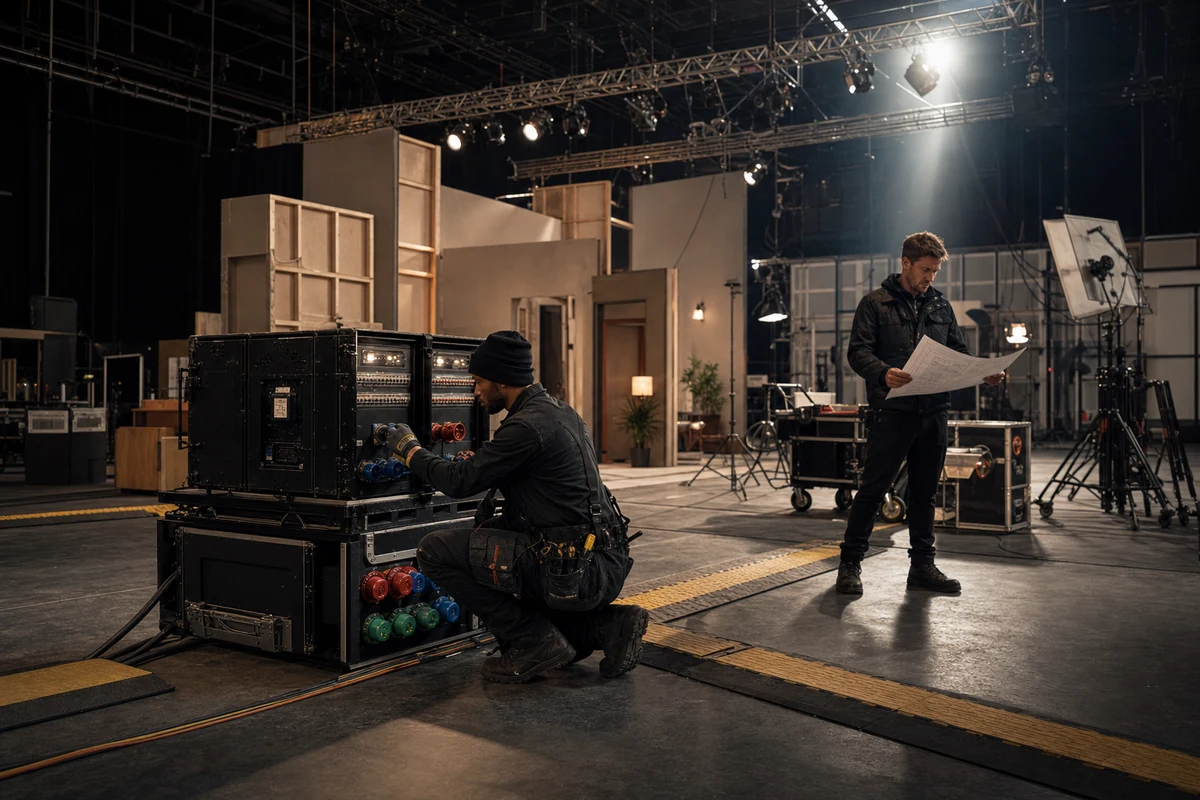
A studio soundstage can combine a permanent building supply with temporary production boards, generators, dimmers, LED walls, lighting rigs, set practicals, workshops, catering and location-style cabling. The electrical configuration may change between scenes, stages or shoot days.
There is no useful single “stage-set COC” that magically approves the building, production equipment, temporary distribution and every future set change. The compliance plan must define the fixed installation, the temporary electrical-installation scope, hired equipment and production operating checks separately.
The aim is a system that can be isolated, understood and retested after change—without losing the speed a production needs.
01
Map the fixed studio and temporary production scopes
The studio’s incoming supply, fixed boards, outlets and installed building services form one scope. Production distribution from authorised connection points, generators or temporary boards forms another. Hired luminaires, cables, distro equipment and set practicals have their own inspection and maintenance evidence.
Record the point at which production takes control. Do not let a vendor connection or art-department modification create an undocumented bridge between responsibility areas.
- Studio supply points, ratings and fixed-installation COC records.
- Generators, changeover arrangements and earthing strategy.
- Production boards, dimmers, power distribution and cable routes.
- Lighting grids, LED walls, set practicals and workshop supplies.
- Critical communications, safety and emergency lighting loads.
- The responsible production electrician and authorised change process.
02
Certify the installation that actually exists
The Electrical Installation Regulations require valid certification and test evidence for qualifying installations and altered work. The document must describe the relevant installation or portion. It should not be worded as approval of every production activity or piece of hired equipment.
A fixed studio COC does not automatically cover temporary set power installed later. Equally, testing a production board does not replace the studio owner’s responsibility for the fixed supply feeding it.
- Electrical Installation Regulations, 2009 — Official scope, alteration and COC requirements.
- Commercial electrical services — Support for studios, production premises and fixed distribution.
03
Design from the production load schedule
Prepare a schedule for luminaires, dimmers, LED processors, video walls, camera support, practicals, workshops, special effects support, catering and auxiliary equipment. Record phase, current, inrush, power factor and operating pattern where relevant.
Separate critical systems and avoid a single fault taking down safety lighting, communications or the entire shoot. Consider cable length, voltage drop, phase balance and the heat generated by bundled conductors and distribution equipment.
- What is the maximum credible simultaneous demand?
- Which source and board feed each production department?
- What may remain energised between takes or overnight?
- Which circuits require special environmental or mechanical protection?
- How are emergency isolation and restart controlled?
- What changes require the responsible electrician to retest?
04
Protect temporary distribution from people, vehicles and set changes
Temporary does not mean informal. Boards should be secure, suitable and clearly labelled. Cables must be supported or protected from trolleys, vehicles, doors, sharp scenery, water, hot lights and rigging activity. Public or performer access requires particular care.
Set practicals and art-department wiring must enter the same controlled electrical process as the rest of production. A visually convincing prop can still present shock or fire risk when modified without electrical supervision.
- Crushed, cut, overheated or contaminated cables and connectors.
- Moved boards or leads no longer protected from access.
- Unapproved splitters, adaptors or added equipment.
- Missing labels or a circuit schedule that no longer matches.
- Water, smoke, special-effects residue or construction dust.
- Repeated tripping, abnormal heat, smell or sound.
05
Control generator and mains operating modes
Generators must be integrated with suitable isolation, earthing, neutral arrangements, protection and changeover. Backfeeding a studio supply is unacceptable. Confirm fuel, exhaust and acoustic controls separately from the electrical scope.
Document which systems can be supplied by mains, generator or UPS/inverter power and whether any parallel operating mode exists. Test protective-device behaviour for the actual source configuration.
- Generator and inverter changeover compliance — Practical source-selection and backfeed-prevention guidance.
06
Use a fast change-control system between setups
Production changes do not always allow a long approval meeting, but they still need control. Use a short change request that records the new load, board, cable route or practical, the approving electrician, required tests and the drawing revision.
Only authorised people should energise new work. A lock-off or clear hold tag prevents another department switching on a circuit while it is being modified.
- Supply source, generator or changeover arrangement.
- Distribution board, protective device or conductor size.
- Cable length, route or environmental exposure.
- Set practicals, sockets or fixed connections.
- Load, phase balance or critical-circuit separation.
- Any system involved in shock, damage, overheating or tripping.
07
Give the producer a concise electrical production file
The file should be practical enough to use during the shoot and complete enough to support the studio, producer, insurer and safety team afterwards. Keep current revisions available at the stage and archive the final version.
- Responsibility matrix and emergency contact list.
- Fixed-studio supply information and applicable COC records.
- Temporary single-line diagram, load schedule and board schedules.
- Applicable COCs and test results for the installed production scope.
- Generator, earthing and changeover information.
- Equipment inspection records and vendor declarations.
- Change log, daily check records and incident actions.
- Wrap report confirming safe isolation and removal.
- Contact Wesslink Electrical — Request studio supply, temporary distribution, inspection or fault-finding support.
- Electrical fault finding — Measured diagnosis for production tripping and power-quality problems.
FAQ
Questions readers also ask
Does a temporary film set need an electrical COC?
A qualifying temporary electrical-installation scope can require inspection, testing and a COC. The exact boundary must be defined; the fixed studio, production distribution and hired equipment are not automatically one certificate.
Does the studio building COC cover the lighting rig?
Not automatically. It may cover the fixed supply installation, but temporary production distribution and later additions require their own appropriate inspection and evidence.
Must the temporary electrical system be retested for every scene?
Not merely because the scene changes. It should be reassessed when electrical configuration, load, source, board, cable route, environmental exposure or connected equipment changes materially.
Can art department wire illuminated props?
Any powered set practical should be controlled by the production electrical process and installed or supervised by appropriately competent people. Visual appearance does not remove electrical risk.
What evidence should a generator supplier provide?
Equipment details, ratings, maintenance information and connection requirements are useful, but the generator still has to be integrated, protected and tested in the actual production installation.
Who should keep the electrical records?
The producer or designated production safety function should keep the final file, while the studio, electrical contractor and equipment suppliers retain the records applicable to their own scopes.