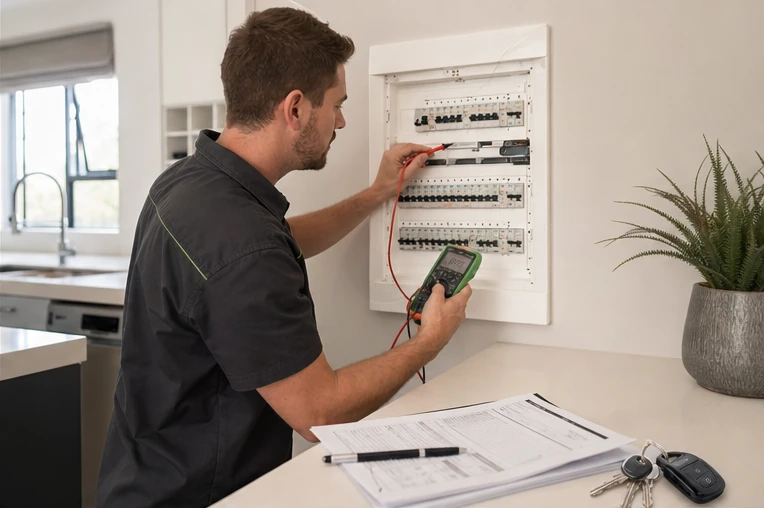
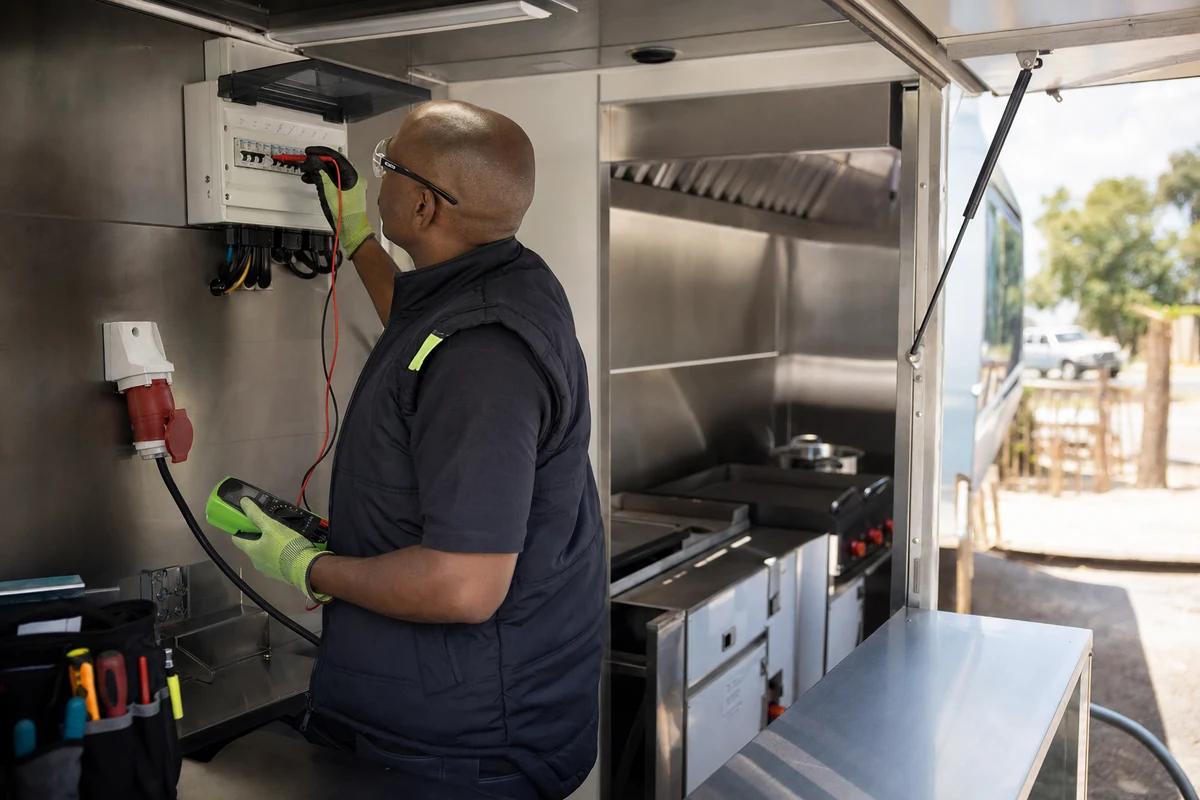
A request for an “electrical COC for a food trailer” sounds simple, but it can describe several different things. A mobile kitchen may contain a distribution board, socket outlets, lights, refrigeration, extraction, water-heating equipment, cooking appliances, an industrial inlet, a generator, an inverter and battery storage. It may then connect to a shopping centre, office park, market, event venue or private property, each with its own electrical supply and operating rules.
The safest approach is to stop treating the trailer, the equipment and the site supply as one certificate. First define each electrical boundary. Then identify which statutory certificate, inspection record, product approval, road document, municipal approval or venue declaration belongs to that boundary.
This distinction matters because the South African Electrical Installation Regulations, 2009 expressly exclude an electrical installation on a vehicle from their definition of an “electrical installation”. The exclusion does not make unsafe trailer wiring acceptable. It means that a statutory property-style COC should not be casually presented as if it automatically certifies every part of the mobile trailer.
01
Start with the legal definition—not the name printed on a quotation
Under the Electrical Installation Regulations, a certificate of compliance is issued by a registered person for an electrical installation or part of an installation. The same Regulations define an electrical installation in relation to machinery on premises from a point of control to points of consumption, but specifically exclude an electrical installation on a vehicle, vessel, train or aircraft.
A road-going food trailer falls within the vehicle context. That makes it essential to describe the requested work accurately. The question is not merely “Does the trailer have a COC?” It is: what is being inspected, what supplies it, where is the point of control, what documentation is legally applicable and what additional evidence will the owner, venue, insurer or authority require?
- Electrical Installation Regulations, 2009 — Official definitions, responsibilities and COC requirements from the Department of Employment and Labour.
- Department of Employment and Labour COC notice — Official reminder that registered contractors and proper inspection and testing are required for statutory electrical-installation COCs.
02
Separate the project into five compliance scopes
A useful inspection brief names the boundaries before testing begins. This prevents an owner from receiving a certificate for one portion while believing that the entire trading operation has been approved.
- The mobile trailer’s internal fixed wiring, distribution board, protection, earthing and outlets.
- The inlet, flexible supply lead, plugs, couplers and any adaptors used between the site and trailer.
- The fixed premises installation and outlet that supplies the trailer at each trading site.
- Generators, inverters, batteries, changeover arrangements and the operating mode of alternative supplies.
- Individual appliances and equipment, including refrigeration, extraction, water heating and electric cooking loads.
03
What should be inspected inside the food trailer?
The vehicle exclusion should never be interpreted as permission for improvised wiring. Mobile equipment is exposed to vibration, heat, grease, moisture, movement, repeated connection and changing supply conditions. Those risks make competent design, installation, inspection and testing especially important.
The inspection scope should be agreed before work begins and should produce an intelligible record. It may include the main isolating arrangement, protective devices, conductor sizing, cable support, mechanical protection, polarity, continuity, insulation, earthing, residual-current protection, socket outlets, appliance connections, labels and the relationship between the inlet rating and the maximum connected load.

- Domestic multiplugs or extension reels permanently used as distribution equipment.
- Loose cables crossing hot, wet or food-preparation areas.
- Unlabelled breakers or more than one source without a clear isolation method.
- Socket outlets, switches or enclosures unsuitable for the environment.
- No reliable circuit schedule or record of alterations.
- Burnt plugs, discoloured terminals, nuisance tripping or equipment that shocks the user.
- A supply connector rated below the trailer’s realistic simultaneous demand.
04
The venue’s fixed supply is a separate electrical-installation responsibility
A market, shopping centre, office park, event site or private property may provide the socket outlet or connection point feeding the trailer. That fixed premises installation falls within a different responsibility boundary from the road-going trailer.
The venue should know what outlet is authorised, what rating is available, which protection serves it and whether the fixed installation has the required electrical documentation. A food-trailer owner should not be expected to repair a venue’s installation, while a venue should not assume the trailer is safe merely because its outlet has a valid COC.
At handover, record the supply voltage, phase arrangement, available current, connector type and any limits imposed by the venue. Do not solve an incompatible connection with layers of unverified adaptors.

- Commercial electrical services — Wesslink support for fixed venue supplies, distribution boards, fault finding and planned commercial electrical work.
- Electrical COC services — Inspection and testing of applicable fixed electrical-installation scopes.
05
Build a real load schedule before choosing the inlet and supply
Food trailers often grow one appliance at a time. A fridge is followed by a freezer, fryer, coffee machine, hot-water unit, extraction fan, air conditioner or additional cooking equipment. The original inlet and distribution design may no longer match the present load.
List the nameplate rating and operating pattern of every electrical item. The designer or electrician can then consider diversity, starting currents, continuous loads and the operating sequence instead of adding the printed wattages blindly or relying on a verbal estimate.
- Appliance description, rated voltage and input current or power.
- Whether the item is fixed, plugged in, thermostatically controlled or motor-driven.
- Which appliances must run simultaneously during the busiest trading period.
- Starting or heating demand where relevant.
- The circuit and protective device serving each item.
- The inlet, generator or inverter capacity available in each operating mode.
06
Generator and inverter operation needs its own design review
A generator or inverter is not simply a second extension lead. The system needs a defined operating mode, source selection, isolation arrangement, compatible protection and an earthing strategy that has been assessed for the actual equipment and connection method.
An owner should be able to explain whether the trailer can be supplied by the venue, the generator or the inverter; whether sources can ever be connected together; which circuits are excluded from backup; how the source is started and stopped; and how the system returns safely to the normal supply.
Never backfeed a trailer or premises through an ordinary socket outlet. Do not assume that an earth-leakage device will behave correctly under every generator or inverter configuration without the necessary design and testing.
- Generator and inverter changeover guide — A practical explanation of source isolation, backfeeding and changeover records.
- Electrical fault-finding services — Evidence-led diagnosis where protection trips or equipment fails under load.
07
Check that regulated electrical products are suitable and approved
The NRCS regulates categories of electrical and electronic products and components, including plugs, adaptors, switches, flexible cords, cord sets, circuit-breakers, earth-leakage units and electrical apparatus. Product approval is not the same as certification of the whole trailer, but unsuitable or unapproved components weaken the safety case.
Keep supplier invoices, model information and available approval evidence. A CE mark alone should not be treated as automatic proof of South African regulatory acceptance; the NRCS explains that the applicable South African conformity route must be followed.
- NRCS electrotechnical approvals and regulated products — Official NRCS information on regulated electrical products, LOAs, RCCs and product approval.
08
Electrical evidence does not replace the trailer’s other approvals
A mobile food business can have sound electrical work and still lack other approvals required for lawful trading. Keep the compliance streams separate so that no certificate is misrepresented as covering a different risk.
The National Department of Health lists R638 of 2018 as the regulations governing general hygiene requirements for food premises and the transport of food. Municipal environmental-health processes use those requirements when considering a Certificate of Acceptability. Municipal trading rules can add site, food-vending, roadworthy and permission requirements.
The NRCS also explains that trailers intended for public-road use fall within vehicle conformity and homologation processes. Gas installations, fire equipment, extraction and local trading permission may introduce further requirements depending on the equipment and operating location.
- Food-premises Certificate of Acceptability and environmental-health conditions.
- Business, trading-site or event permission required by the relevant authority or venue.
- Trailer registration, roadworthy and applicable vehicle conformity documentation.
- Gas-system documentation where LPG or other gas equipment is installed.
- Fire equipment, extraction, cleaning, water and waste arrangements.
- Electrical inspection, testing, product and supply records appropriate to each scope.
- National Department of Health food-control regulations — Official source for R638 and related national food-control regulations.
- NRCS vehicle homologation — Official overview of vehicle and trailer conformity for public-road use.
- City of Tshwane food-vending trailer requirements — A municipal example showing that food-vending, health and roadworthy requirements remain distinct from electrical evidence.
09
Buying a completed trailer: request evidence before paying the balance
A polished stainless-steel interior does not prove that the electrical design matches the appliances or that the trailer has been tested. Agree on the required records in the purchase contract rather than asking for them only after delivery.
If the seller uses the phrase “electrical COC”, ask which legal scope the document covers, who issued it, what was inspected and which test results accompany it. A correctly described inspection and test record is more valuable than an impressive heading with an uncertain basis.
- Trailer identification, builder information and a dated description of the inspected scope.
- Single-line diagram or circuit schedule showing the inlet, isolation, protection and outlets.
- Load schedule for installed appliances and the maximum permitted supply.
- Inspection and electrical test results appropriate to the agreed trailer scope.
- Generator, inverter, battery and changeover operating instructions where applicable.
- Product model information and available NRCS approval evidence for regulated equipment.
- A defect list, repair record and final verification after authorised changes.
10
A ten-minute pre-event electrical handover
Before each event, the venue representative and trailer operator should confirm the agreed connection point and responsibility boundary. This is an operational handover, not a substitute for the required technical inspection and documentation.
- The correct trailer, inlet, lead and authorised venue outlet are being used.
- Connector ratings and phase arrangements match.
- The supply lead is protected from traffic, sharp edges, water, heat and trip hazards.
- No unapproved splitter, domestic adaptor or daisy-chained extension is introduced.
- Cables and enclosures show no damage, burning or contamination.
- The operator knows the normal isolation point and emergency shutdown method.
- The agreed appliances and maximum load have not changed.
- Generator exhaust, fuel and noise controls are dealt with outside the electrical scope.
- Required venue and municipal documents are available.
- Any failed test, tripping or damage is escalated rather than bypassed.
11
Reassess the trailer whenever the equipment or supply method changes
Replacing a small appliance with a high-load fryer, adding a coffee machine, installing an inverter or changing the inlet can alter the design assumptions. The same is true when a trailer that normally uses one venue begins working from generators or unfamiliar event supplies.
Keep a change register. Record what changed, who authorised the work, what tests followed and which drawings or operating instructions were updated. This protects the owner from relying on documents that describe an earlier configuration.
12
How to request the right professional assessment
Send the trailer make or identification, photographs of the inlet and board, the appliance list, the available supply sources and any existing diagrams or test records. State where the trailer operates and what the venue, purchaser, insurer or authority has asked you to provide.
Wesslink can then clarify whether the request concerns the fixed premises supply, fault finding, load planning, the trailer wiring evidence, or coordination between several compliance scopes. A responsible answer may be a defined inspection and report rather than a property-style COC for an excluded vehicle installation.
- Contact Wesslink Electrical — Send the trailer details, operating locations, appliance list and the exact document requested.
- Electrical services — Explore Wesslink inspection, fault-finding, compliance and commercial electrical services.
FAQ
Questions readers also ask
Does a mobile food trailer legally need an electrical COC in South Africa?
The Electrical Installation Regulations, 2009 exclude an electrical installation on a vehicle from their definition of an electrical installation. A food trailer should still have competent electrical design, inspection and testing, while the fixed premises supplying it remains a separate statutory electrical-installation scope. Ask exactly what document the venue or authority requires and what it is intended to cover.
Can a property electrical COC certify all the wiring inside a food trailer?
It should not be assumed to do so. The Regulations expressly exclude vehicle electrical installations. The electrician or inspector should define the legal and technical basis of any trailer report and avoid misdescribing the document.
Does the socket outlet supplying the trailer need to be compliant?
Yes. The fixed premises installation and its supply outlet form a separate scope. The venue or premises user or lessor is responsible for the applicable installation safety and COC obligations.
Is an extension lead enough for a mobile food trailer?
Not automatically. The cable, connectors, protection, environment, route and current rating must suit the actual load and operating conditions. Domestic adaptors and daisy-chained extensions are poor substitutes for a designed supply arrangement.
What electrical documents should I request when buying a food trailer?
Request a defined inspection scope, circuit schedule or diagram, load schedule, test results, inlet and source ratings, appliance information, alteration history and generator or inverter instructions. Confirm separately what statutory, municipal, vehicle, food and gas documents are required.
Does a generator make the trailer independent of venue compliance?
No. The generator operating mode still needs appropriate isolation, protection and earthing consideration. If the trailer also connects to premises, the venue supply remains a separate responsibility.
Is a Certificate of Acceptability the same as an electrical COC?
No. A Certificate of Acceptability relates to food-premises hygiene requirements under R638 and municipal environmental-health processes. It does not replace electrical inspection or documentation.
When should the trailer be reassessed?
After changes to appliances, wiring, the inlet, generators, inverters, batteries or the normal supply method, and whenever there is damage, overheating, electric shock, repeated tripping or an unexplained failure.