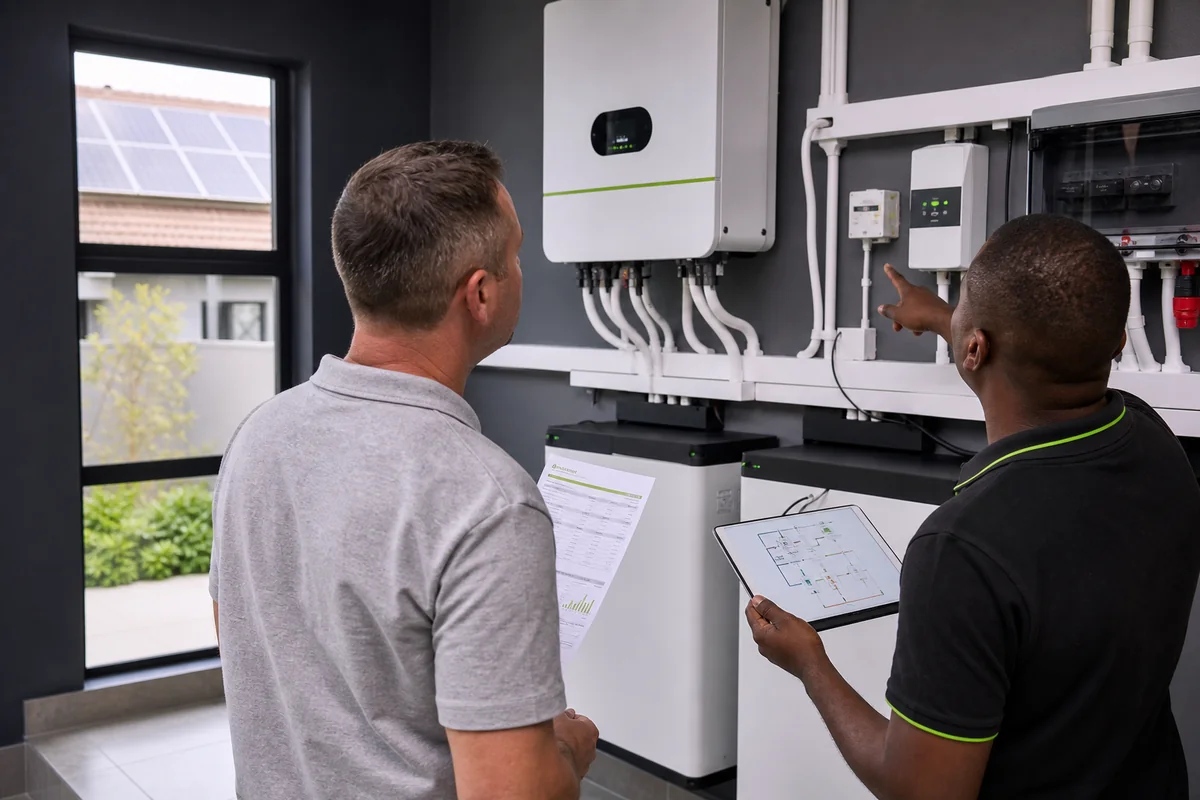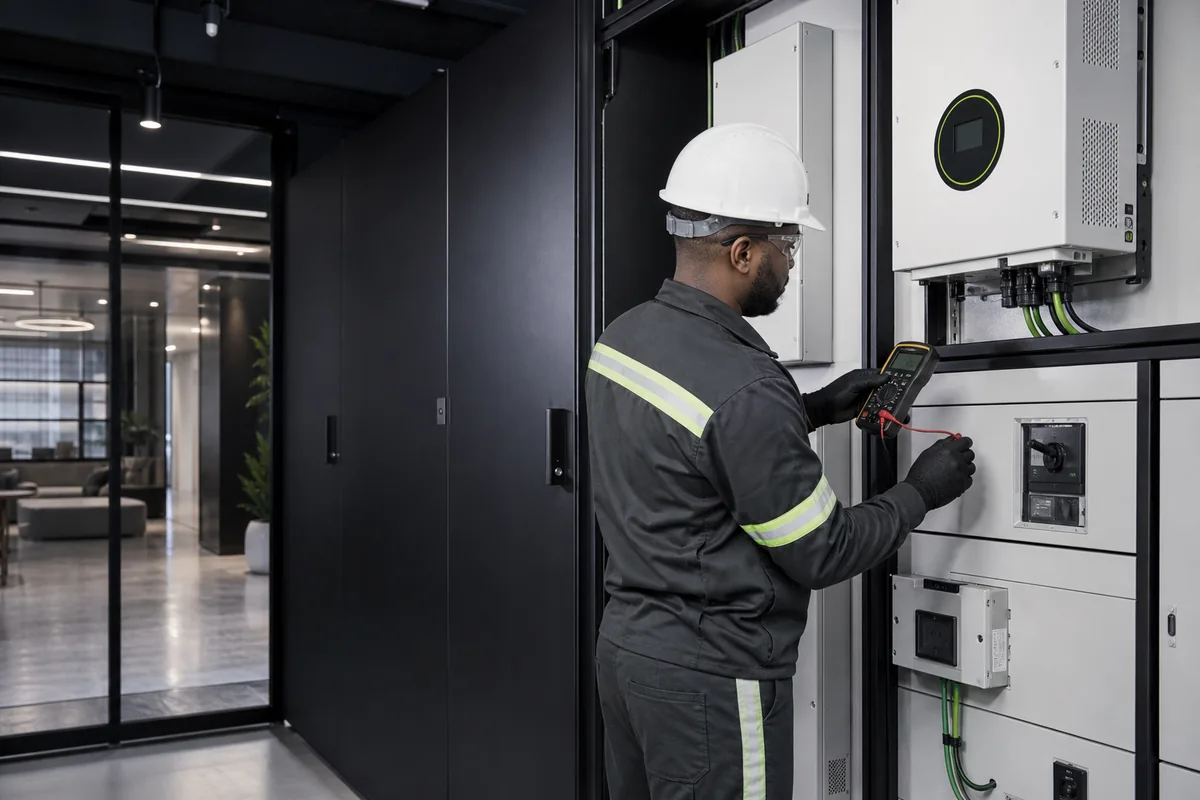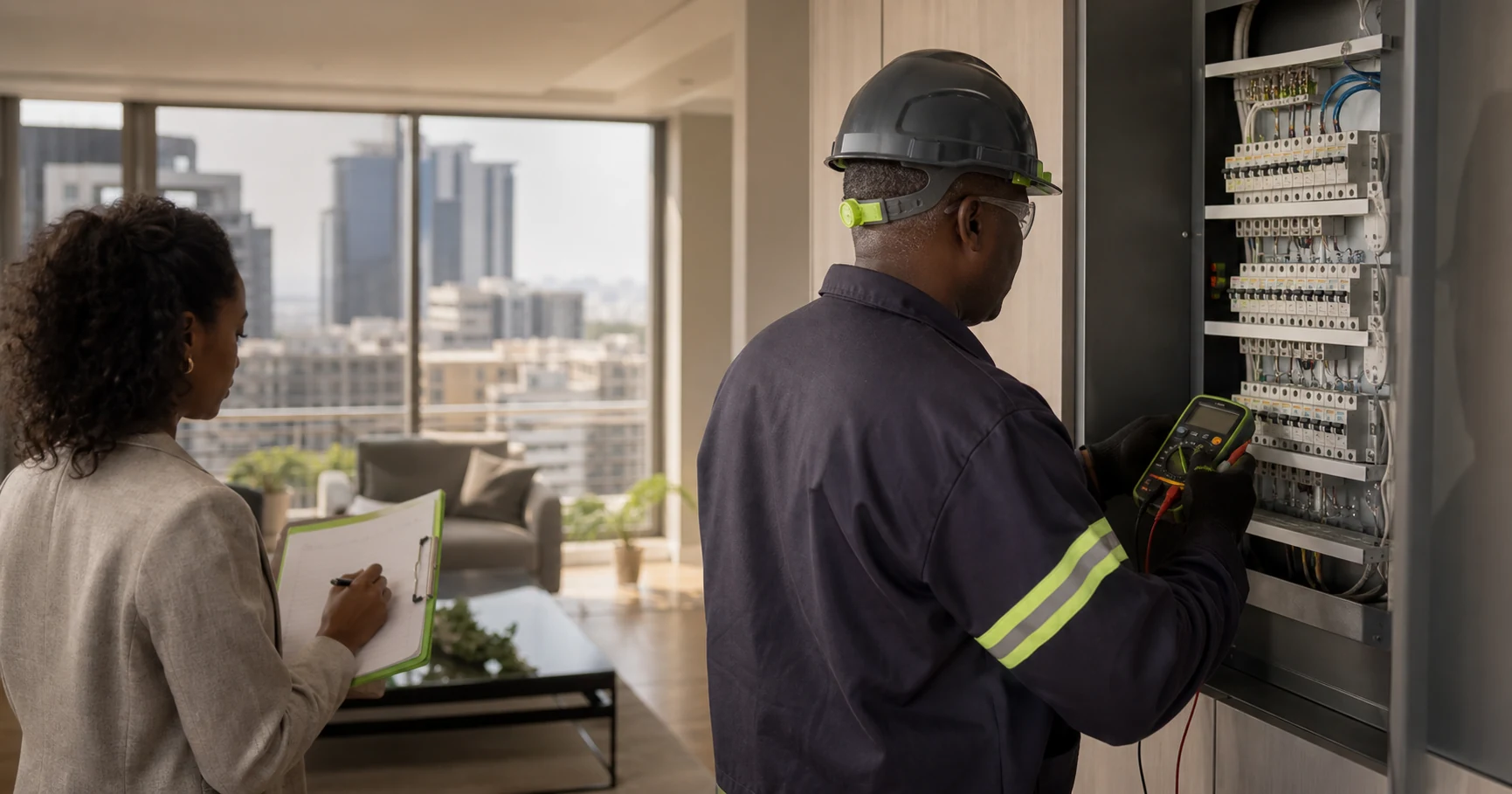
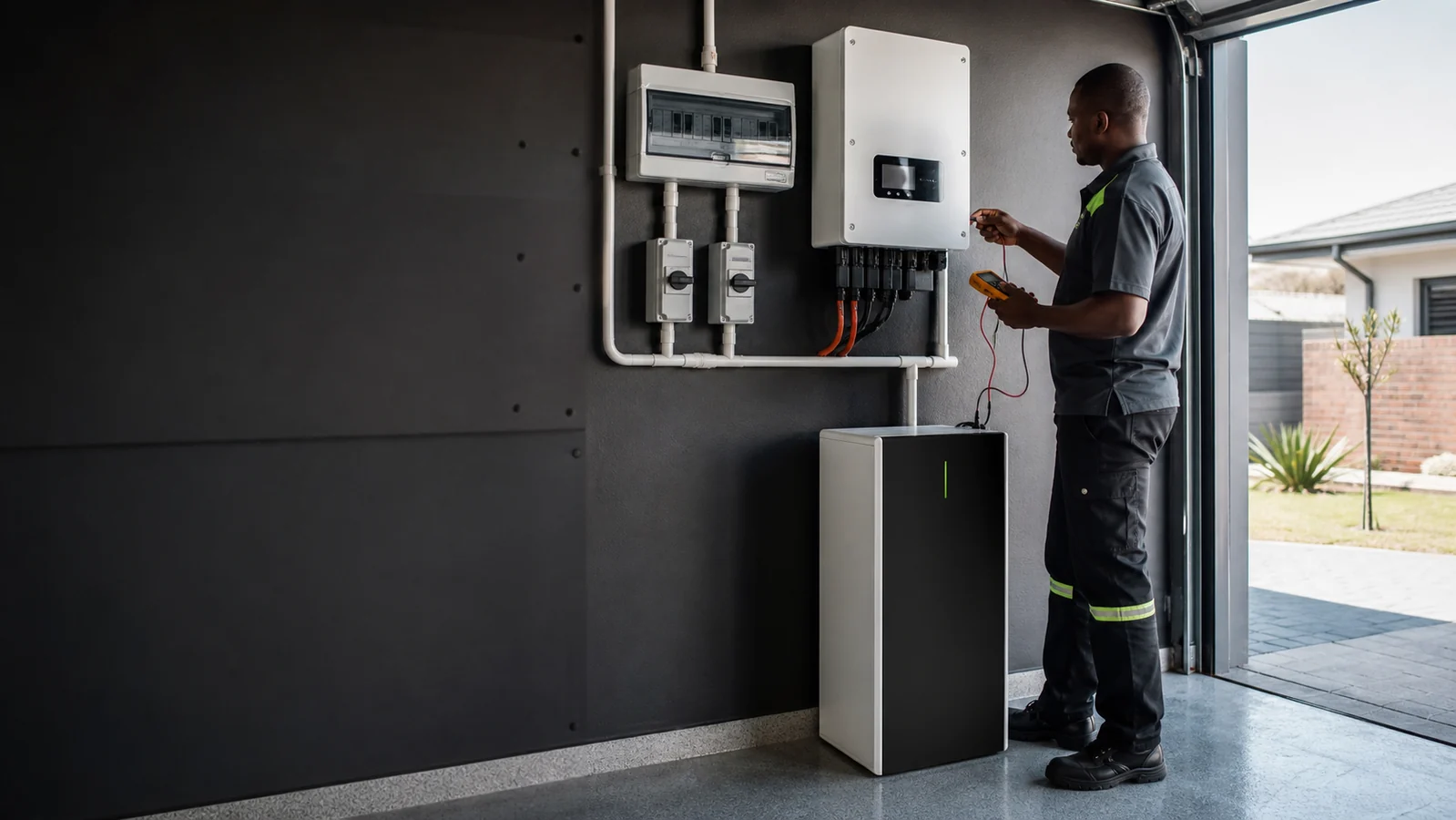
Can an inverter be installed in a garage? What about a bedroom, cupboard, scullery, passage, roof void or outside wall?
The safest answer is not a one-line list of “legal” and “illegal” rooms. In South Africa, a household inverter and battery location must pass four separate tests:
The four tests are electrical compliance; building and fire safety; the exact product requirements; and any network or local approval that applies to the intended operating mode.
That means a garage may be an excellent location in one house and a poor location in another. An outdoor wall may be acceptable for one weather-rated product and expressly prohibited for another. A tidy cupboard can still be unsafe if it traps heat, contains combustible material or prevents emergency access.
01
First separate the inverter from the battery
People often call the complete system “the inverter”, but an installation can include several different risk items:
The inverter’s preferred environment is not necessarily the battery’s permitted environment. The battery chemistry, enclosure rating and manufacturer’s manual can be decisive. This distinction matters throughout this guide: the strongest room-location exclusions in the international material discussed below apply to storage batteries and battery energy storage systems (BESS). They must not automatically be rewritten as a universal ban on an inverter-only unit.
For example, one Freedom Won residential battery manual describes the product as IP20 and strictly for indoor use, away from moisture and direct sunlight. It says no specific gas ventilation is required for that product, but air circulation may still be needed to control room temperature. By contrast, Victron’s Lithium SuperPack NG has an IP65 enclosure, yet its manual still says it should not be exposed to direct sunlight, heavy rain or other weather conditions. These examples show why an IP number or the word “lithium” is not enough to approve a location. Read the manual for the exact model. (Freedom Won manual; Victron manual)
- an inverter or inverter-charger;
- one or more batteries and a battery-management system;
- AC and DC isolators, overcurrent protection and surge protection;
- distribution boards and changeover or transfer equipment;
- PV strings and DC cabling, if solar panels are included;
- communications, meters and monitoring equipment.
02
The practical location matrix
The table is deliberately not a substitute for a site inspection. It identifies the questions that must be answered before anyone drills mounting holes.
Wesslink artistic safety illustration: these are locations to avoid as a default and investigate professionally. The red outlines do not mean that every inverter-only installation in a room with that name is automatically unlawful.
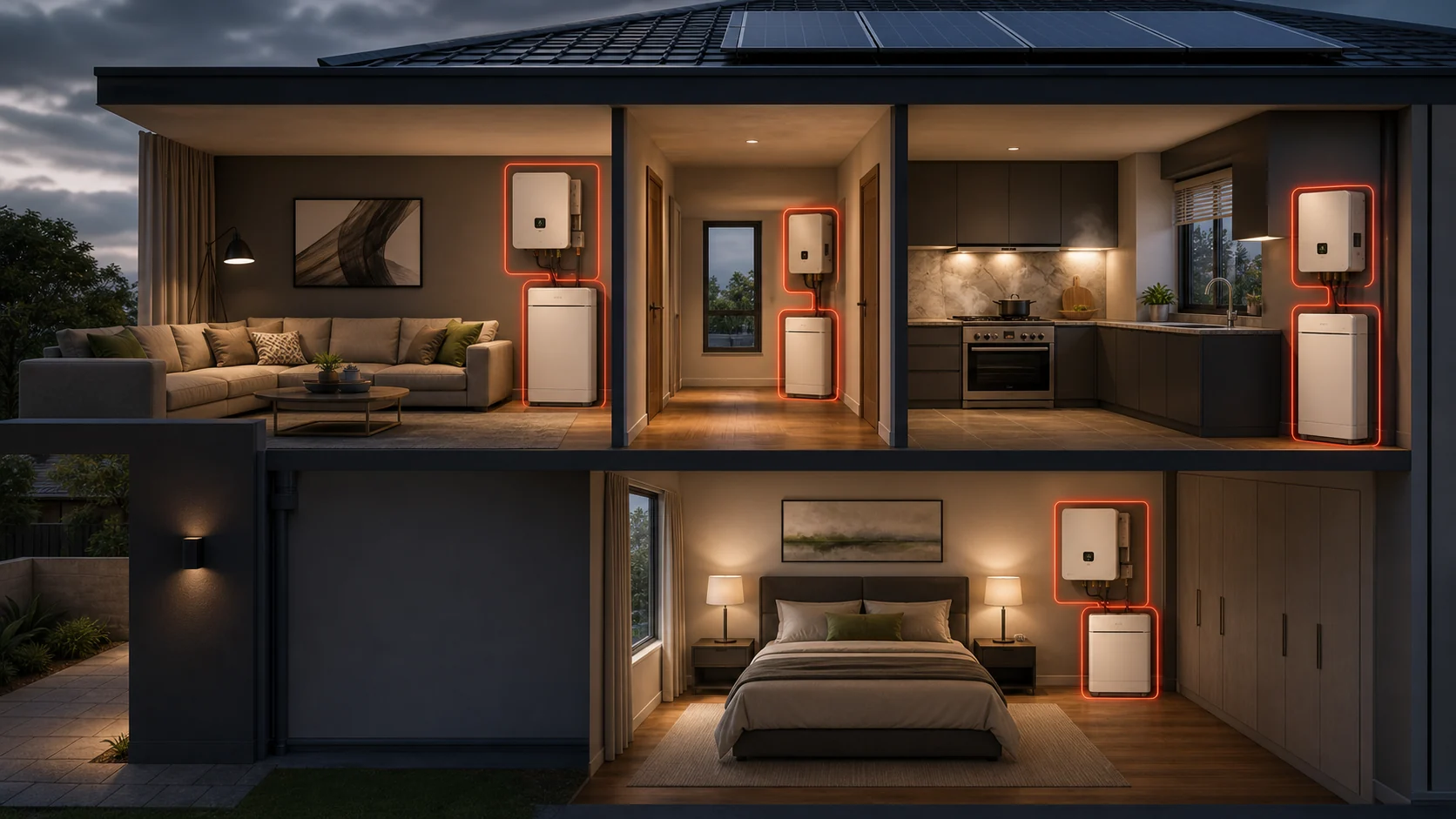
- Dedicated equipment or plant room — Usually the strongest candidate — Fire separation, ventilation or temperature control, access, floor/wall loading, battery instructions, clearances, emergency isolation and any local building/fire requirements.
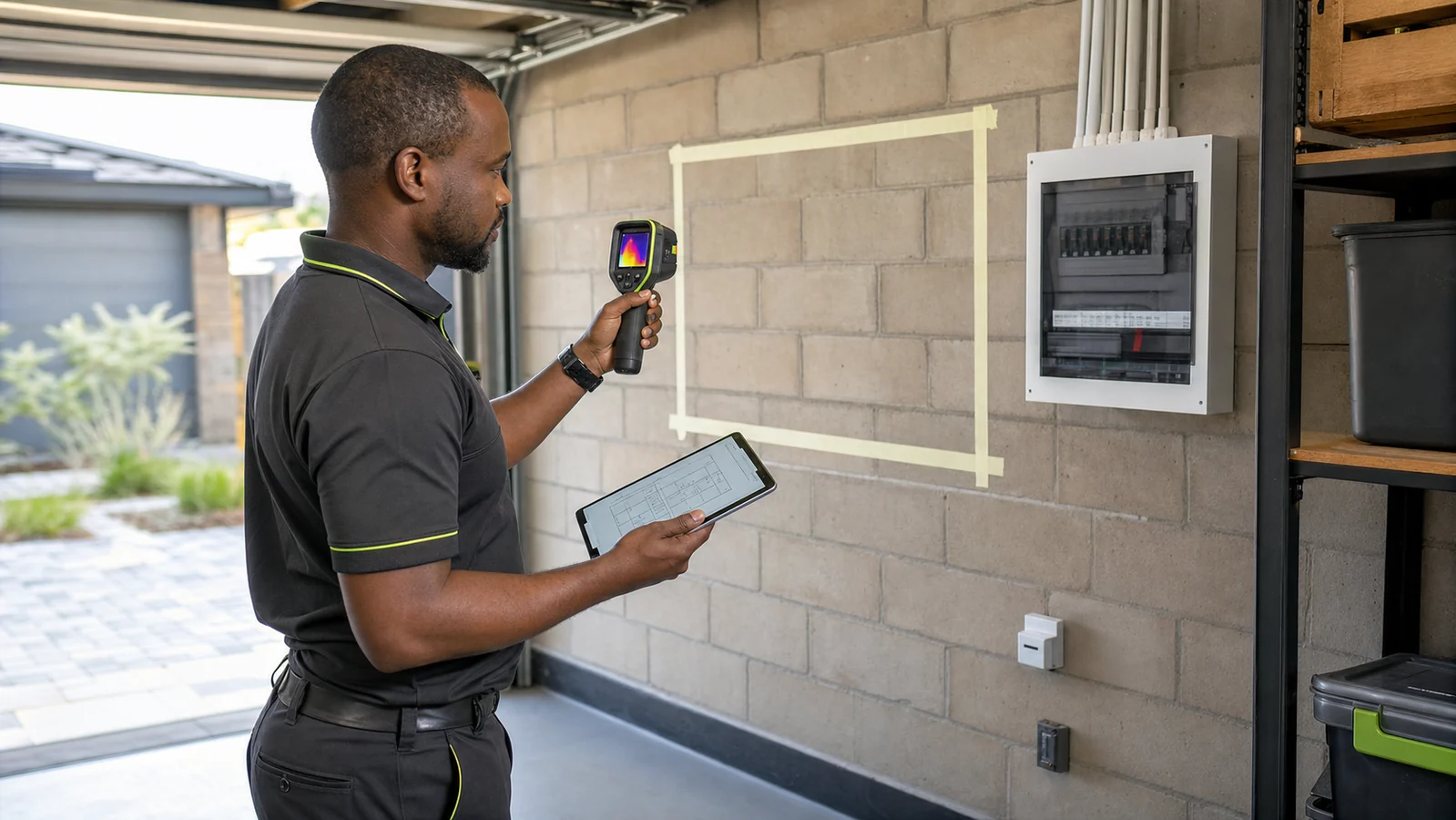
- Garage — Often workable, but never automatically compliant — Vehicle impact, petrol/paint/solvent storage, escape routes, heat, dust, moisture, children’s access, wall strength and unobstructed service space.
- Dry, purpose-assessed utility room — Conditional — Water pipes, sinks, steam, heat, household storage, escape routes, noise and the product’s ingress-protection rating.
- Protected outdoor position — Only if the exact equipment is approved for it — IP rating, direct rain, driven rain, sun, heat, condensation, corrosion, flooding, vandalism, impact and manufacturer-prescribed shelter.
- Bedroom — Do not use as the default location for a storage battery — Sleeping occupants, smoke exposure, combustible furnishings and escape. PAS 63100:2024 excludes batteries from sleeping rooms; this is international guidance, not a South African room-name ban. An inverter-only proposal still needs product, electrical, noise, access and fire assessment.
- Lounge or living area — Poor default for a battery system — Occupant exposure, curtains, upholstery, electronics, children, escape paths, noise and heat. We found no public South African clause that universally prohibits the room by name, so a site-specific professional decision is required.
- Kitchen or scullery — Poor default unless purpose-designed and professionally accepted — Water, steam, grease, cooking heat, gas, cleaning chemicals, combustible storage, blocked access and the equipment’s ingress and temperature limits.
- Ordinary linen or kitchen cupboard — Normally reject unless purpose-designed and professionally assessed — Trapped heat, blocked vents, combustible contents, lack of access, moisture and inadequate separation. Removing the shelves does not automatically make it an equipment room.
- Roof or ceiling void — High-risk and generally best avoided — Extreme temperatures, combustible roof materials, difficult emergency access, structural capacity, dust, pests, water ingress and cable/fire-stopping requirements.
- Bathroom, shower room or wet zone — Normally unsuitable — Electrical location zones, moisture, condensation and enclosure suitability. Most domestic products are not intended for this environment.
- Passage, stair enclosure or exit route — Do not place a battery where it obstructs or weakens escape — National Building Regulation T2(2) prohibits causing or permitting an escape route to be obstructed or rendered less effective. International battery guidance is stricter and excludes batteries from escape routes and corridors.
- Near gas cylinders, fuel, paint or other combustibles — Do not proceed without specialist assessment and required separation — Ignition risk, local fire/by-law rules, ventilation, hazardous-area implications and insurer requirements.
03
What SANS 10400-T actually establishes—and what it does not
The Government Gazette of 15 November 2024 identifies the current amended fire-protection standard as SANS 10400-T:2024 Edition 5.1. Its stated purpose is to provide a deemed-to-satisfy route for Part T (Fire Protection) of the National Building Regulations. The full current standard is a controlled SABS publication; the lawful route to obtain it is through the SABS standards service, not an old free copy or an unauthorised upload. (Government Gazette notice)
The publicly available National Building Regulations themselves provide the legal starting point. Regulation T1 requires a building to protect occupants and provide safe evacuation, minimise the spread and intensity of fire, control smoke as far as reasonably practicable, and provide suitable firefighting access and equipment. T1(2) recognises compliance with SANS 10400-T as the deemed-to-satisfy route, while allowing a local authority to require a rational design by an approved competent person where necessary. Most directly for a passage, Regulation T2(2) makes it an offence to cause or permit an escape route to be obstructed or rendered less effective in a way that could hinder escape. (National Building Regulations, Part T, page 123)
Those public documents do not provide a simple list saying that every inverter or battery is prohibited in every lounge, kitchen or bedroom. We therefore cannot responsibly claim that SANS 10400-T itself imposes a universal room-name ban without checking the licensed current clauses and the actual building design. The defensible South African conclusion is performance-based: do not compromise evacuation, increase unacceptable fire or smoke risk, weaken fire separation, overload a structure or prevent emergency access.
04
What international battery guidance adds
ECA(SA)'s June 2024 InFIReS presentation explicitly labels its placement material as international specifications. Its summary of Australia/New Zealand AS 5139:2019 says batteries should not be in passageways, walkway exits or evacuation routes; below entrances, exits, staircases, escape routes or passageways; or in roofs, ceiling spaces and wall cavities. It also points to manufacturer-specific restrictions. (ECA(SA)/FPASA InFIReS presentation, page 15)
The British PAS 63100:2024 takes a similarly conservative fire-safety approach. Section 6.5 says batteries should be outdoors where practicable and excludes storage batteries from sleeping rooms, escape routes including landings, staircases and corridors, protected escape routes, certain cupboards opening into bedrooms, roof or loft voids, locations near stored flammables and basements without outside access. It also addresses ventilation, fire-resisting separation and fire detection for certain indoor locations.
These documents are valuable risk-control benchmarks, but AS 5139 and PAS 63100 are not South African legislation. They strengthen a conservative design decision; they do not replace current South African electrical rules, the licensed SANS 10400-T, manufacturer instructions, municipal decisions or a competent person's rational design.
Gauteng incident experience supports taking access and separation seriously. An FPASA firefighter presentation records lithium-battery incidents in Houghton and Witpoortjie involving dense smoke, re-ignition, storage clutter and difficult access. One Witpoortjie installation was in a small room behind a garage and next to a living room, with no independent access. These case studies do not prove that every garage or living-room installation fails, but they show why access, combustible storage, fire separation and emergency information must be designed rather than assumed. (FPASA firefighter incident presentation)
05
Why a garage is often preferred—and why it can still fail
A garage frequently offers masonry walls, shorter routes to the main distribution board, good service access and separation from sleeping areas. That is useful, but the word “garage” is not a compliance certificate.
A garage location may still be unsuitable where:
Where a garage is selected, the designer may need impact protection, a dedicated no-storage zone, appropriate fire separation and a clear isolation point. Those details are site-specific.
- a vehicle can strike the battery or inverter;
- petrol, gas, paint, thinners or other combustible products are stored nearby;
- the equipment narrows the route from the house to an exit;
- direct afternoon sun drives the wall temperature above the product limit;
- water enters under the garage door or through the roof;
- shelving, bicycles or household goods can block ventilation and isolators;
- the wall or floor cannot safely support the equipment;
- the design leaves no safe working clearance for inspection or maintenance.
06
Can an inverter or lithium battery be installed in a bedroom?
Do not rely on anyone who answers this with an unconditional “yes” simply because a manufacturer calls the product safe, or an unconditional “no” without identifying the applicable rule.
We did not find a single national regulation that names every household bedroom installation as automatically unlawful in every configuration. However, sleeping rooms contain occupants for long periods, combustible furnishings and critical escape paths. A battery fault can involve heat, smoke and hazardous decomposition products. These are strong reasons to choose a better location wherever reasonably possible.
Johan’s source document—formally titled Structural Stability / Fire Protection of PV System Installation – National Building Regulations, prepared by Willem Johannes Beukes Pr.Eng of WIAM Consulting for ECA(SA) on 15 November 2022—argues that a battery-backup and inverter area should be treated as high-risk storage (J1) for fire-protection purposes and separated from other occupancies. That is a consequential professional interpretation. It is not itself legislation, and the document predates later editions of the building fire standard. We therefore do not reproduce its stated fire-resistance period as a universal rule for every modern domestic battery. The current standard, battery design and local authority’s interpretation must be checked by the responsible fire/building professional.
The practical conclusion is straightforward: do not select a bedroom as the default location for a household storage battery. PAS 63100:2024 expressly excludes batteries from rooms intended for sleeping, and ECA(SA)'s international comparison reinforces the conservative approach. In South Africa, the final decision must still be tied to current local rules, the licensed SANS text, the exact product and a documented building/fire and electrical assessment—not an informal assurance from a salesperson.
07
Why a passage outside bedrooms is especially sensitive
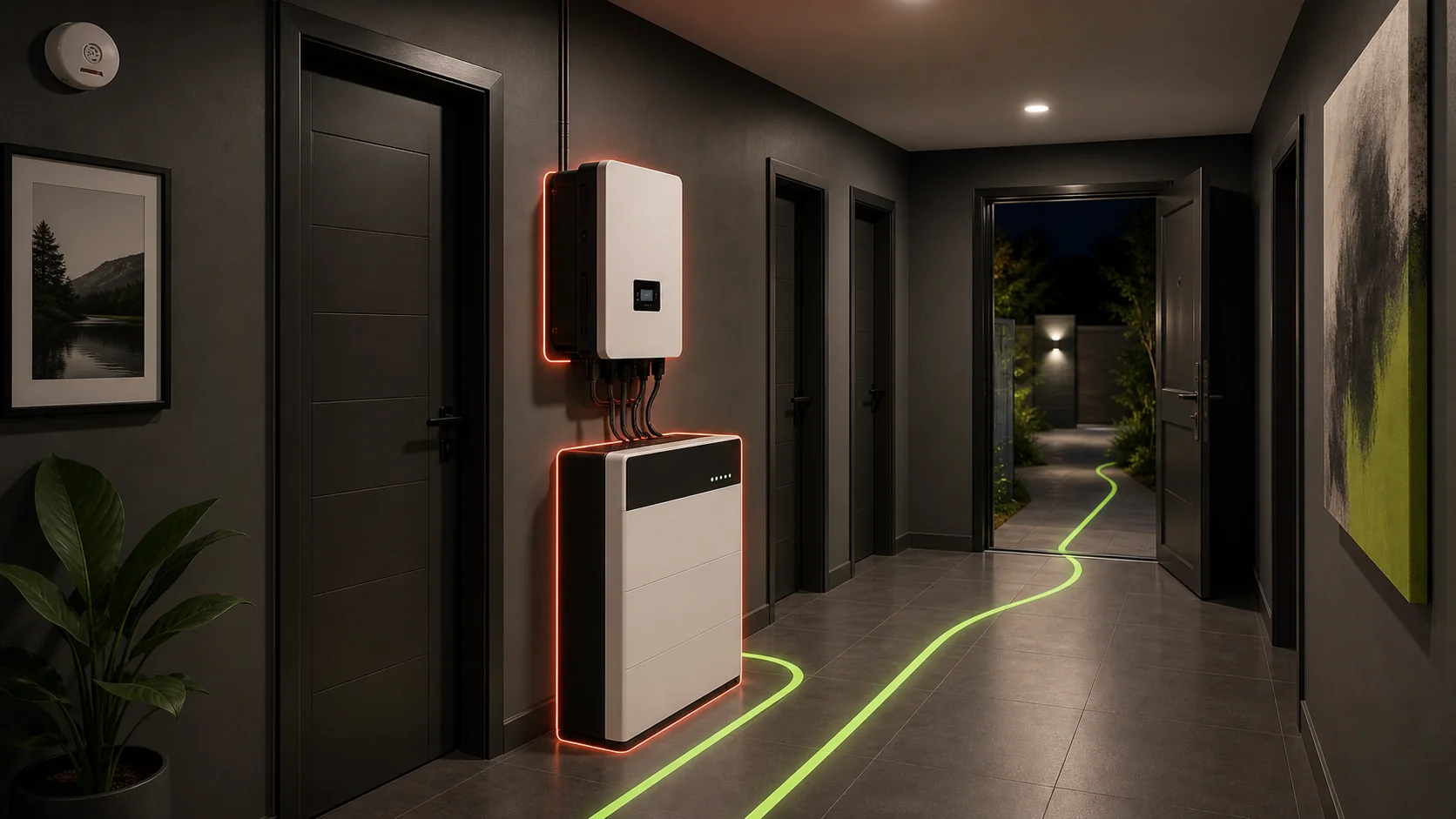
A bedroom passage may be the only route occupants can use to reach an exterior door. That makes the question more serious than whether the equipment physically fits against the wall.
For South Africa, Regulation T2(2) supplies a direct rule: no person may cause or permit an escape route to be obstructed or rendered less effective in a way that could hinder escape during a fire or other emergency. A battery cabinet can create more than a width problem. It can introduce smoke, heat, a collision point, restricted access to doors, blocked maintenance space or a reason that occupants must pass close to energy equipment during an emergency.
International battery guidance goes further by excluding batteries from corridors and escape routes. The safest design response is therefore to keep the battery out of the bedroom passage and preserve a clear, simple route to safety.
Wesslink artistic safety illustration: the green line represents the escape path. The legal question is whether the route remains effective; the international battery guidance supports keeping storage batteries out of it entirely.
08
Can a battery system go in a lounge?
A lounge is not automatically approved merely because it is dry and air-conditioned. It normally contains upholstered furniture, curtains, timber cabinetry, consumer electronics, children or pets, and people spending long periods close to the equipment. Noise, heat, impact, tampering, emergency isolation and the route between bedrooms and exits also matter.
We have not found a freely available current South African clause that bans every inverter or battery from every lounge by room name. The responsible wording is therefore that a lounge is a poor default for a BESS, not that it is always illegal. If a designer proposes it, require written product approval and a documented electrical and building/fire assessment that addresses the equipment, stored energy, separation, detection, ventilation, access and actual escape layout.
09
Can an inverter and battery go in a kitchen or scullery?
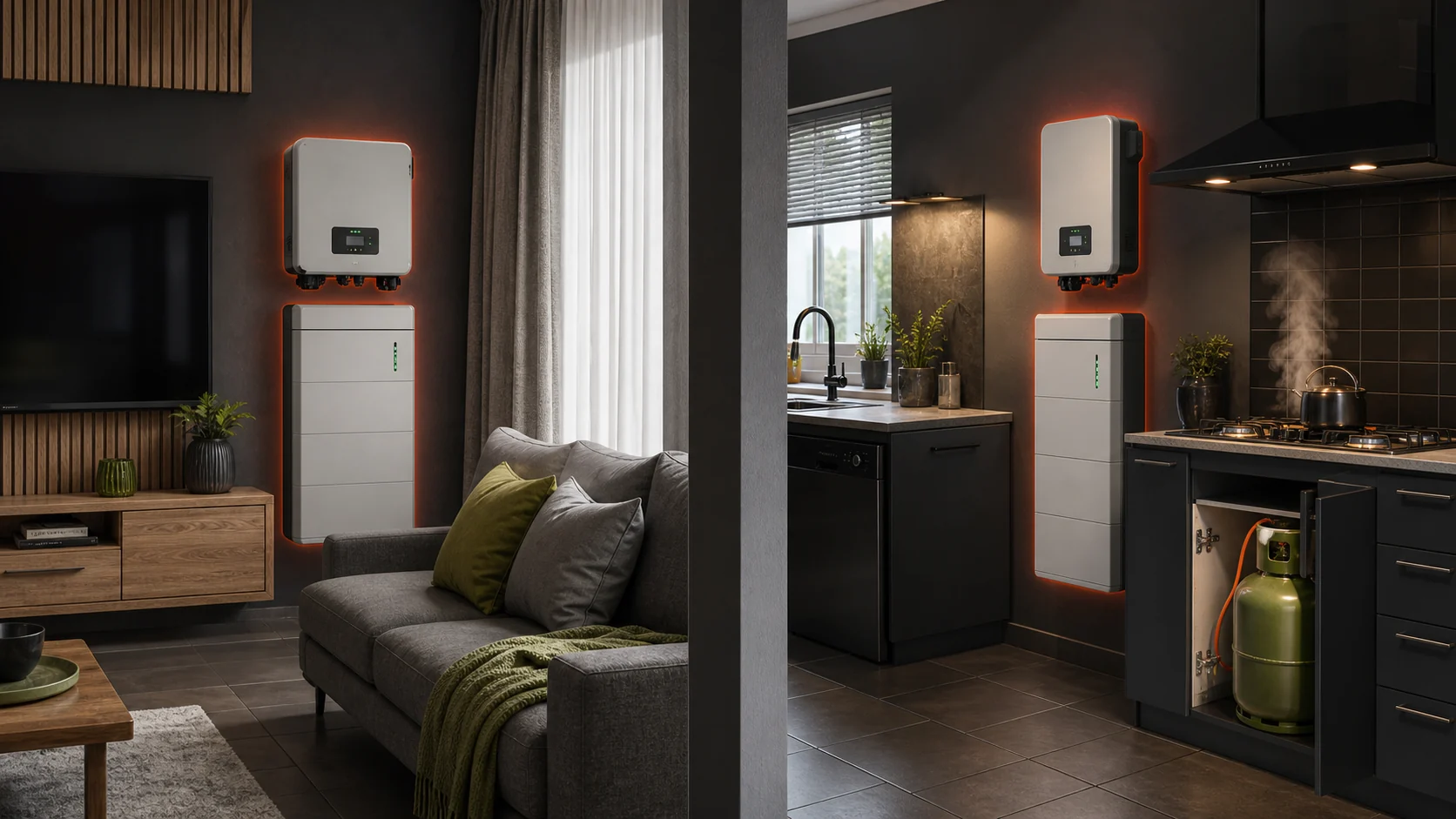
Kitchens and sculleries combine several conditions that energy equipment does not automatically tolerate: sinks and water pipes, steam and condensation, cooking heat, grease, gas cylinders or appliances, cleaning chemicals, food storage and frequent movement. Cupboards can also trap heat or invite people to store combustible items against equipment.
That does not create a universal room-name prohibition in the public South African material we reviewed. It does make the kitchen a poor default unless the exact product, enclosure, separation, clearances, moisture protection, temperature, gas and fire conditions have been purpose-designed and accepted by the responsible professionals. A battery should never be squeezed between a sink and a stove because it is the only unused wall.
Wesslink artistic safety illustration: lounge and kitchen placements require far more than a convenient wall. The image identifies common risk factors; it is not a substitute for a site-specific compliance decision.
10
Can it go inside a cupboard?
An ordinary cupboard is designed for storage, not energy equipment. It may trap heat, allow clothing or cleaning products to touch the equipment, block ventilation openings and make isolation difficult during an emergency.
A purpose-designed enclosure is different. It can be engineered around a particular product’s ventilation, temperature, access, fire and cable requirements. But a cabinet is not compliant merely because it is metal. The equipment manual, heat dissipation, clearances, cable entries, fire behaviour and maintenance access all need to be addressed.
If the plan is “put it in a cupboard so nobody sees it”, pause the project and assess a safer location first.
11
Can an inverter and battery be installed outside?
Only if the exact models and the complete arrangement are suitable for that environment.
Check at least:
An IP65 label does not mean “install anywhere outside”. The Victron example above is IP65 but still excludes direct sunlight and heavy rain. Conversely, an IP20 battery designed for indoor use cannot be made outdoor-rated by placing a small awning above it. The enclosure and thermal design must be approved as a system.
- the enclosure’s IP rating;
- whether the manufacturer permits outdoor installation;
- direct sunlight and maximum ambient temperature;
- rain, driven rain and hose or sprinkler exposure;
- condensation and daily temperature cycling;
- flooding or water pooling;
- corrosion, dust and pests;
- theft, vandalism and accidental impact;
- whether the canopy or cabinet compromises required airflow;
- access for emergency isolation and maintenance.
12
Why roof voids and hot ceiling spaces are a weak default
Gauteng roof spaces can become extremely hot. They can also contain timber, insulation, dust, rodents, leaking tiles and hidden cable routes. Access is poor precisely when firefighters, electricians or homeowners may need rapid isolation.
Johan’s document also highlights that PV installations can affect structural loading, wind loading and fire performance. The National Building Regulations use SANS 10400 as the deemed-to-satisfy route for building matters; Part T addresses fire protection. The NRCS confirms that SANS 10400-T is the deemed-to-satisfy document associated with the fire-protection part of the National Building Regulations. (NRCS building-regulations overview)
Do not mount heavy batteries on roof trusses or place equipment in a ceiling simply to shorten a solar cable route. Structural capacity, fire safety, access, temperature and the product instructions all have to be proved.
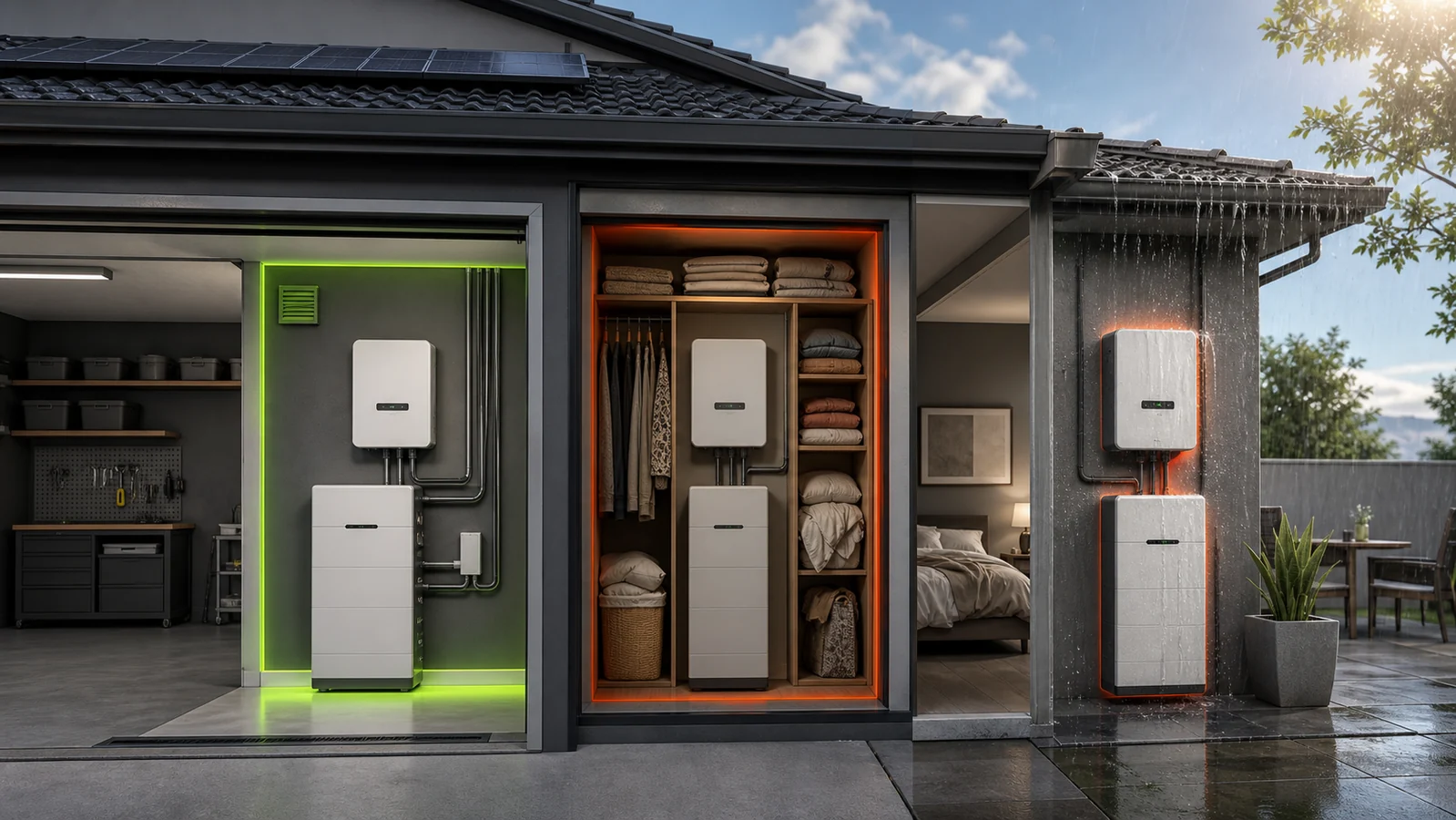
Wesslink artistic illustration: green and amber indicate planning preference and risk questions, not a legal approval or rejection. Every property still requires assessment.
13
The South African legal framework homeowners should understand
1. Electrical work must be done through the correct registered contractor
Regulation 6 of the Electrical Installation Regulations, 2009 prohibits a person from doing electrical installation work as an electrical contractor unless registered in terms of those regulations. The Department of Employment and Labour has warned the public to verify contractor registration because fraudulent contractors and invalid certificates create electrocution and fire risks. (Electrical Installation Regulations, 2009; Department warning)
ECA(SA)’s consumer guidance explains an important competency distinction: a single-phase tester is not permitted to certify DC-voltage installations such as household solar panels, battery-backup systems and inverters; an appropriately registered Installation Electrician or Master Installation Electrician is required for that scope. Ask to see the current Department of Employment and Labour registration—not only a trade certificate or company brochure. (ECA(SA) consumer guidance)
2. The inverter or battery addition needs a Certificate of Compliance
Regulation 7 places the duty on the user or lessor to have a valid electrical Certificate of Compliance (CoC) and test report. Where an addition or alteration is made to an installation that already has a CoC, the user or lessor must obtain a CoC for at least that addition or alteration. A permanently connected inverter, battery-backup or solar installation is not outside the electrical installation simply because it was sold as a packaged system. (Electrical Installation Regulations, 2009)
Keep the CoC, test report, single-line diagram, equipment datasheets, commissioning records, warranty documents and utility approval together. A CoC does not replace building, fire, product or network approvals that may also apply.
3. Do not rely on the withdrawn SANS 10142-1-2
This is a frequent source of outdated online advice. ECA(SA) confirmed in January 2026 that SANS 10142-1-2 was withdrawn after publication and appeal, and that relevant material was being integrated into the main SANS 10142-1 work. Any installer, article or municipal checklist that casually presents the withdrawn document as the current national installation standard needs to be checked. Use the current incorporated standards and current distributor requirements applicable on the date of design. (ECA(SA): “SANS 10142-1-2 has been withdrawn”)
4. Building and fire questions are separate from the electrical CoC
The National Building Regulations and Building Standards Act and its regulations address building approval, structural safety, occupancy and fire protection. SANS 10400 provides recognised deemed-to-satisfy routes, including Part T for fire protection. A change that affects a structure, fire-separating element or escape route may require input and approval beyond an electrician’s electrical CoC.
This is especially important for a dedicated battery room, a large energy-storage system, equipment mounted on structural elements, or a design that changes walls, doors, ventilation or a route of escape. The correct response may involve the municipality’s building-control/fire department and an appropriately registered fire or structural professional.
5. Grid-parallel systems may require distributor registration
The electricity supplier depends on the property—not merely the suburb. Parts of Johannesburg are supplied by City Power and others by Eskom; Centurion properties may fall under the City of Tshwane or another supply arrangement. Confirm the account and point of supply.
City Power’s household solar guide lists documents including a single-line diagram, inverter datasheet, NRS certificate, commissioning information and CoC for its SSEG process. (City Power household solar guide)
Eskom’s current guidance says households and small businesses with systems below 100 kVA must register grid-connected SSEG with Eskom even if they do not export; fully off-grid systems are treated differently if they are genuinely independent. Eskom identifies three key documents: a valid CoC, an NRS 097-2-1 inverter type-test certificate and an Embedded Generation Installation report. Customers supplied by a municipality must confirm that municipality’s requirements. (Eskom SSEG guidance)
Do not confuse “zero export” with “not connected to the network”. Anti-islanding, changeover, neutral-earth arrangements and isolation must be correctly designed and tested for the operating mode. ECA(SA)’s technical note emphasises that neutral-earth bonding arrangements change between grid-connected and islanded conditions and that manufacturer instructions must be followed. (ECA(SA) technical note)
14
The site assessment that should happen before a quote is finalised
A responsible pre-installation assessment should record:
The cheapest proposed location can become the most expensive choice if it shortens battery life, voids a warranty, forces later building work or fails an inspection.
- Electricity supplier and operating mode: Eskom, City Power or municipality; grid-parallel, backup-only, export or zero-export.
- Existing electrical condition: supply type, main DB, earthing, earth leakage, fault levels, available ways and existing CoC.
- Equipment data: exact inverter, battery chemistry, model, mass, IP rating, temperature limits, clearances, warranty requirements and NRS certification where relevant.
- Proposed location: moisture, heat, direct sun, dust, flooding, ventilation, access, noise, children, pets, vehicle impact and nearby combustible material.
- Building and fire impact: wall and floor capacity, penetrations, fire-stopping, escape routes, separation and whether professional fire/structural input or municipal approval is required.
- Cable route: protected AC and DC routes, voltage drop, physical protection, isolation, labelling and access.
- Emergency arrangements: accessible shutdown points, warning labels, emergency information and any fire-protection measures required by the design or authority.
- Documentation: single-line diagram, commissioning results, CoC/test report, product records, utility documents and handover instructions.
15
If an inverter is already in the wrong place
Do not open, disconnect or move the system yourself. Batteries can deliver very high fault currents even when the mains supply is off.
Arrange a documented compliance inspection that checks:
If relocation is required, the altered work must be tested and certified. Keep the corrective records with the property file.
- the electrical CoC and test report against the installed system;
- the exact product manuals and environmental limits;
- AC/DC protection, isolation, labelling, earthing and changeover arrangements;
- signs of water exposure, overheating, blocked vents, impact risk or combustible storage;
- the single-line diagram and distributor registration status;
- whether the location creates a building, fire or escape-route concern.
16
Book a household inverter-location and compliance assessment
Wesslink Electrical assists homeowners, landlords, body corporates and businesses across Gauteng with inverter planning, electrical inspection, remedial work and compliance documentation. Before buying equipment, ask us to assess the proposed location, existing distribution board, supply authority and intended operating mode.
Call or WhatsApp Wesslink Electrical: 072 271 7111
Service coverage includes Roodepoort, Randburg, Sandton, Midrand, Centurion, Soweto and surrounding localities, subject to booking availability.
17
Sources and editorial method
This article prioritises primary and industry-authoritative material and distinguishes legislation from professional interpretation:
Editorial limitation: South African National Standards are controlled documents. The Government Gazette confirms that the current amended fire standard is SANS 10400-T:2024 Edition 5.1, but the full standard must be obtained lawfully from SABS. This article does not reproduce its controlled clauses or tables and must not be used instead of the licensed edition. Johan's 2022 document is credited as a professional interpretation; its exact classifications and fire-resistance figures must be checked against the current SANS 10400-T edition and accepted by the responsible professional or local authority before being used in a design. AS 5139:2019 and PAS 63100:2024 are identified as international battery-safety guidance, not South African legislation.
- Willem Johannes Beukes Pr.Eng, WIAM Consulting, Structural Stability / Fire Protection of PV System Installation – National Building Regulations, prepared for ECA(SA), 15 November 2022 (shared source document).
- Department of Employment and Labour — Electrical Installation Regulations, 2009
- Department of Employment and Labour — warning about fraudulent electrical contractors
- South African Government — National Building Regulations and Building Standards Act regulations
- Government Gazette, 15 November 2024 — SANS 10400-T:2024 Edition 5.1 notice
- Department of Trade, Industry and Competition — National Building Regulations, Part T
- SABS — lawful standards purchase and access service
- NRCS — National Building Regulations overview
- ECA(SA) — consumer guidance on contractor registration and competency
- ECA(SA)/FPASA InFIReS 2024 — international battery-placement specifications
- FPASA InFIReS 2024 — Gauteng firefighter experiences with lithium-battery incidents
- BSI — PAS 63100:2024 electrical energy storage systems in dwellings
- ECA(SA) — withdrawal of SANS 10142-1-2
- ECA(SA) — neutral-earth bonding clarified
- Eskom — current SSEG registration and document guidance
- City Power — household solar installation guide
- Freedom Won — product-specific indoor installation and temperature guidance
- Victron Energy — product-specific IP65, weather and clearance guidance
FAQ
Questions readers also ask
Is it legal to install an inverter in a garage in South Africa?
A garage can be suitable, but the room name does not create compliance. The design must address vehicle impact, combustible storage, moisture, heat, access, fire/escape considerations, the exact equipment manual and electrical certification.
Can a lithium battery be installed in a bedroom?
A bedroom is not an acceptable default choice because people sleep there and it contains combustible furnishings and an escape route. PAS 63100:2024 expressly excludes storage batteries from sleeping rooms, but it is British guidance rather than South African legislation. In South Africa, use a safer location and require a documented site-specific electrical and fire/building assessment. A salesperson's verbal assurance is not enough.
Can a battery be installed in a passage outside bedrooms?
It should not obstruct or weaken that escape route. National Building Regulation T2(2) prohibits causing or permitting an escape route to be obstructed or rendered less effective where that may hinder escape. International battery guidance also excludes batteries from corridors and escape routes. Keep the route clear and choose a different location.
Can a battery be installed in a lounge or kitchen?
Neither room is a good default. A lounge adds sleeping-area escape, combustible furnishing, occupant and tampering concerns; a kitchen adds water, steam, grease, cooking heat, gas and storage. We found no public current South African rule that automatically bans every installation by either room name, so the decision must be documented against the exact equipment, building, fire, electrical and manufacturer requirements.
Can an inverter be installed inside a cupboard?
Not in an ordinary storage cupboard unless the equipment manufacturer and a competent designer accept a purpose-designed arrangement that deals with heat, ventilation, access, fire behaviour and clearances. Never store linen, chemicals or household goods around the equipment.
Can an inverter be installed outside?
Only where the exact product and complete enclosure arrangement are approved for the conditions. Check IP rating, direct sun, heavy rain, temperature, condensation, flooding, corrosion, impact and manufacturer instructions.
Can a battery be installed in a ceiling or roof void?
It is generally a weak choice because of heat, combustible materials, difficult access, structural loading, dust, pests and water ingress. A competent structural, fire and electrical assessment would be required before considering it.
Does an inverter installation need a CoC?
Yes, where it forms an addition or alteration to the electrical installation. Regulation 7 requires a CoC for at least that addition or alteration where an existing installation was previously certified.
Can a single-phase tester sign off a household inverter and battery?
ECA(SA)’s published consumer guidance says a single-phase tester may not certify DC-voltage installations such as solar panels, battery-backup systems and inverters. Use an appropriately registered Installation Electrician or Master Installation Electrician for the relevant scope.
Do I need municipal or Eskom approval if the inverter exports nothing?
Possibly—and often yes where the system can operate in parallel with the network. “Zero export” is not the same as “fully off-grid”. Check the rules of the supplier shown on the property’s electricity account before commissioning.
Is IP65 enough for an outdoor inverter or battery?
No. IP65 describes a level of protection against dust and water ingress; it does not override the manufacturer’s restrictions on sunlight, heavy rain, temperature, condensation or mounting. Read the exact model’s manual.
Must an inverter be installed next to the distribution board?
Not necessarily. Shorter compliant cable routes can be beneficial, but the final position also needs to satisfy environmental, fire, access, protection and manufacturer requirements. Location should be designed, not chosen solely for cable convenience.
What should I receive when the installation is complete?
At minimum, retain the CoC and test report, single-line diagram, commissioning results, equipment datasheets/manuals, serial numbers, warranties, shutdown instructions and any Eskom/municipal approval or registration records that apply.