
Sandton apartment decisions often move quickly. The lease or sale agreement, access tags and furniture receive attention, while the electrical handover is reduced to checking whether the lights switch on. That is not enough to understand the installation you are occupying or the responsibilities you are accepting.
This checklist is for buyers, tenants, landlords, estate agents, managing agents and body corporates. It does not replace a property-specific electrical inspection. It helps everyone capture the right evidence, ask better questions and separate a unit fault from a building, supplier or backup-power issue.
01
Start with four different electrical boundaries
An apartment can involve the electricity supplier, the body corporate or building owner, the private unit installation and a separate backup-power provider. Those systems may meet at meters, risers, distribution boards and changeover equipment, but they are not automatically one party’s responsibility.
Before occupation, record who manages each boundary. This prevents a later outage or billing dispute from becoming a circular argument between the resident, managing agent, municipality and installer.
- The municipal or Eskom account and the main incoming supply.
- The unit meter, prepaid vending arrangement and meter communications.
- Common-area distribution, risers, corridors, lifts, gates and pumps.
- The unit distribution board, fixed wiring, sockets, lighting and fixed appliances.
- A central generator, solar plant, battery system or unit-level inverter.
02
Match the meter to the unit and the account
Record the meter number and reading at handover. Compare them with the account, vending platform or building schedule. A clear dated photograph—taken without opening or interfering with equipment—can become valuable if there is later disagreement about consumption or responsibility.
If the building uses sub-metering, ask who supplies tokens, who administers tariffs and what happens when the meter or communication system fails. A private sub-metering dispute is not always a City Power fault.
- Meter number and opening reading.
- Date, time, unit number and building name.
- Supplier or sub-meter administrator contact details.
- Recent statement or token receipt showing the same meter reference.
- Any written explanation of common charges or backup-power levies.
- High electricity bill in Sandton — A structured evidence plan for meter and billing concerns.
- City Power or Eskom in Sandton? — Identify the likely supplier before logging a fault.
03
Understand what the electrical COC does—and does not—tell you
South Africa’s Electrical Installation Regulations require a valid Certificate of Compliance for an electrical installation, subject to the regulations’ provisions. A certificate is issued by a registered person after inspection and testing; it is not a substitute for recording later alterations or for investigating a new fault.
Ask for the certificate and test report available for the unit, and ask whether electrical, solar, inverter or renovation work occurred afterwards. Additions and alterations need appropriate inspection, testing and certification. For a sectional-title property, clarify which records belong to the unit and which belong to common property.
- Electrical COCs and Gauteng transfers — How inspection, remedial work and certification fit together.
- Official Electrical Installation Regulations — South African Government source.
04
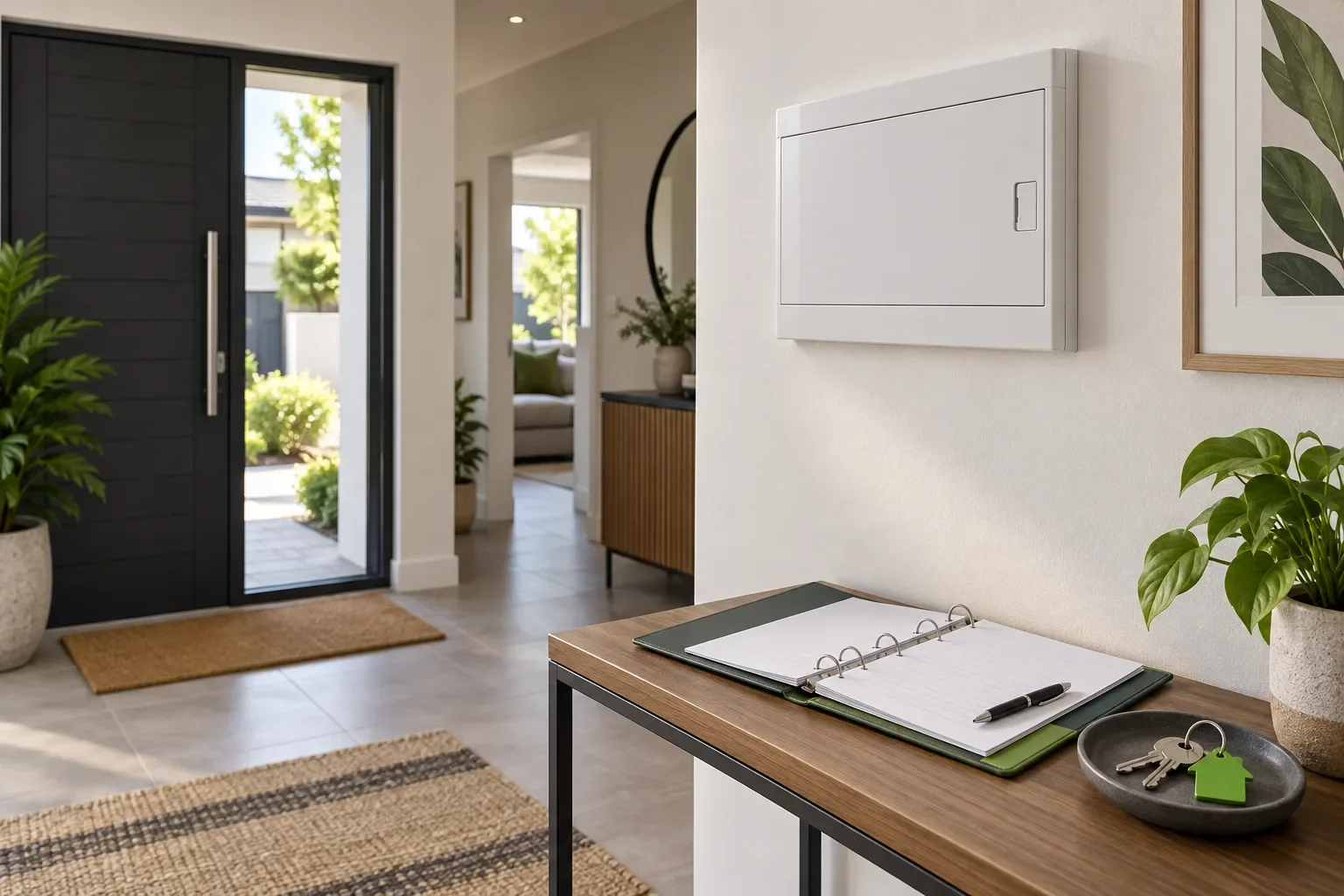
Inspect the accessible condition and labelling of the unit board
From a safe position, check whether circuits are legibly identified and whether the board is accessible rather than hidden behind fixed furniture. Do not remove covers or touch internal components. Heat, burning smells, buzzing, damage or repeated tripping require professional assessment.
Ask which circuits remain supplied during backup operation. Residents often discover too late that the inverter supports selected lights and sockets but not the oven, air-conditioning, geyser or other high-load equipment.
- Distribution-board warning signs — What to observe and when to stop resetting equipment.
- Electrical fault finding in Sandton — Property-side diagnostic support.
05
Test the backup-power handover, not only the grid supply
Ask whether backup power belongs to the building or the unit, which loads it supports, how long it is expected to run and who maintains it. Record any shutdown procedure, alarm indication and emergency contact supplied by the installer or facilities team.
Grid-connected solar and inverter systems have technical and registration requirements. Do not assume that a visible inverter or battery proves that the system is compliant, registered or safely integrated. Obtain the available commissioning and compliance documents and confirm the responsible service provider.
- The owner and maintainer of the system.
- Essential-load schedule and circuits not supported.
- Normal operating indications and escalation procedure.
- Certificate and commissioning records available for the installation.
- Building rules for future alterations or additional unit-level systems.
06
Create one handover record before keys change hands
Place the meter evidence, certificate references, board photographs, backup-power notes and responsible contacts in one handover record. For rentals, both parties should acknowledge the opening condition. For sales, unresolved questions should be raised early enough for the property professionals and electrical contractor to deal with them properly.
Wesslink assists Sandton homes, apartments and managed properties with fault finding, repairs, compliance inspections and planned electrical work. A precise building, unit and responsibility brief makes the first visit far more productive.
- Electrician in Sandton — Sandton service hub and local property support.
- Property managers and complexes — Support for common-property and managed electrical systems.
- Contact Wesslink — Send the building, unit and electrical brief.
FAQ
Questions readers also ask
What electrical information should I get before renting a Sandton apartment?
Record the meter number and reading, supplier or sub-meter administrator, unit distribution-board condition, backup-power arrangement, available compliance records and who handles unit versus common-property faults.
Does an apartment electrical COC cover the whole building?
Not automatically. The certificate identifies the installation or portion described by it. Ask which record applies to the unit and which records apply to common property.
Who fixes an electrical fault in a sectional-title apartment?
Responsibility depends on where the fault is located and the scheme’s rules. First establish whether the problem is in the private unit, common property, supplier network or backup-power system.
Should I photograph the prepaid meter at handover?
Yes, where it is safe and permitted. Capture the meter number, reading, date and unit details without opening or interfering with the equipment.
Can Wesslink inspect an apartment before occupation?
Wesslink can discuss an appropriate property-specific inspection or fault-finding scope. Provide the building, unit, access arrangements and the purpose of the inspection when booking.