
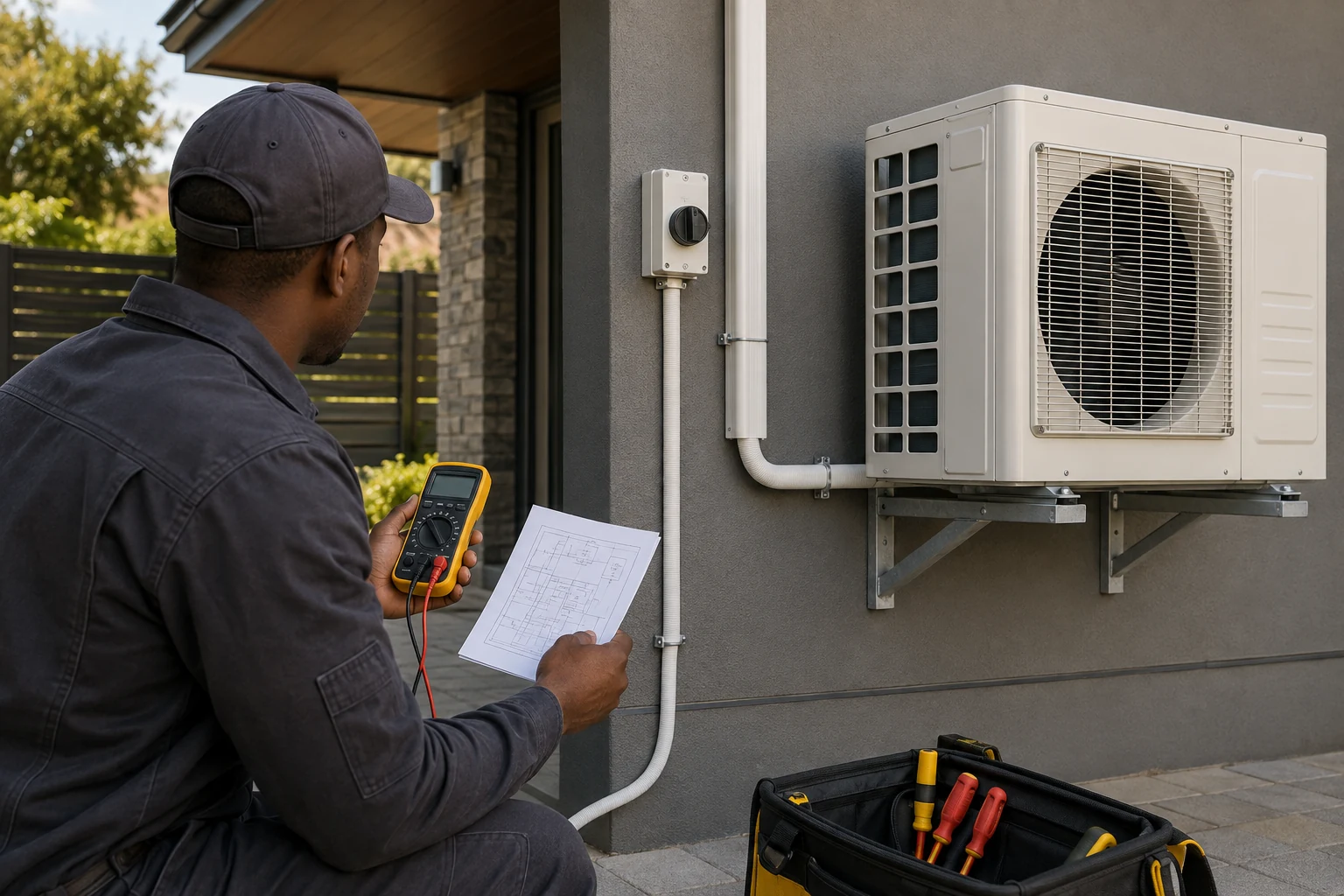
Buying an air conditioner is only part of getting your home ready for summer. Before the unit arrives, there is another question to answer: where will its electricity come from, and is that connection suitable?
An aircon power point is not simply the nearest socket. The connection needs to suit the particular unit, the existing electrical installation and the location where it will operate. Getting this checked early helps you plan the complete job instead of discovering an electrical problem on installation day.
This guide explains plug-in connections, aircon isolators, cable concerns, electrical compliance certificates and electricity consumption for homeowners and property managers in Gauteng.
Why prepare for summer 2026/27?
There is a credible reason to plan ahead. On 2 September 2026, South Africa's Department of Agriculture reported that SAWS expected El Niño to continue through summer 2026/27. Its advisory describes the associated risk of hot, dry conditions. Source: South African Government's September 2026 advisory.
Separately, the UK Met Office said in August 2026 that 2027 was very likely to become the warmest year in the global record as El Niño adds to the effects of climate change. That is not a declaration that South Africa, or every Gauteng suburb, will necessarily experience its hottest year. Source: Met Office's August 2026 El Niño outlook.
For a household already considering air conditioning, the practical step is to plan the unit and its electrical supply together. You do not need a record-breaking forecast to make a safe connection worthwhile.
Can an aircon be plugged into a normal wall socket?
Some models are designed for plug-in use; others need a fixed electrical connection. Do not decide from the BTU label alone.
A portable air conditioner supplied with a factory-fitted plug is different from a split-system outdoor unit fitted with an improvised trailing lead. GE Appliances, for example, instructs users of its room air conditioners to connect directly to a suitable earthed wall outlet, without an extension cord or multi-outlet adaptor. Follow the instructions for the actual model being installed; overseas product instructions do not replace South African wiring requirements. Source: GE Appliances' air-conditioner connection guidance.
For a fixed split-system aircon, ask the electrician to check:
- The manufacturer's required connection method and electrical ratings.
- Whether supply enters the indoor or outdoor unit.
- The existing circuit and other loads connected to it.
- The suitability of the socket, protection and means of isolation.
- The cable route, outdoor exposure and access for maintenance.
The useful question is not simply, “Can a 12,000 BTU aircon plug in?” It is, “Can this model use this connection safely and compliantly?”
Why BTU is not a plug-point rating
BTU/h describes cooling capacity, not the electrical current the installation must accommodate. Two aircons with similar cooling capacity can have different electrical requirements.
For example, Midea's BZE-INV-24 specifications list 24,000 BTU/h cooling capacity and 2,191 W cooling input, but also a separate higher rated input of 4,140 W and rated current of 18 A. A standard 16 A plug connection cannot be justified by looking only at the lower cooling-input figure. This is an example for one model, not a universal rule for every 24,000 BTU aircon. Source: Midea South Africa BZE-INV-24 specifications.
Does an aircon need a dedicated circuit and isolator?
A dedicated circuit supplies the intended aircon load separately from general household socket loads. An isolator provides a means of disconnecting the equipment for work on it. They perform different jobs.
Ask for an assessment of both. A remote control's off button is not a substitute for electrical isolation, and fitting an isolator does not make an overloaded or unsuitable supply circuit safe.
The final arrangement must follow the applicable wiring requirements and the model's instructions. Do not assume that being below a particular BTU size automatically removes the need for a separate circuit or isolator.
Must the isolator or socket be within arm's reach?
Accessibility matters, but “within arm’s reach” should not be used as a universal BTU-based rule. The ECA explains that fixed appliances need an appropriate means of disconnection. Its published explanation is based on an older wiring-code edition, so the electrician must confirm the current aircon-specific isolation requirements and the manufacturer’s instructions for the actual installation. Source: ECA fixed-appliance guidance.
For an outdoor aircon connection, discuss safe maintenance access, suitable weather protection and clear identification before the unit is mounted. A socket somewhere inside the house should not simply be assumed to provide suitable isolation for someone working outside.
Can an aircon run from an extension lead or cabtyre cable?
Do not plan an aircon installation around a household extension lead, adaptor or multiplug. Arrange a suitable supply connection instead.
It is important to distinguish an extension lead from flexible cable used as part of a properly specified appliance connection. “Cabtyre” is a cable description, not proof that every use of that cable is either safe or prohibited. Its suitability depends on its construction, rating, environment, terminations and the appliance's requirements.
Manufacturer restrictions still apply. GE's room-aircon guidance expressly excludes extension cords and multi-outlet adaptors. A cable being advertised as heavy-duty does not override such instructions. Source: GE Appliances.
What about the three-metre cable rule?
The ECA's older explanation says flexible appliance cords longer than three metres are not recommended; it does not describe an absolute ban on every cable exceeding that length. Do not confuse an appliance cord with a properly designed fixed supply circuit or refrigerant pipework. None of this gives permission to extend a manufacturer's lead. Source: ECA fixed-appliance guidance.
If the proposed power point is too far away, have the connection position and supply route redesigned. Do not treat a longer lead as the default solution.
Is a cable through the wall with a plug on the end acceptable?
A cable disappearing through a drilled hole does not establish that an aircon installation is compliant. There are several separate things to check.
Rigid installation cable is not a makeshift appliance lead
Do not accept rigid solid-core installation cable being treated as interchangeable with a flexible appliance cord. The installer must establish that the cable is suitable for the application and for the particular terminals, plug or connector, including its cord grip and strain relief.
A cable's appearance or trade name is not enough to identify its construction. Ask for the actual cable specification rather than relying on “it looks thick enough”. If an existing aircon has an improvised plug-top connection, arrange an inspection before relying on it through summer.
Protect the wiring where it passes through the wall
Plan a suitable protective sleeve, conduit or other approved wiring method at the penetration. Do not leave wiring rubbing against rough masonry or sharp edges, or assume that sealant alone provides cable protection. The electrician must check the applicable building-penetration and fire-sealing requirements.
This is also a practical installation issue: a Midea split-system installation manual specifies a protective wall cuff for the opening carrying the interconnecting services. That example supports protecting the penetration; it is not a substitute for checking the South African requirements for the particular cable and building element. Source: Midea split-system installation manual.
Check the whole route, not only the visible plug
Ask the electrician to assess the connection from its supply circuit to the equipment, including inaccessible joints, outdoor cable protection, earthing, isolation and the indoor-to-outdoor wiring arrangement. A neat-looking plug is not evidence that everything behind the wall is correct.
Can the aircon installer install the electrical power point?
An air-conditioning qualification alone does not authorise someone to carry out electrical contracting work. Under the Electrical Installation Regulations, electrical contractors must be registered, installation work must be under a registered person's general control, and only a registered person may issue the electrical CoC after the required inspection and testing. A suitably registered aircon business may also offer electrical work, or subcontract it. Source: Electrical Installation Regulations, regulations 5(4), 6 and 9.
Before accepting an installation package, ask who is responsible for the new power point, circuit or isolator, and who will issue the electrical certificate. The mechanical installation and electrical supply should be coordinated, with neither left as an unexplained extra.
Does a new aircon power point or isolator need a supplementary CoC?
Yes. Adding an electrical point, circuit or isolator alters or extends the electrical installation. Regulation 7(4) requires a CoC covering at least the addition or alteration where a certificate was previously issued. This is normally documented through a supplementary CoC and accompanying test report linked to the initial certificate. Source: Electrical Installation Regulations, regulation 7(4) and Annexure 1.
Keep the initial certificate, supplementary certificate and relevant test reports together. If the original certificate is missing or existing defects are discovered, ask the registered person what further inspection or remedial work is necessary.
The electrical CoC covers the relevant electrical installation; it is not a certificate of the aircon's cooling performance, refrigerant charge or manufacturer warranty. The ECA specifically distinguishes fixed wiring, sockets and isolators from the appliances they supply. Source: ECA, Electricity and the Homeowner.
See Wesslink's electrical Certificate of Compliance service for help with the electrical documentation.
How much electricity does a 9,000, 12,000, 18,000 or 24,000 BTU aircon use?
There is no single reliable electricity-use figure for each BTU size. The model, operating conditions and time spent at different compressor outputs matter.
The table below uses published examples from one inverter range, not claimed market averages or guaranteed household consumption. The running-cost column assumes an illustrative electricity rate of R3.00/kWh and one full hour at the listed cooling input. It is not a forecast of 2027 electricity tariffs.
| Aircon size / example model | Published cooling input | Energy for one hour at that input | Illustrative cost at R3.00/kWh |
|---|---|---|---|
| 9,000 BTU class — BZE-INV-09* | 733 W | 0.733 kWh | R2.20 |
| 12,000 BTU — BZE-INV-12 | 1,099 W | 1.099 kWh | R3.30 |
| 18,000 BTU — BZE-INV-18 | 1,608 W | 1.608 kWh | R4.82 |
| 24,000 BTU — BZE-INV-24 | 2,191 W | 2.191 kWh | R6.57 |
The BZE-INV-09 is marketed in the 9,000 BTU class; its detailed cooling specification lists 9,500 BTU/h.
Sources: Midea South Africa's BZE-INV-09, BZE-INV-12, BZE-INV-18 and BZE-INV-24 specifications. Costs are calculated from those inputs.
Do not use this running-cost table to choose a cable, breaker or plug. Electrical design must consider the full manufacturer requirements, including applicable higher input/current ratings and site conditions.
Calculate a useful monthly estimate
Use this calculation:
Average electrical input in kW × operating hours × your applicable R/kWh tariff.
For example, a measured average input of 0.8 kW over six hours uses 4.8 kWh. At an assumed R3.00/kWh, that is R14.40 per day, or R432 over 30 identical days.
This is an illustration, not a promise. Use your actual tariff and measured or realistic average consumption. Fixed charges and tariff blocks can affect the bill. A competent person can advise on suitable energy monitoring; do not add an unsuitable plug-in meter to a hardwired or high-current installation.
Why choose an inverter aircon?
An inverter aircon can vary its compressor speed to match cooling demand, instead of relying only on full-output operation followed by stopping. This can improve temperature stability and reduce energy consumption under suitable conditions. Daikin explains how controlling compressor output supports both comfort and energy efficiency. Source: Daikin's inverter-compressor explanation.
That does not mean every inverter model saves the same percentage in every home. Compare efficiency information for the specific units, suitable room sizing, installed cost, service support and expected hours of use.
Ask the aircon supplier to account for sun exposure, windows, ceiling height, insulation and occupancy rather than selecting only from floor area. An efficient unit still needs correct installation and maintenance.
Does “inverter aircon” mean it can automatically run on home backup power?
No. The inverter inside the aircon controls its compressor; it does not establish compatibility with your home's battery inverter. Have the combined load, backup-system capacity and intended operating time assessed before adding air conditioning to essential-load circuits.
If backup operation matters, mention it when requesting the aircon electrical assessment, so it forms part of the design from the outset.
What affects the cost of installing an aircon electrical point?
A short, accessible connection and a new circuit routed across a property are different jobs. A useful electrical quotation should identify what is included, rather than simply describing everything as “an aircon point”.
Ask Wesslink to assess:
- The unit's model and electrical requirements.
- Distance and access between the supply board and connection position.
- Existing circuit capacity and the condition of the distribution board.
- Cable routing, containment and outdoor protection.
- Socket or isolator requirements.
- Necessary testing, certification and any identified remedial work.
- Wall finishes, access equipment and reinstatement responsibilities.
Do not assume the aircon supplier's standard installation price includes a new electrical circuit or supplementary CoC. Confirm the scope before booking.
Aircon electrical points in Roodepoort, Randburg and Sandton
If you are looking for an electrical point for an aircon in Wilgeheuwel, an aircon power point in Little Falls or an aircon isolator in Randpark Ridge, send the property location and model details with your enquiry.
Wesslink's regional pages provide the appropriate starting point:
- Roodepoort electrical services — including enquiries from Wilgeheuwel, Little Falls, Strubens Valley and Weltevreden Park.
- Randburg electrical services — including Randpark Ridge, Ferndale, Blairgowrie and surrounding suburbs.
- Sandton electrical services — including Bryanston, Rivonia, Sunninghill and nearby areas.
For properties further north, use the Midrand or Centurion service pages. Office and business enquiries can start with our commercial electrical services.
Before installation day: your aircon electrical checklist
- Get the exact model number and installation manual, not only the BTU size.
- Confirm the planned indoor and outdoor positions.
- Arrange assessment of the electrical supply and isolation.
- Identify who is completing and certifying the electrical work.
- Confirm any landlord, body-corporate or estate permissions.
- Agree the electrical scope, access and documentation before work starts.
Photographs can help prepare an enquiry, but they cannot replace inspection and testing. Do not remove your DB cover or touch exposed wiring to obtain photographs.
Common aircon electrical questions
My existing aircon trips the power. Do I just need a bigger breaker?
No. Do not increase a breaker rating to stop tripping without investigating the cause and checking the circuit design. Arrange electrical fault finding to distinguish a supply problem from an appliance fault.
Can I use the socket behind the television?
Do not assume so. Its location alone says nothing about available capacity, suitability for the model or safe isolation. Ask for an assessment before making it the proposed aircon supply.
Does plugging a portable aircon into an existing socket require a new CoC?
Merely using an existing suitable socket is different from adding or altering the fixed installation. A new socket, circuit or isolator introduces electrical work and its certification requirements. Follow the portable unit's instructions and have doubtful sockets checked.
The aircon works. Does that mean the connection is compliant?
No. Operation does not verify cable suitability, protective devices, earthing or isolation. The ECA explains that electrical certification concerns installation safety, not simply whether an appliance runs. Source: ECA homeowner guidance.
Get the electrical side ready before the aircon arrives
Tell Wesslink which aircon you are planning, where it will be fitted and whether there is an existing electrical connection. We can assess the supply requirements and help you plan the electrical work alongside your aircon installer.
Call 072 271 7111, WhatsApp Wesslink, email bookings@wesslink.co.za or request an aircon power-point assessment.
Planning guidance checked on 4 September 2026. Final connection methods, protection, cable selection and certification depend on the applicable requirements, the actual appliance and an on-site assessment.