
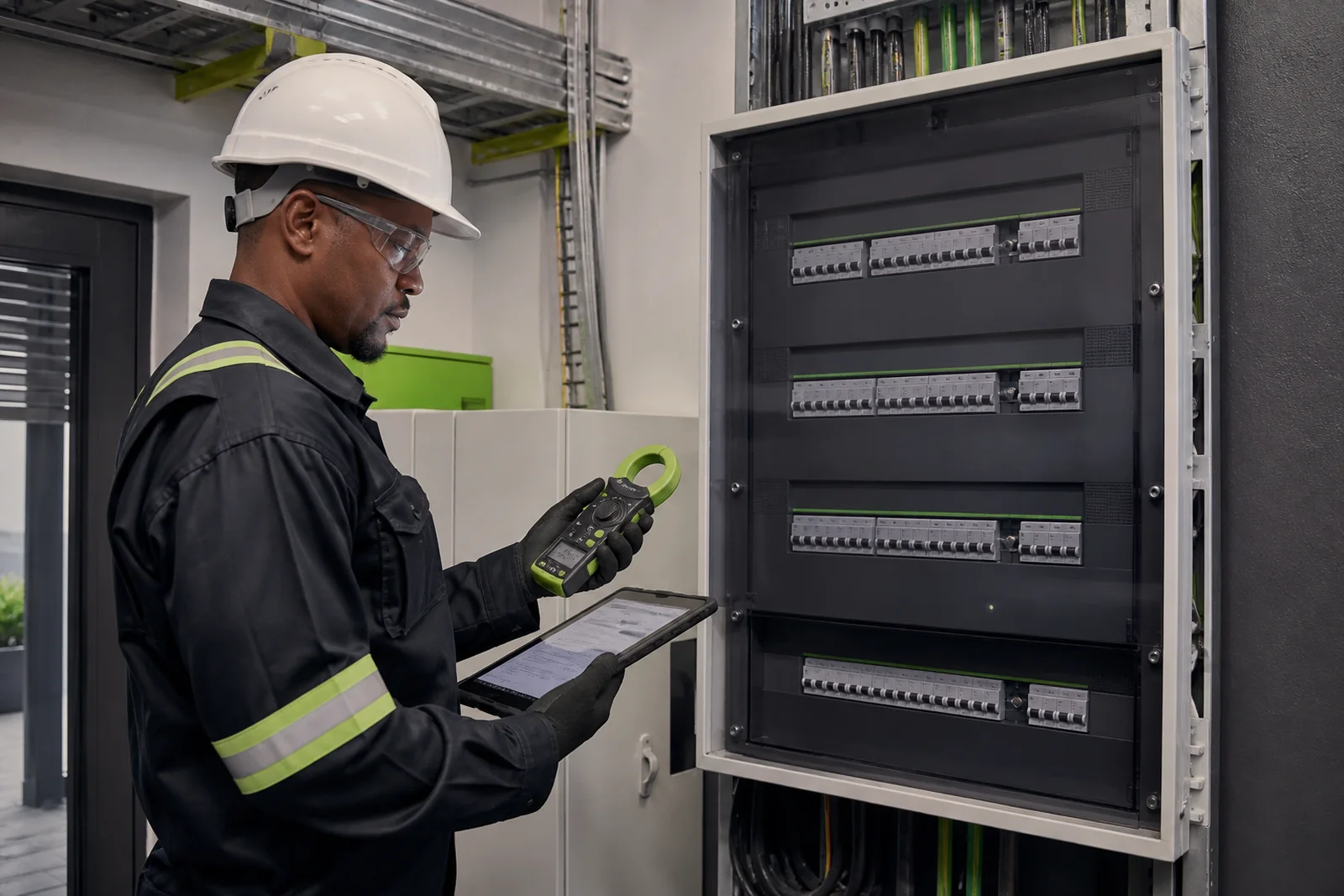
A distribution board is not automatically too small because a breaker trips, and it is not automatically healthy because every device stays on. Repeated operation of a circuit breaker, earth-leakage device or main protective device is a symptom that needs to be classified. The cause may be excessive demand, a faulty appliance, insulation leakage, a loose or damaged connection, incorrect circuit allocation, phase imbalance, an unsuitable protective arrangement or a supply problem outside the board. Replacing the board before that distinction is made can move the symptom without resolving the fault.
This guide helps Gauteng homeowners, landlords, trustees, facilities teams and business operators prepare an evidence-led distribution-board assessment. It explains which observations are useful, why increasing a breaker rating is not a shortcut, how single-phase and three-phase decisions differ, what phase balance can reveal and which factors shape the scope of an upgrade. It does not provide a remote design, a fixed quotation or permission to open a board. Internal inspection, testing, alterations and certification belong with appropriately competent and legally registered people.
01
Identify exactly what operated before calling it an overload
The phrase the power tripped can describe several different events. A final-circuit breaker may disconnect one group of sockets or one appliance. An earth-leakage device may disconnect several circuits together. A main protective device can remove supply from most or all of the property. A utility interruption can produce the same dark-room symptom without any protective device inside the property operating. The first useful record is therefore the label and position of the device, the area affected and the condition of neighbouring or common supplies.
Do not repeatedly reset a device to prove that it trips. One safe observation from outside the closed board, followed by a clear incident record, is more useful than a sequence of resets that adds heat or re-energises a fault. If there is smoke, burning odour, arcing, water, discolouration, a damaged enclosure or evidence of electric shock, keep people clear and arrange urgent professional assessment. The objective is safe classification, not amateur fault reproduction.
Record the affected boundary
Write down whether the loss affects one appliance, one circuit, several circuits, an entire dwelling, one tenant or a whole building. Note whether lighting, sockets, gates, pumps, geysers, air-conditioning, server equipment and backup-power circuits behave differently. That boundary narrows the first diagnostic path without pretending to identify the cause.
Capture timing and sequence
Useful timing includes the hour, operating loads, weather, utility status and what started immediately before the event. A trip during simultaneous cooking, water heating and vehicle charging suggests a different investigation from a trip at low demand after rain. The pattern is evidence; it is not a verdict until inspection and testing support it.
02
Separate overload, short-circuit and earth-leakage clues
An overload generally develops when a circuit carries more current than its design and protection allow for long enough to operate the breaker. It can follow several high-demand appliances sharing one final circuit or a load that has changed since the circuit was designed. A short-circuit or severe fault can operate protection rapidly and may be accompanied by sound, smell or visible damage. Earth-leakage operation points toward current leaving the intended live-and-neutral path, but the source still has to be located by systematic testing.
Occupants should not decide the category from the speed of the trip alone. Device characteristics, fault magnitude, temperature, upstream protection and circuit arrangement all affect what is observed. A useful professional assessment identifies the protective device, confirms the circuits it controls, inspects condition and labelling, and performs suitable tests. The result should explain which evidence supports overload, leakage, equipment failure or another cause.
Why appliance substitution can mislead
Moving a heater, kettle or machine to another socket can shift demand onto a different circuit and make the symptom disappear temporarily. That does not prove the first socket is faulty, and it may overload the second circuit. Record what was moved, then restore a safe operating arrangement and let the circuit allocation be verified.
Why wet conditions matter
Outdoor fittings, pumps, gates, roof equipment and damaged flexible leads can behave differently after rain or cleaning. Moisture history is valuable for earth-leakage diagnosis. It is not a reason to bypass the earth-leakage device or to keep resetting it until the equipment dries.
03
Never treat a larger breaker as extra circuit capacity
The rating on a circuit breaker is only one part of a coordinated protective arrangement. The conductor size, installation method, ambient conditions, grouping, termination quality, expected load, fault-loop conditions and downstream equipment all influence what protection is suitable. Increasing the rating without checking those factors can allow conductors or connections to overheat before protection operates. It can also conceal the symptom that would have triggered a proper investigation.
The same caution applies to replacing a device because it feels old or trips at inconvenient times. Protective devices can fail, but diagnosis should establish whether the device, the circuit or the connected load is responsible. Where replacement is justified, the new device must suit the system and coordinate with upstream and downstream protection. A catalogue match based only on pole count and printed amperage is not a complete selection process.
Circuit capacity belongs to the whole path
A final circuit begins at the board but includes conductors, joints, outlets, isolators and connected equipment. Hidden additions, long runs and mixed conductor sizes can change the safe design. Capacity is therefore established from the circuit evidence, not inferred from the breaker face.
Main protection is not a monthly demand target
A property may operate below its main protective rating most of the time and still experience short periods of excessive coincident demand. Conversely, a high main rating does not prove that every downstream circuit or busbar arrangement can carry new loads. Demand diversity and operating sequence need to be understood at the relevant level.
04
Build a load inventory before discussing an upgrade
A useful load inventory lists fixed and portable equipment, nameplate information, normal operating periods and which loads can run together. For a home this may include cooking, water heating, pool equipment, air-conditioning, borehole pumps, electric-vehicle charging, solar or inverter interfaces and workshop tools. For a business it may also include refrigeration, motors, kitchen equipment, tenant supplies, server rooms, lifts, pumps and process equipment.
The inventory must distinguish installed rating from actual demand. Some loads cycle; some start with a current higher than their running current; some operate only during emergencies; and some are expected to grow. Measurements taken over a representative period can reveal peaks and phase distribution that a one-minute spot reading misses. Historical utility data, backup-power logs and building-management records can support the picture when interpreted with the circuit schedule.
Include planned loads, not only existing ones
An upgrade planned without the next air-conditioner, vehicle charger, induction hob, tenant fit-out or pump may be undersized soon after completion. Record confirmed projects and realistic future allowances separately. That keeps present defects from being confused with optional capacity for later expansion.
Map each load to a known circuit
An inventory becomes actionable when equipment can be related to a labelled protective device and conductor path. Missing or inaccurate labels should be corrected through tracing and verification. Guessing from handwritten notes is not enough for isolation, balancing or upgrade design.
- Photographs of the closed board, labels and any visible damage taken from a safe position.
- Times, affected areas and operating loads for each recent trip.
- A list of recent electrical, solar, generator, appliance or tenant changes.
- Known high-demand equipment and the loads expected within the next two years.
- Available COCs, test reports, single-line diagrams, board schedules and previous fault reports.
05
Assess board condition as well as electrical demand
A property can have adequate theoretical capacity and still need board work because of heat damage, loose terminations, contamination, corrosion, broken blanks, deteriorated devices, mixed incompatible components or poor circuit identification. Enclosure integrity and access also matter. A board installed in a damp, dusty, crowded or publicly accessible position may need environmental and security improvements as part of the scope.
Thermal evidence can be useful when collected and interpreted under known load conditions, but a warm image is not a standalone diagnosis. Temperature is influenced by current, connection resistance, device design, ambient temperature and viewing access. The finding should be correlated with inspection, load measurement and electrical tests. Covers must not be removed by occupants to obtain a clearer photograph.
Look for a pattern of previous alterations
Unused openings, unmatched devices, doubled conductors, handwritten labels and abandoned wiring can indicate that the board has changed over time. They do not prove a defect by themselves, but they justify tracing the installation history and checking whether additions were tested and documented.
Space is a maintainability issue
A crowded enclosure makes safe termination, testing, labelling and future isolation harder. Spare ways are not automatically spare capacity, yet a planned board can reserve sensible physical space for approved future work. The decision should account for enclosure rating, heat, busbar arrangement and access—not appearance alone.
06
Treat single-phase to three-phase conversion as a supply project
Three-phase supply can help distribute suitable loads and support equipment that requires three phases, but it is not an automatic cure for a badly allocated or faulty installation. The property first needs a defensible demand forecast, confirmation of the available supply, an understanding of the point of control and a design for the main and downstream distribution. The electricity supplier may have application, metering, cable, tariff and capacity requirements that affect feasibility and timing.
South Africa’s Electrical Installation Regulations require supplier notification before installation work that needs a new supply or an increase in supply capacity, unless the supplier waives that requirement for a specified type of work. Completed installation work must also be inspected and tested by a registered person before connection and certification. The project programme should therefore separate supplier work, private installation work, inspection, testing and energisation.
Conversion may change more than the board
The incoming service, meter, main conductors, point of control, earthing arrangements, main switchgear and selected downstream circuits may all need review. Some existing single-phase loads can be distributed across phases, while genuine three-phase equipment needs its own design and protection. The site survey must define the boundary of each party’s work.
Keep outage planning in the scope
Conversion normally requires controlled isolation and a commissioning sequence. Homes need a plan for security, refrigeration and occupants; businesses need a plan for tenants, servers, access systems, pumps and operating hours. A good quotation states the assumed outage window and what happens if supplier work is delayed.
- Electrical Installation Regulations, 2009 — Official Department of Employment and Labour regulations covering responsibility, registered work, certification and supplier notification.
07
Measure phase balance instead of assuming it
On a three-phase installation, many everyday circuits remain single-phase and are distributed across the phases. If several high-demand circuits are concentrated on one phase, that phase can reach a limit while the others remain lightly loaded. Moving suitable circuits may improve allocation, but only after the circuits, shared neutrals, protective arrangements and operational consequences are understood. A neat arithmetic split on a schedule does not prove balanced real-world demand.
Eskom’s quality-of-supply guidance explains that unequal single-phase loading on a three-phase system can contribute to voltage unbalance and increased neutral current, with consequences for motors and other inductive equipment. Measurements should therefore consider phase currents, neutral current, voltage, operating state and time. Non-linear electronic loads can add harmonic current, so the neutral and power-quality picture may require more than a basic current comparison.
Balance critical and ordinary loads deliberately
A facilities team may need refrigeration, servers, security or pumps distributed so that one phase event does not create an avoidable concentration of operational risk. The electrical design and the continuity plan should be reviewed together. Randomly moving circuits to make three numbers look similar can create new isolation or backup-power problems.
Measure during representative operation
A restaurant before opening, an office on a weekend or a home while major loads are off will not reveal the normal peak. Record the operating state during measurement and use logging where demand varies. The goal is evidence that corresponds with how the property is actually used.
- Eskom quality-of-supply guidance — Official Eskom overview of unbalance, neutral current, harmonics, voltage regulation and other quality-of-supply effects.
08
Choose between repair, partial renewal and a full upgrade
A focused repair may be appropriate when the enclosure and wider board remain suitable and the defect is confined to an identifiable connection, device or circuit. Partial renewal can make sense when a section needs replacement, additional protection or improved segregation while the retained equipment is compatible and in acceptable condition. A full upgrade becomes more defensible when condition, compatibility, capacity, documentation and future work combine to make piecemeal repairs unreliable or uneconomical.
The scope should state what is retained, what is replaced and why. Retained circuits still need to be identified and verified at their connection points. New labels must describe the actual installation. If an old device is unavailable, the response is not automatically to fit the closest-looking alternative. Compatibility with the enclosure, busbar system and protective scheme must be established.
When staged work is reasonable
A managed property may prioritise immediate safety defects, then separate capacity, labelling and future-load work into planned phases. Staging is useful only when each completed stage is safe, testable and documented. Temporary arrangements should not become the undocumented final installation.
When replacement alone will not solve the problem
If the connected load, supply limit or downstream circuits remain unsuitable, a new enclosure and breakers can reproduce the same trip pattern. The board is the control and distribution point; it cannot create upstream capacity or correct undersized downstream circuits by itself.
09
Understand scope drivers without turning diagnosis into a price promise
Two boards with the same number of visible breakers can require very different work. Scope is shaped by supply type, enclosure condition, circuit count, protective-device requirements, prospective fault conditions, conductor condition, labelling, access, outage constraints, supplier involvement, testing, remedial defects and the need to trace undocumented circuits. Commercial continuity and after-hours work can add planning requirements that do not appear in a parts list.
This article deliberately does not publish a one-size-fits-all figure. Its role is to improve the diagnostic brief and help clients compare like with like. Wesslink’s dedicated price guide explains the cost categories and quotation questions for users whose primary intent is budgeting. Keeping diagnostic and pricing intent separate protects both decisions: the technical article does not masquerade as a quote, and the price guide does not pretend every board has the same scope.
Ask what the quotation includes
Clarify whether the price includes circuit tracing, new enclosure and devices, main conductors, labels, blanks, surge protection where specified, earth-leakage arrangements, testing, certification, supplier charges, making good and after-hours isolation. Exclusions should be as clear as inclusions.
Keep defects separate from optional expansion
A quotation should distinguish work needed to address identified safety or condition issues from optional capacity for a future charger, tenant or appliance. That separation helps owners approve the urgent scope while making a deliberate decision about expansion.
- DB board upgrade cost guide — Use the dedicated price-intent page for budgeting factors and quotation comparisons.
10
Make testing and close-out evidence part of the upgrade
The Electrical Installation Regulations place responsibility for safety, safe use and maintenance on the user or lessor, subject to the written-transfer provision in the regulations. They also require electrical installation work to be carried out under the general control of a registered person, and require appropriate certification for additions or alterations. A board upgrade should therefore be scoped as installation work with inspection, testing and close-out—not as a cosmetic equipment swap.
Useful close-out can include a clear circuit schedule, device and enclosure information, photographs, test results, the applicable COC and test report, and notes about retained limitations or future work. Commercial and managed properties may also need an updated single-line diagram, asset register, isolation procedure and tenant or facilities handover. The records should match the completed installation, not the original quotation.
Certification follows inspection and testing
A registered person may issue a COC only after satisfying themselves through inspection and testing that the relevant work meets the applicable requirements. If a defect prevents certification, the defect must be rectified before the certificate is issued. A promise of paperwork without a defined test scope is not a substitute for that process.
Keep the next electrician in mind
Accurate labels and records reduce unsafe assumptions during later faults, solar work, renovations or tenant changes. Good documentation is part of maintainability. It can save diagnosis time years after the physical installation has disappeared behind a closed board cover.
- Department reminder on electrical installation laws and COCs — Official 2025 reminder to appoint competent, legally registered contractors and issue COCs only after proper inspection and testing.
11
Match the assessment to the Gauteng property context
A Sandton office floor, a Midrand warehouse, a Randburg house, a Centurion complex and a Roodepoort retail property can all present a tripping complaint, yet their operating patterns and approval routes differ. Commercial sites may require permits, landlord approval and after-hours isolation. Complexes need a clear boundary between unit and common-property boards. Homes may combine legacy circuits with newer solar, air-conditioning or vehicle-charging loads.
Regional links are useful for service-area context, but they do not change the electrical evidence required at the property. Record the supply, board hierarchy, responsible contacts, access rules and utility account before the visit. That helps the assessment begin at the correct board and prevents a tenant fault from being confused with a common-supply or supplier issue.
Define who can approve isolation
In a business park or sectional-title scheme, the person reporting the fault may not control the main switchboard. Confirm the managing agent, facilities contact, landlord or trustee who can authorise access and an outage. Residential owners should also disclose tenants, medical needs and security systems affected by isolation.
Separate utility and private capacity
A larger private board cannot create capacity that the point of supply does not provide. Where an increase or conversion is proposed, supplier feasibility and private installation design must be coordinated. The quotation should state which party handles each application and connection step.
- Sandton electrical service-area guidance — Local context for offices, apartments and managed properties.
- Randburg electrical service-area guidance — Local context for homes, businesses and established installations.
- Midrand electrical service-area guidance — Local context for warehouses, business parks and expanding properties.
- Centurion electrical service-area guidance — Local context for complexes, homes and commercial sites.
- Roodepoort electrical service-area guidance — Local context for residential, retail and managed properties.
12
Use a defensible assessment and quotation workflow
Begin with the symptom record, existing documents and planned loads. The attending electrician can then inspect the installation, verify circuit identity, take appropriate measurements and determine which further tests or isolation are required. Findings should separate immediate hazards, confirmed defects, capacity limitations, documentation gaps and optional future improvements. This prevents every observation from being presented as an urgent full replacement.
The proposed solution should describe the electrical boundary, retained and new equipment, supplier dependencies, outage assumptions, testing, certification and close-out. If important circuits cannot be traced or safely assessed during the first visit, the quotation can define an investigation stage before committing to final equipment. That is better project control than pricing an unknown board as though its internal condition were already established.
A useful finding is specific
Statements such as old DB or overloaded are too broad on their own. Useful findings identify the affected circuit or component, the evidence observed or measured, the consequence and the recommended next action. Where a cause remains unconfirmed, the report should say what additional access or testing is needed.
A useful quotation is comparable
Comparable quotations use the same circuit count, supply assumptions, outage window, equipment scope, testing and certification requirements. A lower price that excludes tracing, labels, defects or supplier work is not automatically better value. Ask each contractor to identify assumptions rather than hiding them inside a lump sum.
- The final board and circuit arrangement, including accurate labels.
- The inspection and tests completed and any stated limitations.
- The COC and test report applicable to the completed installation work.
- Supplier or metering work completed separately from private installation work.
- Retained equipment, future allowances and outstanding recommendations.
- The safe isolation and handover information needed by the property team.
FAQ
Questions readers also ask
Does a tripping breaker mean the distribution board must be replaced?
No. The cause may be a circuit overload, connected appliance, damaged circuit, loose connection, unsuitable device or another fault. Inspection and testing should establish the cause before repair, partial renewal or full replacement is selected.
Can I stop nuisance tripping by fitting a larger breaker?
Not without a proper circuit assessment. Protection must suit the conductors, installation method, load and fault conditions. Increasing the rating can allow overheating or damage and may conceal the problem that caused the trip.
What is the difference between a breaker trip and earth-leakage trip?
A circuit breaker generally protects against overcurrent and fault current, while an earth-leakage device responds to current leaving the intended live-and-neutral path. The occupant symptom can overlap, so the operated device and affected circuits must be identified and tested.
Will changing from single-phase to three-phase stop overloads?
Not automatically. Three-phase supply can support suitable loads and distribute single-phase circuits, but existing faults, poor circuit allocation and downstream limitations still need correction. Supplier feasibility, demand, design and phase balance must be assessed.
What determines whether a DB needs repair or a full upgrade?
Condition, compatibility, circuit capacity, protective coordination, enclosure space, documentation, planned loads and the extent of defects all matter. A written scope should explain what can be safely retained and why other parts need renewal.
What should I prepare before requesting a distribution-board quotation?
Prepare a safe photograph of the closed board and labels, a trip log, recent electrical changes, a list of major and planned loads, access and outage constraints, and any COCs, test reports, board schedules or single-line diagrams available.