

For most residential rentals, the landlord should be able to show that the fixed electrical installation handed to the tenant is covered by a valid electrical Certificate of Compliance (CoC) and its test report. The tenant should use the installation safely, report defects promptly and obtain written permission before making alterations.
Commercial leases require a closer reading. South Africa’s Electrical Installation Regulations place responsibility on the “user or lessor”, as the case may be, and allow responsibility for an electrical installation to be transferred to a lessee by written undertaking. A commercial tenant may therefore become responsible for all or part of the installation under the lease—especially the tenant’s fit-out.
The practical answer is not simply “landlord” or “tenant”. First identify which part of the installation is involved, who changed it, what the lease says and whether a registered person issued a CoC for the work.
01
Quick decision guide
The practical answer is not simply “landlord” or “tenant”. First identify which part of the installation is involved, who changed it, what the lease says and whether a registered person issued a CoC for the work.
- Existing landlord installation at the start of a residential lease: ask the landlord or agent for the CoC and accompanying test report, and ask whether later additions have separate certificates.
- Pre-existing fault or unsafe landlord installation: normally raise it with the landlord in writing; do not attempt a DIY repair.
- Tenant adds a socket, circuit, light fitting point, distribution-board work or hardwired equipment: obtain written approval first and ensure the electrical work is certified by a registered person.
- Commercial tenant fit-out: define the landlord’s base-build installation and the tenant’s installation in writing before work starts.
- Commercial strip-out on departure: if fixed wiring or equipment is disconnected, removed or altered, the work may need a CoC covering at least that alteration.
- Change of tenant only, with no change of ownership or electrical work: the regulations do not automatically require a new CoC merely because a new tenant moves in.
02
What the South African regulations actually say
The Electrical Installation Regulations, 2009 draw an important distinction between ownership, use and contractual responsibility.
This means a lease can allocate electrical responsibility, but it cannot turn unsafe or uncertified work into lawful work. The safest approach is to make the responsibility boundary explicit and keep documentary proof for every alteration.
- Regulation 2(1) says the user or lessor, as applicable, is responsible for the safety, safe use and maintenance of the electrical installation used or leased.
- Regulation 2(3) says a written undertaking can transfer responsibility for an installation from the user or lessor to the lessee. The lessee is then responsible for that installation as if they were the user or lessor.
- Regulation 7(1) requires every relevant user or lessor to have a valid CoC accompanied by a test report.
- Regulation 7(4) requires a certificate covering at least an addition or alteration made after an earlier CoC was issued.
- Regulation 9 says only a registered person may issue the CoC, after inspection and testing. The person undertaking electrical installation work must ensure that a valid CoC is issued for that work.
- Electrical Installation Regulations, 2009 — Official Department of Employment and Labour source.
03
Can a residential tenant ask the landlord or agent for the CoC?
Yes. A tenant can—and should—ask for a copy of the CoC and its test report before signing or taking occupation, particularly where there are visible alterations, an inverter, solar equipment, a generator changeover, an electric gate, a pool installation or an older distribution board.
There is, however, a legal nuance worth stating accurately. Regulation 7 expressly requires production of the CoC on request to an inspector, electricity supplier or approved inspection authority. It does not expressly create a blanket rule saying that every tenant must automatically be given a copy on demand. That is different from saying a tenant should not ask. A copy is sensible due diligence, the lease may require it, and a landlord who relies on the installation being compliant should be able to identify the certificate and test report.
If the landlord or agent will not provide a copy, ask for a written response confirming whether a valid CoC exists, its date, who issued it, what installation it covers and whether any electrical work has been done since it was issued.
04
What a tenant should check when receiving a CoC
A CoC is important evidence, but it is not an eternal warranty that nothing can fail. Later alterations, deterioration, damage or unrecorded work can change the condition of the installation. Where the documents and the physical installation do not match, ask a registered person to inspect before relying on the paperwork.
- The property address and installation description match the premises you are renting.
- The certificate is accompanied by the relevant test report—not supplied as a certificate page on its own.
- The name and registration details of the registered person are present.
- The certificate’s scope is clear. A certificate for one alteration is not necessarily proof that every other part of a large property or commercial unit was tested at the same time.
- The date makes sense when compared with visible later work such as a new inverter, additional circuits, air-conditioning, signage or a renovated kitchen.
- Any supplementary or alteration certificates link logically to the original installation and the work you can see.
- The distribution board, circuits and isolators are labelled clearly enough to operate safely.
05
Residential rentals: a practical responsibility split
The landlord should hand over a reasonably safe and habitable property and maintain the building’s systems and installations in a safe, functional condition. The tenant should record visible defects during the incoming inspection and request the CoC evidence before accepting questionable electrical features.
The tenant should use the installation normally, avoid overloading sockets, keep access to the distribution board clear, report tripping, shocks, heat, burning smells or damaged outlets promptly, and allow reasonable access for authorised inspection or repairs.
The tenant should not add wiring, bypass protection, change a distribution board, install a hardwired stove, connect backup power or modify fixed equipment without the landlord’s prior written approval and a competent electrical contractor.
There is no honest one-line answer for every lease. In practice, the landlord will usually carry the cost of correcting a pre-existing defect in the landlord’s installation. A tenant will usually carry the cost of an alteration requested by the tenant, damage caused by the tenant, or an obligation clearly allocated to the tenant in the lease. The signed lease and the cause of the work matter.
A dispute about payment should not delay action where there is an immediate electrical danger. Make the circuit safe, document the condition and resolve the cost allocation separately.
06
Commercial rentals: separate the base build from the tenant fit-out
Commercial premises are where the phrase “the landlord must provide the CoC” is most likely to be incomplete. A shopping-centre, office, warehouse or restaurant lease may divide the installation into at least two parts:
The lease may transfer responsibility for the tenant’s demise or a defined installation to the lessee in writing. Before signing, the parties should attach an electrical responsibility schedule showing the point of control, the handover condition, existing CoCs, the fit-out approval process, who appoints the contractor, who pays for remedial work and which documents must be delivered at completion and exit.
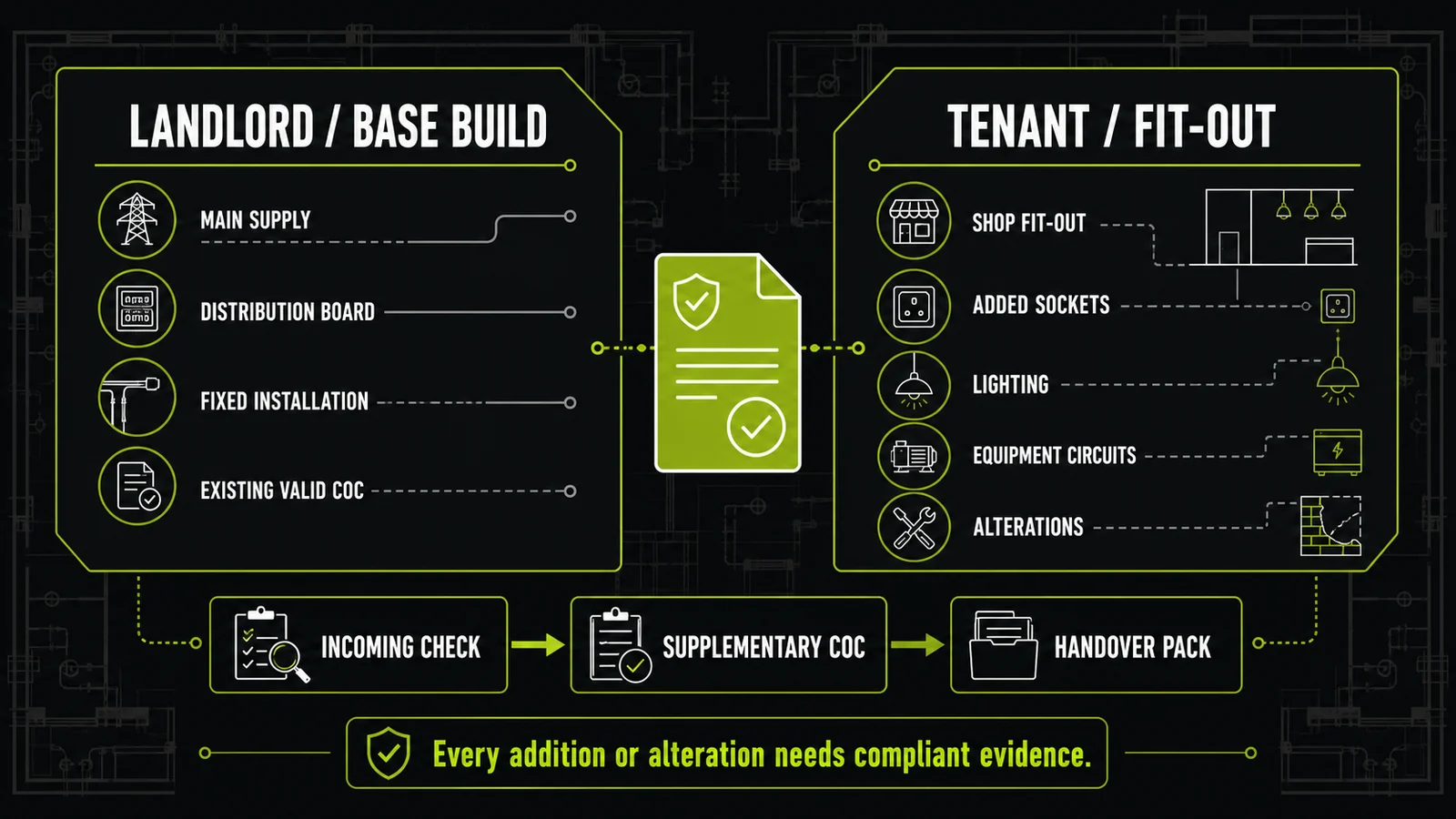
- Landlord or base-build installation: the incoming supply, landlord distribution, common areas and the fixed installation provided before tenant work.
- Tenant installation or fit-out: circuits, sockets, lighting, signage, kitchen equipment, cold rooms, extraction, data-room supplies, machinery, UPS systems, inverters, generators or other work added for the tenant’s operation.
07
Commercial tenant pre-fit-out checklist
- Obtain the landlord’s base-build CoC and test report for the portion being handed over.
- Ask for every later alteration certificate that affects the unit.
- Agree in writing where the landlord’s installation ends and the tenant’s installation begins.
- Confirm available supply capacity, phases, fault level and any landlord design rules before ordering equipment.
- Use a registered electrical contractor and ensure a registered person exercises control, inspects, tests and certifies the work.
- Require drawings, circuit schedules, equipment information and the CoC/test report before final payment.
- Confirm whether the lease requires landlord witnessing, centre-management approval or an independent inspection.
08
Why a public-facing commercial tenant should commission an independent incoming inspection
A landlord’s CoC is essential evidence, but a shop, restaurant, showroom, office or other public-facing business should not treat it as a substitute for its own electrical due diligence. The document may predate later work, may cover only part of a complex premises, or may not reflect the electrical demands and equipment introduced by the tenant.
The Occupational Health and Safety Act requires employers to provide and maintain, as far as reasonably practicable, a working environment that is safe for employees. It also requires employers and self-employed persons to conduct their undertaking so that people other than their employees who may be directly affected—such as customers, visitors and contractors—are not exposed to health or safety hazards.
If a known or reasonably preventable electrical hazard injures an employee or member of the public, the consequences may extend beyond the repair itself. Depending on the facts, the business may face regulatory, contractual, insurance or civil-liability consequences. The landlord’s certificate does not automatically remove the tenant’s duties for the way the tenant occupies, equips and operates the premises.
- Before fit-out or public trading begins, appoint a suitably registered electrical person to inspect the premises independently.
- Compare the physical installation with the landlord’s CoC, test report and any later alteration certificates.
- Check the tenant’s distribution board, protection, earthing, bonding, circuit identification, accessible outlets and the proposed load of tenant equipment.
- Record pre-existing defects in a written schedule with photographs and send it to the landlord or property manager before the tenant starts altering the premises.
- Agree which base-build defects the landlord will correct, who will re-test them and which documents will be handed back.
- After every tenant electrical alteration, obtain a CoC and test report covering at least that work. Do not wait until the lease ends.
- Keep the incoming inspection, defect close-out, original CoC and every supplementary CoC together in the premises compliance file.
09
Which tenant changes normally need electrical certification?
A useful rule of thumb is this: if the work changes the fixed electrical installation between the point of control and a point of consumption, treat it as electrical installation work and obtain professional confirmation of the certification required.
Simply unplugging and removing a portable appliance will not usually alter the fixed installation. Once tools are needed to disconnect, terminate or modify fixed wiring, the work should be treated differently.
- New or relocated socket outlets and lighting points.
- New circuits, circuit breakers, isolators or distribution-board changes.
- Hardwired ovens, hobs, machinery, pumps, gates, air-conditioning or extraction equipment.
- Shopfront or external signage wired into the premises.
- Cold rooms, commercial kitchens and specialised equipment supplies.
- Solar, inverter, battery, UPS, generator or changeover arrangements connected to the fixed installation.
- Removal or disconnection of fixed electrical equipment where wiring, protection or the distribution board is changed.
10
What is a supplementary CoC?
The official CoC form provides for an “initial” or “supplementary” certificate. In everyday use, a supplementary CoC is commonly used to document work added to or altered on an installation that already has an earlier certificate. Regulation 7(4) requires a CoC for at least the addition or alteration.
Keep the certificates together. The practical compliance record for a premises may therefore be the original CoC plus one or more later certificates and test reports. A later supplementary certificate should not be presented as proof of unrelated parts of the premises unless its scope genuinely covers them.
11
Must a shop tenant provide a CoC when moving out?
Not automatically just because the lease ends. A change of tenant, by itself, is not the same as a change of ownership and does not automatically create a new-certification event under the connection rule.
The answer changes when the tenant strips out or reinstates the unit. If the exit work removes hardwired equipment, alters circuits, changes protection, removes lighting or signage supplies, modifies a distribution board or leaves wiring terminated, it is electrical installation work. A CoC should then cover at least the alteration, and the lease may specifically require the tenant to provide it before the landlord accepts handover or releases a deposit.
A tenant who merely removes portable equipment without changing fixed wiring may not need a new CoC for that act, although the lease may still impose a broader handover inspection or certificate requirement.
- CoC and test report covering the final electrical alteration or reinstatement work.
- Copies of all fit-out certificates issued during the lease.
- Registered person and electrical contractor details.
- Final distribution-board and circuit schedules.
- As-built drawings where the installation is complex.
- Safe termination and labelling confirmation for removed equipment.
- Before-and-after photographs and the landlord’s written acceptance of the electrical handover.
12
What if the landlord refuses or the documents do not match?
- Put the request and the safety concern in writing. Identify the exact property, unit and symptoms.
- Ask for the CoC, test report, later alteration certificates and the name of the registered person who issued them.
- Check the lease for clauses dealing with compliance, maintenance, alterations, fit-out, reinstatement and access.
- Do not perform DIY electrical work or allow an unregistered person to “make it pass”.
- If there is an immediate danger—such as smoke, burning insulation, exposed live parts, repeated shocks or severe overheating—stop using the affected circuit if this can be done safely and obtain urgent assistance.
- For a residential dispute, consider the provincial Rental Housing Tribunal or appropriate legal advice. For a technical dispute over an installation, use the routes available under the Electrical Installation Regulations and an appropriately authorised inspection body.
13
Red flags tenants should not ignore
- A CoC is produced without the associated test report.
- The certificate predates obvious later additions but no alteration certificate exists.
- The address, unit number or installation scope is wrong.
- A landlord, agent, handyman or contractor claims to issue the certificate but cannot identify the registered person.
- An inverter, generator or solar installation can energise circuits without a clearly controlled and labelled changeover arrangement.
- Circuits are repeatedly tripping, outlets are hot, lights flicker severely, phases drop inside a commercial unit, or there are shocks or burning smells.
- Loose wiring or unterminated conductors are left after a commercial strip-out.
- The parties cannot explain where the landlord installation ends and the tenant installation begins.
14
The most useful takeaway
Treat electrical compliance as a chain of evidence, not a single piece of paper. The starting CoC shows the landlord or base-build installation at handover. Every later electrical change should add a properly scoped certificate and test report. At the end of the lease, the document chain should match the installation being returned.
That approach protects tenants from inheriting unexplained work, protects landlords from uncertified fit-outs and gives electricians a clear, testable scope.
15
Need help checking the documents or the installation?
Wesslink Electrical can inspect residential and commercial installations, verify whether the available CoC records match the visible installation, identify the scope of tenant alterations and issue appropriate certification where the work and test results comply. If defects are found, they must be corrected before a CoC can lawfully be issued.
Call 072 271 7111 or use the Wesslink contact page to arrange an electrical compliance assessment in Gauteng.
- Electrical CoC services — Inspection, testing and certification of applicable electrical installation scopes.
- Commercial electrician services — Support for shops, offices, managed properties and tenant fit-outs.
- Electrical CoC and property-transfer guide — Related guidance for Gauteng property owners and buyers.
- Contact Wesslink — Send the property address, lease context and available electrical documents.
FAQ
Questions readers also ask
Does an electrical CoC expire?
The regulations do not set a routine annual expiry date for every CoC. However, later additions or alterations need certification, faults may require a new certificate, and a certificate older than two years has a specific consequence when ownership changes. The real question is whether the document still matches the installation as it exists today.
Does a new tenant automatically require a new CoC?
No. A change of tenant without a change of ownership does not, on its own, trigger the connection rule requiring a new certificate. New electrical work, a dangerous defect or a contractual handover requirement may still make inspection and certification necessary.
Can an estate agent issue a CoC?
No. Only a registered person may issue an electrical CoC. An agent can obtain and deliver the documents on behalf of the landlord.
Can a landlord make the tenant responsible?
A written undertaking can transfer responsibility for an electrical installation to the lessee. The clause should identify the installation clearly. Cost allocation, maintenance duties and fit-out responsibilities should also be explicit.
Who pays for the tenant’s supplementary CoC?
Usually the party commissioning the alteration, often the tenant, but the lease and agreed fit-out terms decide the commercial allocation. The contractor doing the installation work must still ensure that a valid certificate is issued for that work.
Does the landlord’s CoC cover tenant appliances?
A CoC covers the electrical installation within its stated scope, not the internal safety of every portable appliance. A hardwired appliance connection and its fixed supply form part of a different assessment from an ordinary plug-in appliance.
Should a tenant rely on a very old CoC?
First compare the certificate and test report with the current installation. Ask whether any work was added later. If the installation has changed, the compliance record should include the relevant later certificates. When in doubt, request an inspection by a registered person.
Must a tenant obtain permission before electrical alterations?
Yes, as a practical and contractual rule. Residential rental standards also treat unauthorised alterations seriously, and commercial leases almost always require written landlord or centre-management approval. Permission does not replace electrical certification.
What should a commercial tenant do before releasing the electrician’s final payment?
Require the CoC and test report, check the scope and address, obtain circuit schedules and drawings where applicable, and make sure any defects identified during testing have been closed. Keep the pack where it will be available at exit.