
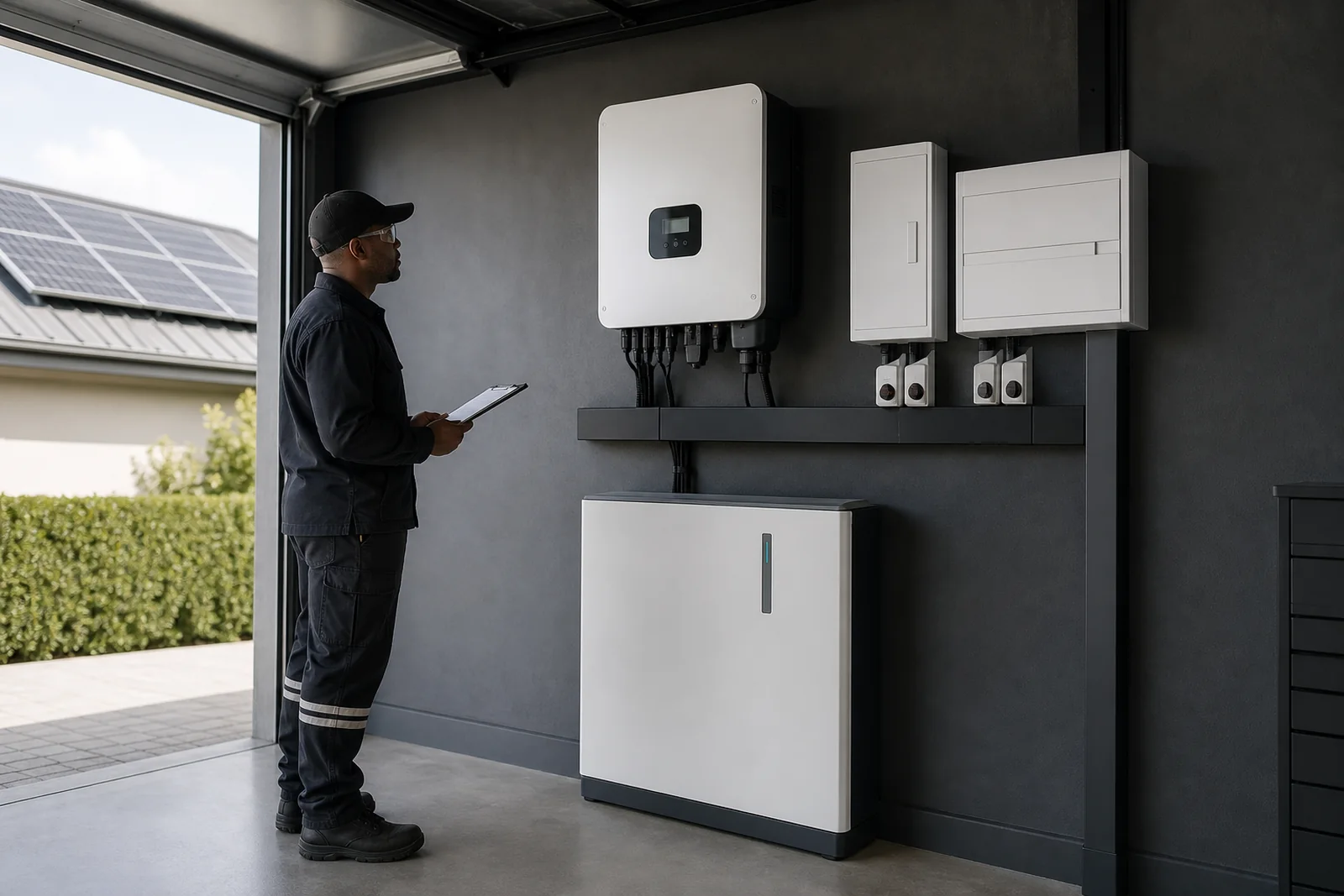
A solar or backup-power system is not electrically complete because the inverter starts, the batteries charge and selected lights remain on during an outage. Those observations show that energy is moving; they do not show that the new source has been integrated safely with the property installation. The compliance question is wider. It includes the source and changeover path, the backed-up distribution boundary, protective conductors, neutral and earth behaviour, isolation, labelling, cable protection, fault protection, product limitations, test results and the documents that explain how the system is meant to operate.
This guide helps Gauteng homeowners, landlords, managing agents, facilities teams and business owners organise that evidence before an inspection, handover, property transaction or corrective project. It focuses on fixed electrical work and the interface between the alternative supply and the existing installation. Inspection and certification must be assessed against the Electrical Installation Regulations and the current incorporated requirements, including the applicable edition of SANS 10142-1, together with any other standards, specifications and distributor rules relevant to the actual configuration. This guide does not reproduce a paid standard, approve a particular inverter, provide a remote compliance finding or replace the inspection and testing required from an appropriately competent and legally registered person. Distributor and regulator processes can also change, so grid-connection requirements must be confirmed for the actual supply authority and system configuration.
01
Start with the system boundary, not the equipment list
Before discussing a certificate, draw the boundary of the electrical work. Identify the normal supply, point of control, main distribution board, any essential-load or backed-up board, inverter AC input and output, PV input, battery bank, generator interface, bypass arrangement and every circuit that can receive energy from an alternative source. A photograph of an inverter model number cannot answer whether a socket, gate motor, pump or office circuit is supplied from the correct side of the changeover arrangement. The boundary must follow conductors and protective devices, not marketing labels such as hybrid, smart or backup ready.
Record which parts existed before the project and which were added, moved or altered. Note the property address, board identifiers, supply phase configuration, equipment locations and the date of the work. If several contractors worked at different times, build a chronology. A later battery expansion, sub-board or generator input can change the safety assumptions of an earlier installation even when the original inverter remains in place. Clear boundaries make inspection, testing, quotation and certificate scope more precise.
Follow every possible source of supply
A circuit may be energised from the utility, inverter, PV array, battery or another standby source. The record should show where each source can be isolated and which equipment can remain live after the main switch is opened. This is essential information for fault finding, emergency isolation and future alterations.
Name boards by function and location
Labels such as DB1 and backup DB are only useful when they match the physical site, diagrams and test report. Use stable identifiers that distinguish the main board, essential-load board, inverter AC protection and any PV or battery isolator enclosure.
- Inverter, solar and backup-power electrical support — Use the dedicated service owner for fixed wiring, changeover arrangements, distribution-board integration and corrective electrical work around backup-power systems.
02
Keep three evidence sets separate and connected
A strong handover distinguishes installation compliance, product evidence and distributor approval. The electrical CoC and its test report address the electrical installation within the stated scope. Product documentation describes equipment ratings, permitted configurations, installation conditions and type testing. Distributor or embedded-generation records address the connection to the electricity network. These documents support one another, but they are not interchangeable. An inverter brochure is not an electrical CoC, and an installation CoC does not automatically prove that the distributor application was completed.
Create an index that lists the current document reference, issuer, date, equipment or installation boundary covered, and related drawing or test result. Query missing pages and mismatched addresses. If a contractor says the solar has a certificate, ask for the certificate, accompanying test report and a clear description of the addition or alteration it covers. If a grid-parallel inverter needs a type-test certificate or distributor submission, file those separately rather than attaching them to the CoC without explanation.
Installation evidence answers site-specific questions
Site evidence connects protective devices, conductors, earthing, isolation and test values to this property. It should be possible to identify the affected boards and circuits without guessing from an equipment invoice.
Product evidence answers equipment questions
Keep manufacturer instructions, data sheets, battery compatibility information, warranty conditions and inverter interface evidence. Product approval does not correct poor wiring, but missing product limits can make the installed configuration difficult to assess.
- The electrical CoC and test report for the relevant installation work.
- Manufacturer and type-test documents for the inverter, battery and associated equipment.
- Current distributor, embedded-generation, metering or connection records where applicable.
03
Classify the actual operating mode before applying a checklist
The words solar system describe several different arrangements. A grid-tied inverter may operate in parallel with the utility and stop when the grid fails. A grid-interactive hybrid system may operate in parallel during normal conditions and form an intentional island for selected loads during an outage. A backup inverter may charge from the grid and supply an essential-load board without PV. A fully stand-alone installation may have no connection to a distributor network. Each mode changes the questions about anti-islanding, changeover, neutral treatment, earthing, distributor approval and commissioning.
Do not classify the system only from what the owner believes it does. Review the single line diagram, settings, equipment capabilities, protection and physical connections. Confirm whether export is possible, intentionally limited or technically prevented; whether there is a maintained neutral path; which circuits remain energised during a grid failure; and whether another generator can be connected. A setting shown on a mobile application is useful operational information, but it does not replace verification of the hardwired safety arrangement.
No export is not the same as no parallel connection
A system can be configured not to export while still operating in parallel with the network. The distributor may therefore require connection information even where the customer expects zero export. Confirm the current process with the actual supply authority.
Backup-only claims must match the wiring
If a system is described as backup only, verify how it is separated from the grid, how it transfers, and whether any path can energise the normal supply side. Labels, diagrams and operating tests should all describe the same mode.
04
Trace source selection, changeover and isolation as one safety chain
A changeover arrangement must prevent unintended connection between sources and allow the installation to reach a known safe state. Trace the normal supply into the inverter or changeover equipment, the alternative output, any bypass path, and the circuits supplied in each position. Confirm that the ratings and switching arrangement suit the supply configuration and the inverter operating mode. A bypass can be useful for maintenance, but an incorrectly designed or poorly labelled bypass can defeat protection or connect sources in a way the operating instructions never anticipated.
Document the isolation sequence in plain language for the user and in technical form for future electrical work. The main switch alone may not isolate PV strings, battery conductors or inverter output. Conversely, opening a DC isolator does not necessarily remove AC supply to the inverter. The handover should state which isolators are normal user controls, which are for competent-person maintenance, and what may remain energised. Do not encourage occupants to remove covers, disconnect batteries or operate unfamiliar devices to test the explanation.
Test normal, bypass and outage states deliberately
Commissioning should exercise the permitted states in a controlled sequence. Record which loads remain supplied, how the inverter responds, whether any protective device operates unexpectedly and how normal supply is restored.
Make emergency isolation understandable
A responder should not need a vendor application or remembered installer message to identify alternative supplies. Durable labels, a current diagram and accessible operating instructions reduce dangerous assumptions during fire, water damage or electrical fault investigation.
05
Verify neutral-earth behaviour and protection in every supply state
Neutral and earth behaviour is a design and testing matter, not a checkbox copied from another installation. The correct arrangement depends on the supply, inverter topology, switching, islanding mode and protective strategy. A system that changes its neutral reference between grid-connected and islanded operation can affect fault-current paths and the operation of earth-leakage protection. An improvised permanent link or a relay used without a verified design can create shock risk, nuisance tripping or parallel neutral paths.
The registered person should understand the equipment instructions and verify the installed result under the relevant operating states. Record continuity, polarity, protective-device operation and the tests required for the affected circuits. If earth-leakage devices trip only during transfer, or fail to test in one mode, do not normalise the symptom. Treat it as evidence that the source, switching, neutral arrangement or device coordination requires investigation. The final diagram and test report should reflect the arrangement actually commissioned.
Do not copy a neutral-earth recipe from social media
A wiring trick that appeared to solve one inverter model can be unsafe in a different topology. Equipment manuals, the installation design and measured behaviour must agree before the arrangement is accepted.
Coordinate protective devices with available fault current
An inverter may supply a different fault current from the utility. Protection and disconnection assumptions must be assessed for the alternative source rather than inferred from normal-grid performance alone.
06
Treat the backed-up distribution board as a controlled boundary
Moving circuits to an essential-load board is an electrical alteration with consequences beyond convenience. The circuit schedule must show what moved, the conductor and protective-device ratings must remain suitable, and the expected demand must fit the inverter output and battery strategy. High-load appliances can overload an inverter or exhaust storage rapidly even if they operated correctly on the utility supply. Conversely, a poorly balanced selection may leave critical communications, security or pumps without backup while nonessential loads consume capacity.
Inspect the enclosure, main isolator or switch, surge and earth-leakage arrangement, circuit identification, blanking plates, conductor entries and separation. Trace borrowed neutrals or shared circuits before transfer; moving only the live conductor of a mixed circuit can create unexpected return paths and nuisance operation. When a single-phase backup system is integrated into a three-phase property, document the phase and circuit strategy clearly. The system should not create an impression that all phases or all loads are supported when only a defined subset is available.
Use measured demand to choose essential loads
A practical load schedule records steady and starting demand, operating priority and allowed simultaneity. It is more useful than a list based only on circuit names or inverter headline capacity.
Update every affected schedule
The main board, essential-load board and single line diagram should use the same circuit names. Conflicting schedules slow fault isolation and make later CoC scope harder to understand.
- Distribution-board inspection and corrective electrical work — Use the DB service owner where the integration exposes enclosure, protection, circuit schedule or capacity defects.
07
Record battery protection, isolation and installation conditions
A lithium battery stores substantial energy even when the grid is off. The inspection record should identify battery make and model, compatible inverter or battery-management interface, nominal voltage, capacity, quantity, arrangement, protective device, battery isolator, conductor routing and enclosure or room conditions. Verify that the installation follows manufacturer limits for clearances, temperature, ventilation where specified, environmental exposure, mounting and access. Do not conceal battery protection behind stored goods or place equipment where impact, water or heat can reasonably damage it.
DC conductors need attention to polarity, fault protection, mechanical protection, termination, identification and separation from unrelated services. The battery isolator should be correctly rated for the DC duty and located so the intended maintenance isolation is clear. Multiple battery modules can introduce additional current and compatibility considerations; an expansion is not merely a capacity setting change. Record who approved the configuration, what firmware or communication requirements apply and which commissioning checks were repeated after expansion.
Do not use the user interface as the only battery record
An application may show state of charge and alarms, but the property file still needs equipment identity, protection, isolation and commissioning evidence that remains available if the account or installer portal disappears.
Escalate heat, swelling, odour or damage immediately
Do not open or move a suspect battery. Keep people away, follow the manufacturer emergency guidance, isolate only where the approved procedure can be followed safely, and contact competent emergency or technical support.
- Battery and inverter models, approved configuration and communication method.
- DC conductor, protection and battery-isolator details.
- Location, mounting, clearances and environmental limitations.
- Commissioning values, alarms checked and safe shutdown instructions.
- Expansion history, updated settings and revised installation records.
08
Connect the PV array record to the inverter and property
The roof array is part of the electrical evidence, not a separate photograph in the sales pack. Record module quantity and arrangement, string configuration, inverter input assignment, design voltage and current information, isolators, connectors, conductor routes, earthing or bonding provisions, surge-protection strategy and rooftop warning labels. The installed string values must remain within equipment limits under the conditions considered by the designer. A commissioning record should connect measured values to the string identifiers shown on the single line diagram.
Inspect visible cable support, weather protection, entry points and protection against sharp edges or mechanical damage. Roof access and live DC work are not homeowner checks. If documentation is absent, the inspection scope must allow safe tracing and testing by competent people rather than guessing from the number of modules. Later roof repairs, extensions or module replacements should update the array record. A mismatch between drawings, inverter inputs and roof layout is a documentation defect even if generation appears normal.
Treat connectors as part of a matched system
Connector appearance alone does not prove compatibility. Record the specified connector system and assembly method; mixed or poorly terminated components can create heat and failure points in a circuit that remains energised in daylight.
Document penetrations and rooftop routes
Water entry and unsupported cable routes can become electrical defects long after commissioning. Include clear photographs and responsibility for making good so later building maintenance does not obscure the cause.
09
Keep grid-interface and anti-islanding evidence current
Where a generating system operates in parallel with the distribution network, the network interface must meet the current distributor requirements for that connection. Anti-islanding is intended to prevent the inverter from continuing to energise a disconnected network. The equipment type-test certificate, settings, commissioning evidence, connection agreement and metering arrangements may all form part of the distributor file. An electrical CoC supports the installation record but does not replace the distributor process.
Confirm the authority supplying the property before applying a generic checklist. City Power, Eskom and other municipal distributors can use different forms, thresholds, metering arrangements and submission workflows. Requirements also change. Record the application reference, approved configuration, export limit if applicable, meter changes and the version of every submitted drawing. If an inverter is replaced, settings are altered or generation capacity changes, check whether the distributor must review the updated system before it operates in parallel again.
Retain the inverter type-test certificate
The certificate should identify the exact inverter model and applicable interface test basis. A certificate for a similar family name or different capacity should be queried rather than assumed equivalent.
Verify shutdown behaviour during commissioning
Controlled testing should confirm how the system responds when the normal supply is removed and restored. The result must match the approved operating mode while maintaining supply only to circuits intentionally designed for island operation.
10
Commission the installation under real operating transitions
A static inspection cannot reveal every integration defect. The commissioning plan should begin with document and visual checks, continue with the electrical tests appropriate to the affected installation, and then exercise normal operation, utility failure, intentional island operation where designed, low-battery response, bypass where provided and restoration of normal supply. Tests must be planned so people, connected equipment and the network are not exposed to avoidable risk. Occupants should receive notice before essential circuits are interrupted.
Record settings that materially affect protection, source interaction or export, but do not turn the handover into an unfiltered screenshot archive. Capture the approved value, purpose, date and person responsible. Note test instruments and results in the appropriate test report. If a transfer causes repeated tripping, flickering, loss of a protective conductor indication, unexpected neutral voltage or energisation outside the essential-load boundary, stop and diagnose the installation. Do not hide the symptom by widening settings or bypassing protection.
Test with representative loads
Commissioning should consider motor starting, electronic power supplies and the realistic essential-load combination. A successful no-load transfer does not prove that the system will support the property operating condition.
Confirm the return-to-grid sequence
Restoration can expose timing, synchronisation, bypass and control issues not seen during the outage transition. Record the observed sequence and any user action that is legitimately required.
11
Connect the new CoC scope to the property compliance history
South African Electrical Installation Regulation 7(4) states that where an addition or alteration is made to an installation for which a CoC was previously issued, the user or lessor must obtain a CoC for at least that addition or alteration. The certificate must be read with its test report and the physical scope it identifies. This means the solar or inverter project should not become an anonymous attachment to an older house certificate. The records need to show which new work was certified and how it interfaces with the existing installation.
A registered person may identify pre-existing defects that prevent safe integration or affect the ability to issue the required evidence. Separate those findings from optional improvements. If the project scope included a new essential-load board, circuit moves, AC and DC protection, changeover wiring and fixed equipment connections, the handover should not describe the work only as inverter installation. Preserve the earlier certificate for chronology, but mark the current pack and every later addition clearly so a future transaction or repair does not rely on an incomplete record.
Do not request a certificate as an administrative stamp
Certification follows inspection and testing of defined work. If the installation fails, the defect record and remedial scope must be resolved before appropriate compliance evidence can be issued.
Keep the test report with the certificate
The CoC reference, test report, affected boards and drawings should remain linked. A certificate image without its accompanying evidence is a weak handover and can be difficult to audit later.
- Official Electrical Installation Regulations, 2009 — Use the Department of Employment and Labour source for the certificate and addition-or-alteration framework.
12
Treat document gaps and operating symptoms as diagnostic inputs
Missing evidence does not automatically prove unsafe work, but it changes the inspection task. An absent single line diagram increases tracing time. An inverter model without a matching type-test document creates a grid-interface question. A battery expansion without updated protection information raises a DC design question. A certificate with the wrong property description creates a scope problem. List each gap, the decision it blocks, the competent person needed and the evidence required to close it.
Operating symptoms also deserve structured recording. Note whether tripping occurs on grid loss, restoration, high load, charging, rain, low battery or generator use. Identify the device that operated if this can be observed without opening equipment. Record alarms, smells, heat, sound and affected circuits without inventing a cause. Repeated resets, bypassed earth leakage, loose extension-based backfeeding, damaged battery enclosures, exposed DC connectors or unexplained energisation after isolation are red flags that require prompt technical attention.
Distinguish a limitation from a defect
A system that intentionally supports only selected loads has a limitation that should be documented. A circuit energised outside the documented boundary, damaged protection or unsafe transfer behaviour is a defect that requires corrective action.
Close the cause, not only the symptom
Replacing a tripped breaker or changing a setting without diagnosis can conceal the original problem. Close-out should state the confirmed cause, completed work, tests repeated and remaining limitations.
- Heat damage, burning smell, swelling, smoke, arcing or water near electrical equipment.
- Exposed conductors, damaged enclosures or accessible live DC connectors.
- A property circuit remaining energised after the documented isolation sequence.
- Bypassed protection, improvised plug-to-plug backfeeding or unsafe extension wiring.
- Repeated protective-device operation that has not been professionally diagnosed.
- A battery or inverter installed outside stated environmental or clearance limits.
13
Plan remedial work in evidence-led stages
When a legacy installation has weak records, resist the temptation to replace every component before the boundary is understood. Start with document collection, safe visual inspection and tracing. Then test the affected installation and reproduce reported transitions under controlled conditions. Classify findings as immediate danger, confirmed non-compliance, documentation gap, reliability defect, capacity limitation or optional improvement. This keeps safety work visible and prevents cosmetic upgrades from consuming the budget first.
The remedial scope should name affected equipment and circuits, access and outage requirements, labels and diagrams to update, tests to repeat and final documents to deliver. If distributor approval is outstanding, separate work needed for electrical safety from documents or equipment needed for the connection process. Sequence changes so the property is not left with ambiguous bypass wiring or undocumented temporary supplies. Any temporary arrangement must have a defined safety basis, owner, expiry and removal or completion action.
Prioritise source separation and protective integrity
Unsafe source interaction, missing isolation, damaged conductors and defeated protection take priority over monitoring upgrades, aesthetic cable management or additional battery capacity.
Retest after every material change
A repaired neutral arrangement, new changeover device, moved circuit or battery expansion can affect more than the component replaced. The close-out plan should repeat the tests and operating transitions influenced by the change.
14
Control solar and backup-power alterations in managed properties
Landlords, trustees and managing agents need a workflow that connects tenant or owner approval to the electrical installation record. Before work begins, confirm the unit and common-property boundaries, roof or equipment-room permissions, meter and distributor account holder, shutdown arrangements and document deliverables. After completion, file the drawings, CoC and test report, equipment evidence, distributor correspondence, settings record, commissioning report and emergency contacts under the correct property reference.
A tenant-installed inverter can affect a landlord board, common supply, fire strategy, maintenance access or later handover even when the equipment sits inside the leased area. Do not treat approval as a once-off email. Keep an alteration register and verify close-out before occupancy changes. The operational responsibilities of landlord, tenant, body corporate and agent should remain distinct from the technical role of the electrician. Contractual or legal allocation for a particular property requires the applicable lease, scheme rules and professional advice.
Require the same handover fields across the portfolio
Consistent board names, drawing references, document indexes and emergency instructions make future inspections faster and reduce the chance that records from one unit are applied to another.
Review the installation at changeover events
A tenant changeover is a useful point to compare the physical system with the alteration register, retrieve portal access, record equipment condition and route unresolved defects before the next occupation.
- Landlord electrical safety records and tenant handover workflow — Use the managed-property guide to connect the solar project to changeover checks, defect escalation and portfolio evidence control.
15
Match the evidence pack to the Gauteng supply authority and property type
A Sandton apartment may require coordination with building management, a central meter room and body-corporate roof rules. A Midrand business park may combine three-phase distribution, tenant boards, generators and a larger embedded-generation application. Randburg homes often mix older house wiring with newer essential-load boards. Centurion estates may impose architectural, fire and common-property controls. Roodepoort portfolios can include freestanding homes, sectional-title units and retail sites under different supply authorities. The national electrical principles remain important, but the submission and access workflow must match the actual property.
Use the account or meter information to identify the distributor, then obtain the current requirements directly. Eskom describes registration and document expectations for small-scale embedded generation on its official site. City Power publishes a Johannesburg household-solar guide that lists application documents such as a single line diagram, inverter information, commissioning form and CoC. These sources can change, so record when they were checked and avoid copying one distributor process to another municipality without confirmation.
Confirm the account holder and authorised applicant
Technical documents can be complete while the submission stalls because the property owner, tenant and electricity account do not align. Resolve authority and consent before commissioning dates depend on approval.
Plan access around the property environment
Office, retail and sectional-title properties may need after-hours shutdowns, security permits, rooftop access and notice to other occupants. Include those constraints in the inspection and remedial scope.
- Sandton electrical service-area guidance — Local context for apartments, offices and managed properties.
- Randburg electrical service-area guidance — Local context for established homes and mixed-age installations.
- Midrand electrical service-area guidance — Local context for business parks, estates and three-phase properties.
- Centurion electrical service-area guidance — Local context for estates, complexes and commercial sites.
- Roodepoort electrical service-area guidance — Local context for homes, retail properties and managed portfolios.
- Eskom small-scale embedded-generation guidance — Check the current Eskom registration and document process for an Eskom-supplied property.
- City Power guide to household solar installations — Check the current City Power application evidence for a Johannesburg supply.
16
Finish with a handover pack that another electrician can use
A useful handover allows a competent person who did not install the system to identify its boundaries and operate the approved isolation sequence without relying on memory. Include the final single line diagram, board and circuit schedules, equipment data, CoC and test report, PV string and battery records, protection and isolator information, distributor correspondence, commissioned settings, operating test results, photographs and limitations. Mark superseded drawings so they remain available for history without being mistaken for the current arrangement.
Give the owner a short operating guide that distinguishes normal user actions from technical maintenance. Explain which loads are backed up, expected transfer behaviour, safe shutdown indicators, alarm escalation, access restrictions and who to contact. Do not encourage repeated resets or opening enclosures. For commercial or managed properties, identify the document custodian and store the pack where it remains available after a contractor or tenant leaves. Schedule review when equipment, settings, circuits, supply mode or ownership changes.
Reconcile every document before sign-off
Equipment models, serial references, board names, circuit descriptions and drawing revisions should agree. Small mismatches create large delays during later fault finding, claims or property transfer.
Keep a clear exception list
List anything outside scope, not tested, awaiting distributor action or retained as a known limitation. Assign an owner and target date so a partial handover is not remembered as complete compliance.
- Property, supply authority, meter, point of control and installation-boundary details.
- Final single line diagram, board schedules and source-isolation information.
- Electrical CoC with its test report and the defined addition-or-alteration scope.
- Inverter, battery and PV product documents with matching model references.
- Protection, settings and commissioning records for normal and outage transitions.
- Distributor approval, application or connection records where applicable.
- User operating guide, emergency contacts, warranties and outstanding exceptions.
17
Prepare a focused brief before requesting an inspection
Send the electrician a concise pack before attendance: property address, supply authority and account reference, reason for the inspection, system operating mode as currently understood, equipment models, available CoCs and test reports, diagrams, distributor correspondence, known alterations, symptoms and access constraints. State the decision you need, such as document-gap assessment, fault diagnosis, remedial scope, compliance inspection or post-repair close-out. This helps the visit allocate enough time for tracing, isolation and operating tests rather than assuming a quick visual check.
Ask the report to separate immediate danger, confirmed installation defects, missing evidence, distributor-process gaps, reliability limitations and optional improvements. Require findings to identify the affected board, circuit or equipment and the evidence used. A precise report supports a precise quotation and a defensible compliance file. If the initial visit cannot safely complete every test, record the limitation and the next access or shutdown required. Unknowns should remain visible until resolved; they should not be converted into a generic statement that the system appears fine.
Allow time for safe tracing
Legacy systems with missing diagrams, multiple boards or undocumented extensions cannot be assessed responsibly from equipment photographs alone. The inspection scope should reflect the complexity and permitted outage window.
Define the required output before attendance
A fault report, remedial quotation, distributor pack and electrical CoC are different outputs. Naming the required decision prevents important testing or documentation from being assumed but not included.
FAQ
Questions readers also ask
Does a fixed solar or inverter installation need an electrical CoC?
Where the work adds to or alters an electrical installation for which a CoC was previously issued, Electrical Installation Regulation 7(4) requires a CoC for at least that addition or alteration. The scope may include fixed AC and DC wiring, changeover equipment, essential-load boards, protection and connections. An appropriately registered person must inspect, test and determine the certificate scope for the actual installation.
Can the original house CoC cover a solar system installed later?
An older certificate cannot describe work that did not yet exist. Keep it as part of the property history, then connect the later solar or inverter addition to its own applicable CoC, test report, drawings and commissioning records. The current compliance pack should show how all certificates relate to the physical installation.
Is an inverter type-test certificate the same as an electrical CoC?
No. A type-test certificate concerns the tested inverter model and its interface characteristics. An electrical CoC and test report concern the site installation within the stated scope. Distributor approval or registration is another separate process. A complete handover may need all three evidence sets.
Does a zero-export setting remove the need to contact the distributor?
Not necessarily. A system may operate in parallel with the network even when export is limited by settings. Distributor rules differ and can change. Confirm the current process with City Power, Eskom or the municipality that supplies the property, and retain the written outcome with the system records.
What documents should I receive after solar and battery installation?
Request the applicable electrical CoC and test report, final single line diagram, board schedules, inverter and battery product documents, PV string information, protection and isolation details, commissioned settings, operating-test record, warranties, user shutdown guidance and distributor correspondence where applicable. The model and board references should match the installed system.
What are warning signs that an inverter installation needs inspection?
Prompt assessment is justified by repeated tripping during transfer, hot or damaged equipment, burning odour, swelling batteries, exposed conductors, improvised backfeeding, missing isolation, unexplained energisation after shutdown, water entry, conflicting board labels or a certificate that cannot be matched to the installation. Do not open equipment or repeatedly reset protection to investigate these symptoms yourself.