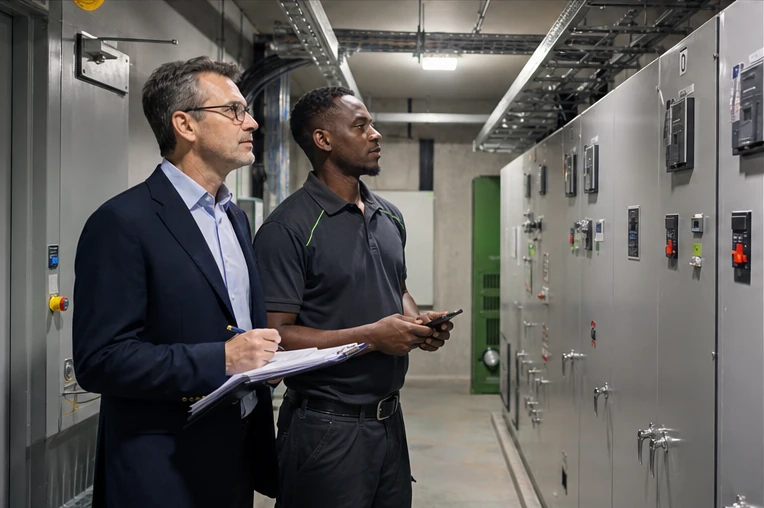

Common electrical assets fail across different timescales. Emergency repairs alone do not create a maintenance strategy or evidence of responsible governance.
A useful annual cycle connects the asset register, observations, professional inspections, budget decisions, work orders and final records.
01
Keep one controlled asset register
List boards, meter rooms, common lighting, gates, pumps, generators, inverters, electric fences and other shared systems. Assign an owner and maintenance contact to each asset.
Record location, condition, last service, documentation and known defects.
- Asset and responsibility register.
- Open fault and repeat-failure review.
- Thermal, visual or electrical inspections where appropriate.
- Backup-power functional tests.
- Budget and planned replacement priorities.
02
Separate observation, inspection and certification
Trustees and managers can record symptoms, but professional testing and compliance decisions require the appropriate competence and scope.
Do not describe a questionnaire or visual walk-through as a COC or formal inspection.
- Electrical Installation Regulations — Official Department of Employment and Labour regulations.
- Department of Employment and Labour COC notice — Official compliance guidance for owners, businesses and contractors.
03
Close every job with evidence
Require dates, locations, photographs where appropriate, materials, test results, outstanding risks and the person accepting the work.
Use repeat failures to change the maintenance plan rather than treating each event as unrelated.
- Property managers and complexes — Local Wesslink electrical service and property guidance.
- Contact Wesslink — Send the address, property type and the symptoms or work required.
04
Define the common-property responsibility boundary
The body corporate is generally responsible for maintaining common property, while owners have duties relating to their sections. Real schemes still need a site-specific boundary for shared boards, risers, meters, pumps, gates, fences and supplies that cross between areas.
Record the boundary before issuing work orders. It prevents delayed approvals, duplicated costs and disputes over who may authorise access.
- CSOS sectional-title management regulations — Official scheme-management rules and maintenance framework.
- CSOS common-property maintenance decision — An official adjudication illustrating the body corporate’s common-property maintenance obligation.
05
Turn inspections into an annual governance cycle
Start with an asset register, review incidents and open defects, approve priority work, budget planned renewals and retain close-out records. The next annual review should show what changed rather than repeat the same observations.
Emergency call-outs remain necessary, but they should feed the plan. Repeated failures on one asset are evidence for a larger maintenance or replacement decision.
FAQ
Questions readers also ask
How often should estate electrical assets be inspected?
Intervals depend on the asset, environment, manufacturer information, history and applicable requirements. Use a risk-based documented schedule.
Is a visual checklist an electrical inspection?
No. It can help identify priorities, but it does not replace appropriate testing or certification.
What should trustees receive after electrical work?
A clear close-out record identifying the asset, work performed, tests or documents supplied and any outstanding action.