
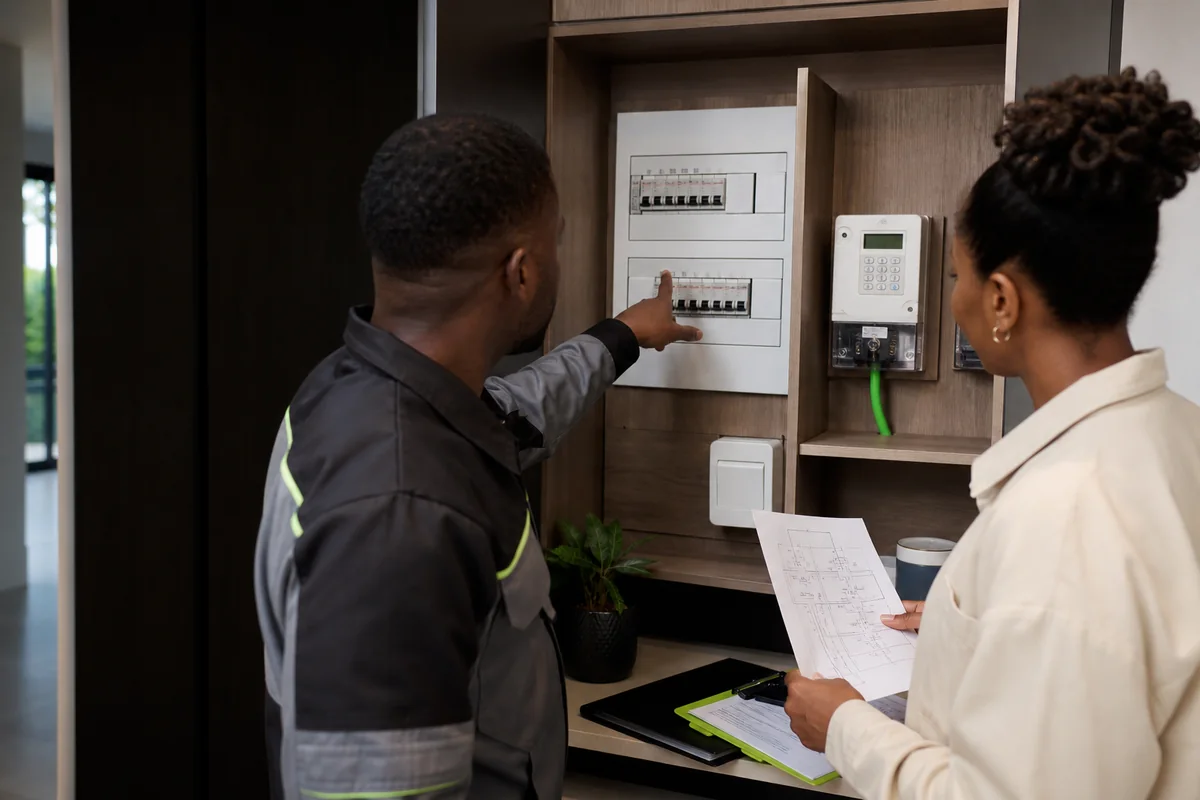
“Install a prepaid meter” can describe a supplier-owned meter change or a private sub-meter used to allocate consumption within a property. Those are not interchangeable projects.
Owners should identify the supply account, ownership boundary, tenant arrangements and electrical alterations before selecting hardware.
01
Define the metering model first
A municipal or utility meter remains within the supplier’s process. A private sub-meter sits downstream of the authorised supply and requires a clear billing and maintenance arrangement.
Do not tamper with seals, bypass equipment or treat a private device as permission to alter supplier-owned infrastructure.
- Who owns the incoming meter?
- Is the project utility metering or private sub-metering?
- Which circuits or dwelling will be measured?
- Who supplies tokens and statements?
- Who maintains the device and handles disputes?
02
Electrical work still requires a proper scope
The installer must assess board space, conductors, protection, isolation and labelling. If the installation is already overloaded or altered, a meter alone does not correct those defects.
Keep records of the device, installation and any applicable certification.
- Electrical Installation Regulations — Official Department of Employment and Labour regulations.
- Department of Employment and Labour COC notice — Official compliance guidance for owners, businesses and contractors.
03
Protect the tenant and the owner with clear records
Explain tariffs, fees, emergency credit and the process for a failed meter before occupation. Record opening values and provide a support contact.
A transparent arrangement reduces disputes and helps future electrical work identify the metering boundary.
- Electrician in Midrand — Local Wesslink electrical service and property guidance.
- Contact Wesslink — Send the address, property type and the symptoms or work required.
04
Decide whether you need a utility meter or a private sub-meter
A utility-owned meter sits at the authorised supply boundary and follows the electricity supplier’s application and equipment process. A private sub-meter sits downstream and records consumption for an internal allocation arrangement, such as a cottage or tenant.
Before accepting a quotation, write down who owns the incoming meter, who buys the electricity, how charges will be calculated and what happens when a tenant moves out. Electrical installation work cannot resolve an unclear commercial arrangement.
- Who owns and controls the incoming supply meter?
- Is body-corporate, HOA or landlord approval required?
- Which board and circuit will feed the sub-meter?
- How will readings, tariffs and disputes be recorded?
- Who is authorised to access or reset the equipment?
05
What the tenant handover should contain
Give the tenant the correct meter identifier, operating instructions, vending route, starting reading and contact route for token or hardware problems. Keep electrical documentation and supplier information with the property record.
A clear handover separates account or vending problems from faults in the circuits downstream of the meter.
FAQ
Questions readers also ask
Can an electrician replace Eskom or City Power’s meter?
Supplier-owned equipment must follow that supplier’s process. Do not authorise interference with seals or utility-owned infrastructure.
What is a private prepaid sub-meter?
It measures consumption downstream of the main authorised supply, usually for a tenant or separate dwelling, under a private management arrangement.
Does a prepaid meter solve an overloaded circuit?
No. Loading, protection and wiring must be assessed separately.