When electricity returns after load shedding or an unplanned outage, some properties come back normally while others immediately lose power again. A common report is: “The power is back in the street, but my earth leakage keeps tripping.”
That sequence is useful evidence, but it does not prove that load shedding damaged the earth-leakage device. Power restoration can cause appliances and fixed equipment to restart together. It can also expose moisture, insulation damage, an appliance fault or another problem that was already developing.
This guide explains what the trip may mean, what can be checked without opening electrical equipment, and when the fault belongs with City Power, a managing agent or an electrician.
Why can earth leakage trip when power returns?
An earth-leakage unit is intended to detect an imbalance that indicates current may be flowing along an unintended path. The ECA's published SAFEhouse guide describes it as an important safety device that automatically trips when it detects this imbalance. It is not simply an inconvenience to be bypassed or repeatedly forced back on. Source: ECA and SAFEhouse guide to distribution boards and earth leakage.
When supply returns, refrigerators, pumps, chargers, gate motors, inverters and other equipment may attempt to start or recharge. The return of power can therefore coincide with a fault becoming visible. Possible patterns include:
- A defective appliance reconnecting automatically.
- Moisture affecting outdoor, pool, gate or garden circuits.
- Damaged insulation or wiring that leaks current to earth.
- Several appliances contributing small amounts of leakage that become significant together.
- A fixed appliance, inverter arrangement or circuit fault that needs testing.
Eskom advises that restoration may include a momentary surge and recommends switching off or disconnecting non-essential appliances during an interruption. That supports sensible appliance protection, but a surge and an earth-leakage fault are not the same electrical event. Source: Eskom load-shedding safety guidance.
Earth leakage, circuit breaker or main switch?
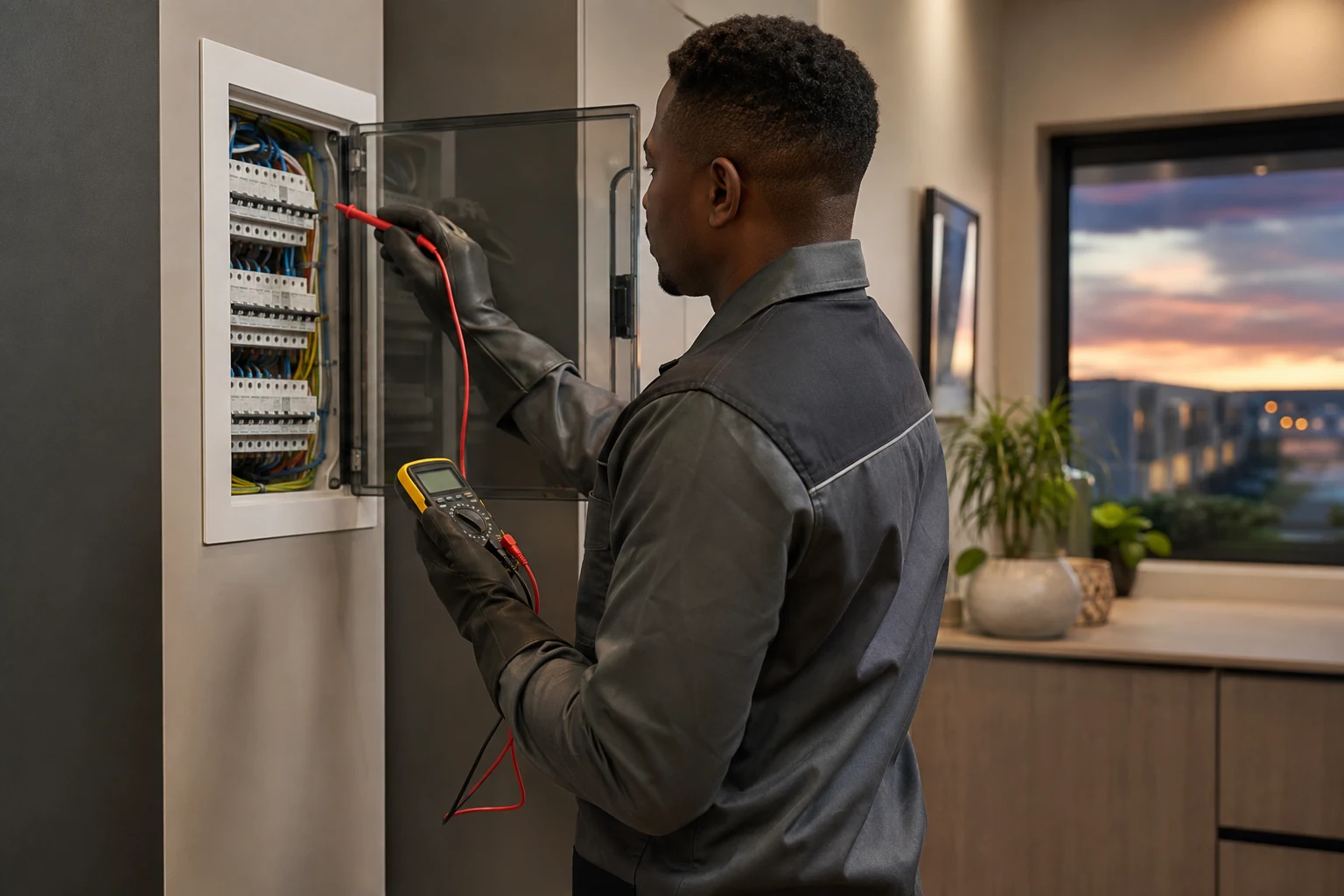
The first useful step is to identify which device moved to the off or tripped position without removing the distribution-board cover. Do not rely only on the phrase “the mains tripped”, because different protective devices point to different diagnostic paths.
Earth-leakage device
A detected imbalance or leakage path may be involved. Appliances, wiring, moisture and fixed equipment can all require investigation.
Circuit breaker
Overcurrent, a short circuit, a faulty load or a circuit-specific problem may be involved. A larger breaker is not a diagnosis.
Main switch or supply
The issue may involve the property's main protection, meter, supply phase or an upstream distribution point. Confirm what neighbours and common areas are experiencing.
A photograph of the closed board front can help identify labels and device positions. Never remove the cover or reach near exposed conductors to obtain a better picture.
Common causes after an outage
A plug-in appliance develops leakage
Fridges, washing machines, dishwashers, kettles, heaters and other appliances can develop faults. Timing can help: a trip that occurs only when one appliance is switched on is different from a trip that happens with every final circuit switched off. This observation is useful, but it does not replace electrical testing.
Outdoor equipment or moisture is involved
Pool pumps, irrigation controls, gate motors, outdoor lights and weather-exposed connections deserve attention when the problem follows rain or damp conditions. Do not open wet equipment or attempt to dry live electrical components.
Backup-power equipment restarts or recharges
An inverter or battery charger may change operating mode when the grid returns. The installation, changeover arrangement, neutral treatment, protection and equipment fault history may need assessment. “It only happens when the inverter changes over” is valuable information for the electrician.
A circuit or connection has deteriorated
An outage does not repair or create a clear boundary around every existing defect. Heat damage, loose connections, damaged conductors and insulation problems can persist until the installation is tested and the real cause is corrected.
Safe checks before booking an electrician
Only perform checks that do not require tools, removed covers or contact with wiring. If anything looks or smells unsafe, stop and keep people clear.
- Check whether the street, neighbours and complex common areas have power.
- Check the published outage information and any City Power reference supplied to residents.
- From a safe distance, note which labelled device has tripped.
- Record whether any lights, sockets or fixed equipment still work.
- Note whether the trip follows one appliance or a particular circuit being used.
- Tell the electrician about recent rain, renovations, inverter work or previous intermittent trips.
Do not repeatedly reset the earth-leakage device. One reset may establish that the fault remains, but repeated attempts can re-energise a defective circuit or appliance. Never hold a protective device in position, bypass it or replace it with a different rating to keep the power on.
Should you call City Power or an electrician?
Eskom advises customers to distinguish scheduled load shedding from unplanned faults and to report an outage that does not match the published schedule, or that continues beyond the expected restoration time. Municipal customers should report those faults to their municipality. Source: Eskom outage guidance.
For a City Power-supplied property, use the official City Power fault-logging and contact information when the wider street or supply area remains off.
- Likely municipal or upstream: neighbours, streetlights or several complexes are also without supply.
- Likely private installation: the surrounding area has power, but your home, unit or private board trips or remains off.
- Shared-property boundary: several units are affected but the street is on. The body corporate, caretaker or managing agent may need to coordinate access to communal electrical equipment.
These are routing clues, not a remote diagnosis. A supply phase, private cable, meter arrangement or communal board can make the boundary less obvious.
Complexes and shared supplies
In a sectional-title property, “my unit has no power” may involve the unit board, a private feeder, communal distribution, metering equipment or the municipal supply. Establish who else is affected before arranging access.
Provide the complex name, unit number, affected common areas and the contact person authorised to open electrical rooms. Wesslink's managed-property electrical support explains how trustees, managing agents and occupants can coordinate fault attendance and reporting.
If only one Little Falls unit remains off after the rest of the complex has recovered, use the dedicated Electrician Little Falls service route. The parent Roodepoort electrical service hub covers the wider regional service area.
Will surge protection stop earth leakage from tripping?
Surge protection and earth-leakage protection address different risks. A surge protective device is intended to limit transient overvoltage reaching connected equipment. An earth-leakage device responds to an imbalance indicating current may be flowing along an unintended path.
Eskom's surge-protection fact sheet explains that switching of high-power devices and restoration after interruptions can create voltage fluctuations and surges. Suitable surge protection can form part of a coordinated protection strategy, but it does not repair a leaking appliance, moisture-damaged circuit or wiring defect. Source: Eskom power-surge protection fact sheet.
Do not install a new surge device, replace an earth-leakage unit or alter board protection without assessing the board, earthing arrangement and applicable requirements.
When is the fault urgent?
Stop using the affected equipment and arrange urgent assistance when there is:
- Smoke, sparking, a burning smell or visible heat damage.
- Water close to sockets, boards or fixed electrical equipment.
- A shock or tingling sensation from an appliance, tap or metal surface.
- A damaged distribution board, exposed conductor or loose electrical cover.
- Repeated tripping that cannot be associated with a safely isolated plug-in appliance.
Keep clear of exposed conductors and treat the installation as energised. Switch off only if it is safe to reach the normal operating handle. Use emergency services if there is fire or immediate danger.
Electrical fault support in Little Falls
Little Falls includes freestanding homes, townhouse complexes, apartments and commercial property near a shared municipal and private distribution boundary. A useful booking should identify the property type, exact location and whether surrounding properties recovered when supply returned.
For local attendance, start with the Electrician Little Falls page. For the diagnostic process itself, use Wesslink's electrical fault-finding service. If a repair adds to or alters the fixed installation, ask the registered person what testing and certification will be required.
The Electrical Installation Regulations state that where an addition or alteration is made to an installation for which a certificate was previously issued, the user or lessor must obtain a certificate covering at least that addition or alteration. Source: South African Electrical Installation Regulations, regulation 7(4).
Common earth-leakage questions
Why did my earth leakage trip when the power came back on?
Power restoration can cause several appliances to restart together or reveal leakage from a faulty appliance, damaged circuit, moisture or another installation defect. The timing is a clue, not proof that load shedding itself caused the fault.
Can I keep resetting the earth-leakage switch?
No. One careful reset may help establish whether the fault remains, but repeated resetting is not a repair. Stop if it trips again or if there is heat, smell, sound, visible damage or water near electrical equipment.
Can one appliance cause the whole property to lose power?
Yes. A faulty plug-in appliance can cause an earth-leakage device protecting several circuits to trip. Fixed equipment, wiring and cumulative leakage from multiple devices can also be involved, so the cause should not be assumed remotely.
Why do only some lights or sockets work after an outage?
A circuit breaker, earth-leakage section, connection, supply phase or shared distribution point may be involved. Record exactly what still works and whether neighbouring properties are affected, then use that information to route the fault correctly.
Should I call City Power or an electrician?
If the wider street or several neighbouring properties are off, report the outage to City Power. If supply has returned around you but only your home, unit or private circuits remain affected, an electrician can investigate the private installation.
Does a new circuit, socket or protective device require an electrical CoC?
Where electrical installation work adds to or alters an installation that already has a certificate, regulation 7(4) requires a certificate covering at least that addition or alteration. The registered person must determine the inspection, testing and documentation required for the actual work.
Need help in Little Falls? Call 072 271 7111, WhatsApp Wesslink, email bookings@wesslink.co.za or send the fault details.
Guidance checked on 5 September 2026. This article is general safety information and cannot identify an electrical fault remotely.