A distribution board does not need replacement merely because it is old, and a new-looking board is not automatically suitable for the circuits it serves. Repair may be appropriate when a defined fault can be corrected without compromising the rest of the assembly. An upgrade may be needed when the board remains usable but the property requires better circuit separation, protection, capacity or documentation. Replacement becomes a stronger option when condition, enclosure, compatibility or accumulated alterations make a limited repair unreliable or uneconomical.
This guide helps owners, landlords, trustees, facilities teams and buyers understand the decision evidence before comparing quotations. It does not instruct anyone to remove a cover or work inside a board. A distribution board concentrates incoming supply, isolation, protective devices and multiple outgoing circuits; inspection, testing and safe isolation belong with appropriately competent electrical people.
01
Repair, upgrade and replacement solve different problems
A repair restores a defined part of the existing arrangement after the cause and affected scope have been established. An upgrade changes capability or organisation: it may add suitable ways, improve circuit separation, introduce protection required for altered circuits, correct labelling or support a planned load. Replacement removes the existing board or enclosure and rebuilds the distribution point to an approved design. Quotations should use those words consistently because they describe very different labour, materials, testing and disruption.
The decision should also separate the board from the wider installation. Repeated tripping can originate in a connected appliance, final circuit, moisture condition, supply problem or downstream board rather than in the main board itself. Conversely, a damaged board can affect multiple otherwise healthy circuits. A board-only conclusion made before fault finding can send the budget to the wrong place.
- Distribution-board warning signs — Recognise heat, smell, noise, damage and repeated trips without opening equipment.
- DB overload and capacity upgrade guide — The existing article that owns overload and capacity-planning intent.
02
Diagnose the symptom before choosing the scope
The first useful question is not “How much is a new board?” but “What evidence shows that the board is the cause or limitation?” Record which protective device operates, which circuits lose power, what was running, whether the condition is intermittent and whether heat, odour, sound, moisture or visible damage is present. Recent renovations, solar work, new appliances and tenant changes can alter the pattern.
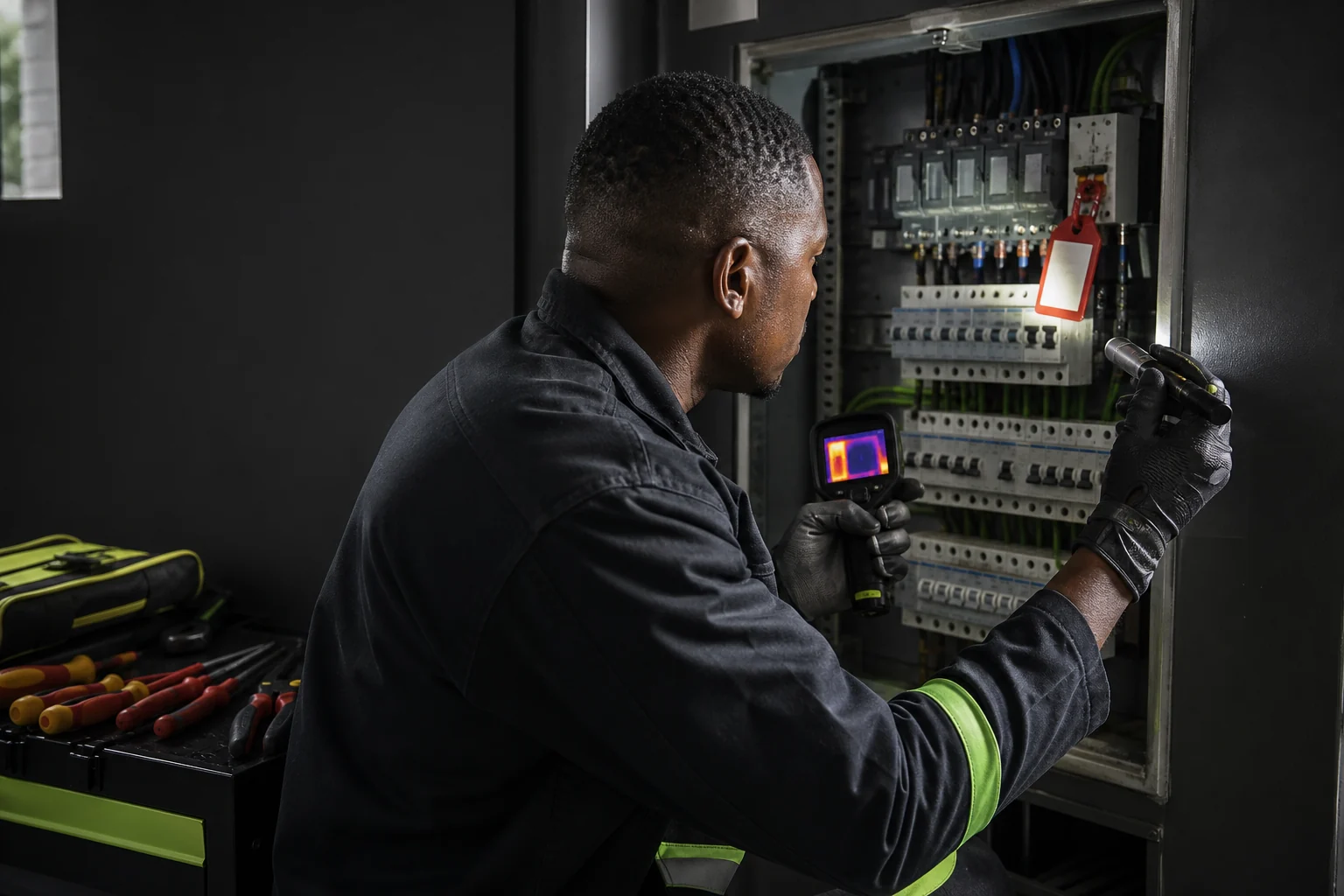
A competent assessment may combine visual inspection with circuit identification, continuity, insulation resistance, polarity, earthing, protective-device and load measurements appropriate to the situation. Thermal imaging can help record surface temperature patterns under defined conditions, but a colourful image is not a diagnosis by itself. The operating load, equipment rating, connection condition and measurement context determine what the image means.
- Board location, source and relationship to any downstream boards.
- Circuit schedule compared with the rooms and equipment actually supplied.
- Trip history, operating load and the exact device that operated.
- Visible condition of the enclosure, blanks, handles and labels from a safe position.
- Recent alterations, added loads or backup-power work.
- Earlier CoCs, test reports, repair invoices and photographs.
03
When a targeted repair may be the defensible option
Repair can be suitable when the fault is limited, the enclosure and remaining equipment are serviceable, compatible components are available, the circuit arrangement remains appropriate and the repaired work can be inspected and tested. Examples might include a defective protective device, damaged termination, failed indicator, missing blank or labelling defect—but only after the condition that caused the failure has been addressed.
Replacing one component without finding the cause can create a repeat visit. A heat-damaged connection may have been affected by looseness, contamination, overload, an unsuitable termination or a device problem. A tripping protective device may be correctly responding to a downstream fault. The repair scope should therefore state what was found, what was replaced or corrected, which circuits were tested and what remains outside the job.
Compatibility matters inside an existing assembly
Protective devices, busbars, enclosures and accessories are not universally interchangeable because they appear to fit. The practitioner must consider the assembly, manufacturer information, ratings, fault conditions and the applicable installation requirements. Improvised combinations can create mechanical and electrical risks that are not visible from the closed cover.
Repair close-out still requires testing
A successful repair is not simply a board that switches on. The affected work and circuit need the appropriate inspection and testing, with the outcome recorded. Where electrical installation work has altered the installation, the certificate implications must also be addressed.
04
An upgrade addresses capability, organisation or protection
An upgrade is appropriate when the existing board can form part of a safe solution but no longer supports the property’s planned circuits or operating needs. A renovation may need additional ways and clearer circuit separation. A home office, cottage, pool, workshop or backup system may need an intentional distribution arrangement. A business may require improved isolation, circuit identification, maintenance access or separation of essential loads.
Capacity is not created merely by installing a larger main protective device. Conductors, fault conditions, board ratings, supply agreement, load profile and downstream circuits all have to support the change. The upgrade design should identify the present demand, proposed loads, diversity assumptions where relevant, essential and non-essential circuits, protective arrangements and the supplier boundary before materials are ordered.
- Existing supply type, main protection and known capacity constraints.
- Current and proposed circuits, loads and operating pattern.
- Required separation for cottages, tenants, workshops or essential loads.
- Backup-power, solar, generator or changeover interfaces.
- Space, enclosure, environmental and access constraints.
- Required test results, schedule updates and certificate documentation.
05
Replacement becomes stronger when the existing platform is no longer dependable
Replacement may be justified by extensive overheating, fire or water damage, a compromised enclosure, exposed live-part risk, corrosion, structural deterioration, incompatible accumulated alterations, insufficient safe space, obsolete equipment without a defensible compatible repair, or a redesign that changes the board substantially. The decision should name the reasons rather than use “old DB” as a complete diagnosis.
A replacement project is more than moving wires into a new box. Circuits must be identified, isolated, assessed and reconnected to a deliberate schedule. Existing defects do not disappear when conductors enter a new enclosure. Unknown shared neutrals, damaged cables, incorrect polarity, insulation problems or undocumented subcircuits may only become visible during the work and need a controlled variation process.
06
Supply capacity and phase changes extend beyond the board
A single-phase to three-phase conversion, larger supply or increased main capacity involves the electricity supplier as well as the private installation. Regulation 8 requires supplier notification before installation work that needs a new supply or increased supply capacity, unless the supplier has waived the requirement for that type of work. Municipal and Eskom application processes, network availability, metering and charges are separate from the electrician’s private-side scope.
The board design should not get ahead of the approved supply. A property can also have an internal capacity or load-management problem even when the public supply cannot be increased. Load scheduling, circuit changes, efficient equipment or an engineered alternative may be considered, but the choice must follow the real load profile and operational need rather than a generic board package.
- Eskom new and additional business supply — Official Eskom connection and load-information route.
- Main breaker or substation trip guide — Separate supplier and property-side fault boundaries before changing a board.
07
Compare quotations by scope, not by the board photograph
A useful quotation identifies whether it is for diagnosis, repair, upgrade or replacement; which board and circuits are included; the assumed supply; major equipment; shutdown requirements; testing; labelling; documentation; and exclusions. It should also explain whether remedial work on downstream circuits is included or will be quoted after testing. Without that structure, two prices may describe different jobs.
Access and continuity affect cost and programme. Occupied homes, tenants, refrigeration, gates, pumps, security, servers and backup systems can limit when circuits may be isolated. Commercial properties may need permits, inductions, escorts and an authorised switching window. Ask how temporary safety work, hidden defects and restoration checks will be approved before work starts.
- What diagnosis and inspection evidence supports the proposed scope?
- Which boards, circuits and connected systems are included?
- What equipment, enclosure and compatibility assumptions are being made?
- How will isolation, access and restoration be managed?
- Which tests, labels, schedules, photographs and certificates are included?
- How are unforeseen defects recorded and authorised?
- DB board upgrade cost guide — Price factors and quotation boundaries without a universal amount.
08
The handover should make the next fault easier to understand
After the work, the owner or facilities team should receive documents that match the project. These may include the final approved scope, updated circuit schedule, defect and variation record, test results, certificate where applicable, product information, safe photographs and outstanding recommendations. The board label and schedule should identify the circuits that actually exist, not the rooms as they were named years earlier.
Record any circuits intentionally left isolated and any work assigned to another contractor, supplier or equipment specialist. A neat board with no close-out record forces the next electrician to rediscover the installation. Good documentation turns the board into an understandable distribution point rather than an anonymous collection of protective devices.
- Randburg electrical service area — Regional support for established homes, rentals and commercial premises.
- Electrical fault-finding cost guide — Understand the difference between attendance, diagnosis and repair.
09
Keep the decision inside the legal installation framework
The Electrical Installation Regulations apply to electrical installation, extension, modification and repair work and require the registered route described in the Regulations. They also require appropriate inspection and testing before certification. The incorporated safety standards include SANS 10142-1 for low-voltage installations. The actual design and test requirements must be confirmed against the current documents and the specific installation.
Property owners remain responsible for the safety, safe use and maintenance of the installation subject to the regulatory provisions. That responsibility is better served by an evidence-led scope than by replacing equipment for appearance or retaining a damaged board to save a short-term cost.
- Electrical Installation Regulations, 2009 — Official installation-work, responsibility and certificate provisions.
- Electrical Installation Regulations explanatory notes — Official explanatory guidance on the installation boundary and standards.
- Department warning on registered electrical contractors — Official reminder to verify the legally registered route.
FAQ
Questions readers also ask
Should an old distribution board always be replaced?
No. Age alone is not a complete technical finding. Condition, enclosure integrity, protection, compatibility, capacity, circuit arrangement, test evidence and planned use should determine whether repair, upgrade or replacement is appropriate.
Can a tripping breaker simply be replaced?
Only after the cause and circuit requirements are assessed. The device may be faulty, but it may also be correctly responding to an overload, insulation fault, connected-equipment problem or another condition. Fitting a larger breaker without design evidence can be dangerous.
What is the difference between a DB repair and upgrade?
A repair corrects a defined fault in a serviceable existing arrangement. An upgrade changes capability, circuit organisation or protection to meet an assessed need. The quotation and close-out should state which outcome is being delivered.
Does replacing a distribution board fix faulty wiring?
Not automatically. Existing circuit defects can remain after a new board is installed. Circuits must be identified, inspected and tested, and findings need to be rectified or clearly recorded within the agreed scope.
Can I change from single-phase to three-phase by installing a new board?
No. A phase or supply-capacity change involves the electricity supplier, approval and metering as well as the private installation design. Confirm the applicable municipal or Eskom process before committing to equipment.
What documents should I receive after DB work?
Depending on scope, request the final quotation and variations, circuit schedule, defect record, test results, applicable certificate, product information, photographs and outstanding recommendations. The documents should identify the actual board and circuits covered.