
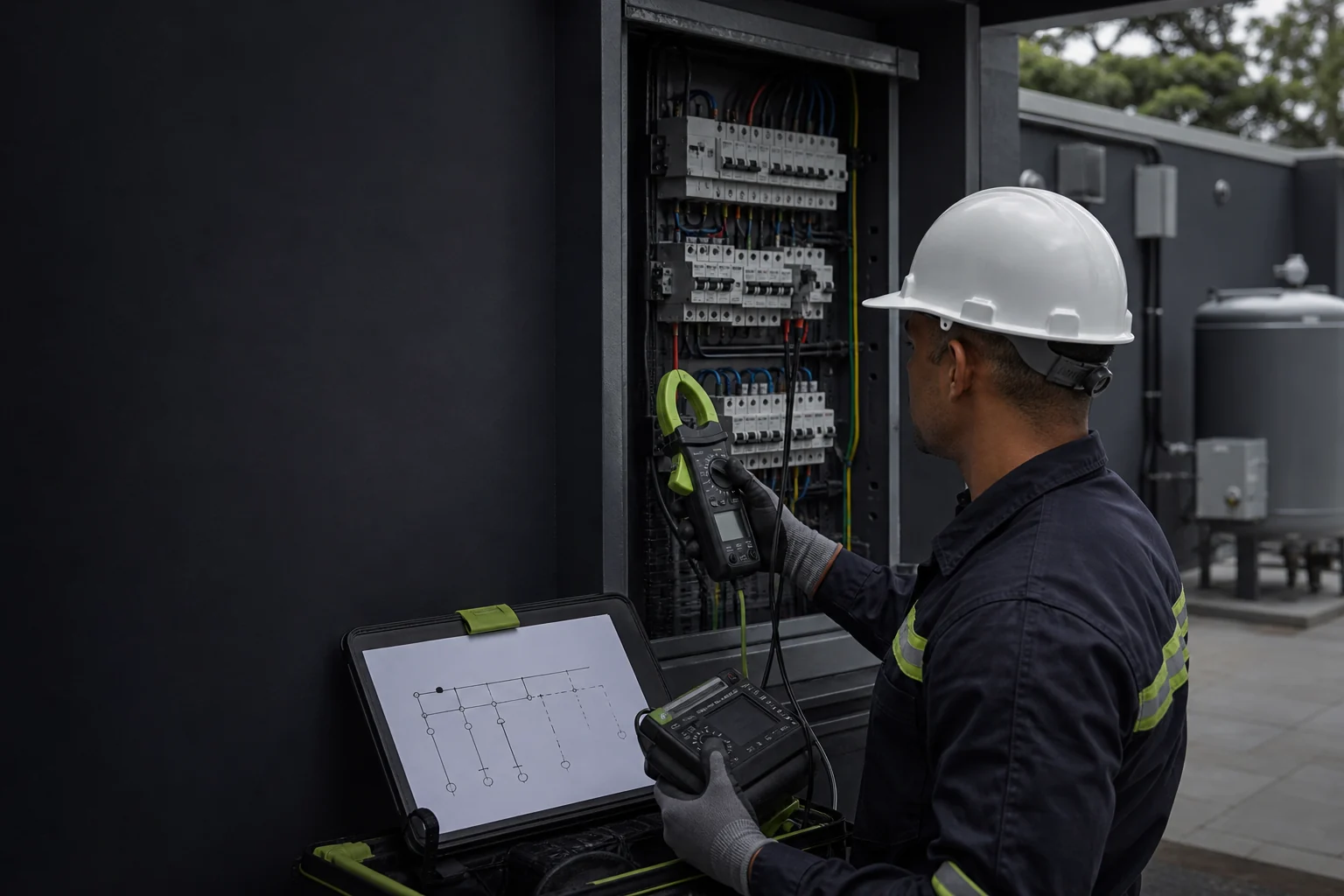
Electrical fault finding is a controlled process of reducing uncertainty. The same customer description—“the power keeps tripping”—can point to an appliance, final circuit, earth-leakage condition, overloaded arrangement, damaged connection, moisture, downstream board, backup-power interface or supply problem. Professional diagnosis starts by defining the symptom and boundary, then selects tests that can confirm or reject the most plausible causes.
This guide explains what property owners, landlords, facilities teams and tenants should expect from that process. It does not provide a do-it-yourself testing procedure. Instruments, isolation decisions and live conditions create serious risk, and an online checklist cannot make a person competent to work inside electrical equipment. The customer’s useful role is to preserve evidence, describe the sequence accurately, arrange access and authorise work through clear decision points.
01
Diagnosis is not the same as replacing the first suspicious part
A device can look damaged and still be only one consequence of a wider fault. A protective device can operate because it is defective, but it can also be correctly removing an unsafe condition. A burnt termination may result from looseness, contamination, unsuitable equipment, overload or heat from a neighbouring connection. The first plausible explanation therefore remains a hypothesis until the evidence supports it.
A disciplined electrician records the reported symptom, observes the installation, establishes safe working conditions, narrows the affected boundary and chooses tests that answer specific questions. The customer should be able to understand what was found, which part of the installation was tested, what remains uncertain and why a proposed repair follows from the diagnostic findings.
- Why the power keeps tripping — The existing symptom guide for occupants and property teams.
- Electrical fault-finding cost guide — Separate attendance, diagnostic time, repair and follow-up scope.
02
Build a symptom timeline before the test instrument comes out
A useful symptom timeline records when the fault began, what was operating, what changed and how the installation responded. “It trips randomly” becomes more diagnostic when the owner can say that one earth-leakage device operates twenty minutes after the irrigation starts, only after rain, while the rest of the property remains supplied. The timeline does not prove the cause, but it helps select the first boundary and reproduce the condition safely.
Preserve indicator lights, alarm messages, inverter event logs and the sequence of protective-device operation where they can be observed without opening equipment. Note whether the fault followed building work, a storm, a utility interruption, a new appliance, water ingress or maintenance. Do not keep resetting a device simply to create more evidence, and do not remove covers for a photograph.
- Exact start time and whether the fault is continuous or intermittent.
- Affected rooms, circuits, tenants, equipment or phases.
- What remains powered and which protective device operates.
- Weather, water, equipment start-up or recent work associated with the event.
- Safe photographs of visible labels, external damage or display messages.
- Supplier fault reference and neighbouring conditions where an outage is possible.
03
Establish the supply boundary before dismantling the property
The first boundary may be public supply versus private installation, main board versus downstream board, one final circuit versus connected equipment, or normal utility supply versus backup operation. A whole-area outage, missing phase, prepaid meter issue or landlord distribution fault does not become a private wiring defect because one occupant called an electrician first. Equally, a supplier outage notice does not explain one damaged circuit inside a property.
Safe external observations, supplier information and controlled electrical tests help locate the boundary. In complexes and commercial buildings, access to common boards, risers, meter rooms and plant may belong to the managing agent or facilities team. The diagnostic appointment should identify who can authorise isolation and who owns each side before time is spent waiting at a locked room.
- Main breaker or substation trip guide — A deeper supplier-versus-property decision guide.
- Gauteng emergency triage and call-out guide — Choose emergency, supplier, managed-property or scheduled routing.
04
Visual inspection directs the test plan
The electrician looks for information that changes urgency or narrows the hypothesis: heat, burning odour, discolouration, damaged enclosures, missing blanks, moisture, contamination, loose equipment, poor identification, recent alterations and interfaces with fixed machinery or backup systems. A visual inspection also compares the circuit schedule and labels with what the property team says is affected.
Some visual findings require immediate safety action rather than further normal operation. Smoke, arcing, exposed live parts, shock risk, severe heat or dangerous water contact must be kept clear and handled through the appropriate emergency route. Other findings guide a controlled isolation or test. No occupant should touch a board to judge temperature or use smell and sound as permission to keep resetting protection.
- Which board, circuit and supply source are involved.
- Whether the condition is safe to investigate under a planned procedure.
- What visible evidence supports or challenges the reported symptom.
- Which circuits and connected equipment may need isolation.
- Whether a specialist equipment contractor or supplier is also required.
05
Tests are selected to answer the fault hypothesis
There is no single mandatory fault-finding sequence for every symptom. The electrician selects measurements for the installation, supply condition and suspected boundary, then interprets them together. Some tests require dead and isolated circuits; others measure operating conditions under controlled circumstances. The purpose is not to collect every possible number but to gather enough reliable evidence to locate the fault and define a safe next action.
Test instruments must be suitable for the task and used by a competent person. Results need context: circuit identity, equipment state, time, load and the portion isolated. A reading without those details may not be repeatable or useful when the fault returns.
Continuity and conductor-path questions
Continuity testing can help assess whether an intended conductor path is complete within the isolated scope. It may be used when investigating protective-conductor integrity, a broken conductor or circuit identification. Parallel paths and connected equipment can affect readings, so the result must be interpreted against the actual arrangement.
Insulation resistance and leakage questions
Insulation resistance testing can help locate unwanted paths between conductors or towards earth. The electrician may divide the installation into sections to narrow a low result. Electronic equipment, controls, surge devices, lamps and backup systems affect how isolation is planned; indiscriminate testing can damage equipment or create false conclusions.
Polarity, supply and protective-device questions
Polarity and supply measurements can help verify conductor relationships and whether the expected supply reaches the correct boundary. Protective-device and earthing evidence may be relevant when a breaker or earth-leakage device operates. The electrician must distinguish a device that is faulty from one responding correctly to a dangerous downstream condition.
Load measurement and operating-condition questions
A load measurement can help investigate overload, imbalance, motor starting, heating or a condition that appears only when equipment runs. One spot reading may miss a cycling geyser, pump, compressor, charger or production shift. Where the symptom varies over time, controlled logging can be more useful than replacing a device after a quiet-period reading.
06
An intermittent fault may require observation rather than guessing
Intermittent faults are difficult because the installation can test normally while the triggering condition is absent. Temperature, moisture, vibration, equipment cycles, utility quality, timers, contactors, inverters and occupancy can change the result. A responsible practitioner may need the symptom timeline, repeat attendance, controlled load operation, temporary monitoring or coordination with another equipment specialist.
That uncertainty should be documented rather than hidden. The report can state what was tested, the conditions present, which hypotheses were excluded and what evidence is still required. Replacing multiple parts “to see what happens” can increase cost without proving which component was defective, and it may erase the original evidence before the condition returns.
- Keep a dated event log with weather, operating loads and device status.
- Preserve safe alarm and inverter logs before they roll over.
- Record which circuit can remain isolated without creating another risk.
- Agree when monitoring stops and who reviews the captured data.
- Define the specialist boundary where pumps, HVAC, gates or machinery are involved.
08
Urgency is set by danger and consequence—not frustration alone
Shock, smoke, fire, visible arcing, exposed live parts, severe overheating, dangerous water contact and equipment that cannot be safely isolated justify an emergency route. A controlled fault with no immediate danger may be better diagnosed during a scheduled visit when daylight, access, operating equipment, supplier support or facilities staff are available. The correct route protects people and improves the chance of a conclusive diagnosis.
Do not minimise danger to avoid an emergency fee, and do not describe a safely isolated inconvenience as a life-safety incident to obtain priority. Send the evidence honestly. In a managed property, notify the landlord, trustee, managing agent or facilities contact where common distribution, access or authorisation may be involved.
- Midrand electrical service area — Regional context for estates, offices, warehouses and growing developments.
- Electrical emergency call-out cost guide — Understand after-hours scope without treating every fault as an emergency.
09
Safety and installation work remain governed by official requirements
Fault diagnosis often leads to electrical installation repair or alteration. The Electrical Installation Regulations define installation work to include installation, extension, modification and repair, as well as inspection and testing for certification. They require the legally registered route for electrical contracting and certification. The applicable incorporated standard and supplier requirements must be checked for the actual work.
Eskom’s public safety guidance warns against unsafe plugs, exposed conductors, overloaded connections and hot outlets, and advises professional attention where electrical equipment is not normal. Public guidance can identify danger and safe behaviour; it cannot replace a property-specific diagnosis. Keep people clear of suspect equipment and preserve the evidence for competent assessment.
- Electrical Installation Regulations, 2009 — Official definitions, responsibility, contractor and certificate provisions.
- Electrical Installation Regulations explanatory notes — Official guidance on the installation boundary and incorporated standards.
- Eskom electricity safety tips — Official public guidance on safe use and visible electrical hazards.
- Department warning on registered electrical contractors — Official reminder to use competent, legally registered contractors.
FAQ
Questions readers also ask
What tests are used during electrical fault finding?
The tests depend on the symptom and installation. A competent electrician may use visual inspection, supply measurements, continuity, insulation resistance, polarity, earthing, protective-device, leakage, load or time-based measurements. The purpose is to answer a defined fault hypothesis, not to perform every possible test.
Why can electrical fault finding take more than one visit?
Intermittent faults may be absent during attendance or depend on rain, heat, vibration, load cycles, utility conditions or specialist equipment. The first visit may establish safe controls and a monitoring plan rather than justify random parts replacement.
Does a tripping breaker mean the breaker is faulty?
Not necessarily. It may be defective, but it may also be operating correctly because of overload, insulation failure, leakage, a connected-equipment fault or another unsafe condition. Diagnosis must separate the protective device from the downstream cause.
Can an electrician diagnose a fault from photographs?
Photographs and a symptom timeline can improve triage, but they cannot replace on-site inspection and testing. Never open a distribution board, meter or equipment enclosure merely to send a photograph.
Is fault finding the same as the repair?
No. Diagnosis establishes or narrows the cause. Repair is a separate authorised scope based on those findings, although a limited repair may sometimes be completed during the same attendance when access, parts, safety and approval allow.
What should I receive after electrical fault finding?
Request a clear record of the symptom, tested boundary, diagnostic findings, safety controls, repair or referral outcome, exclusions and any retesting, monitoring, certification or follow-up still required.