
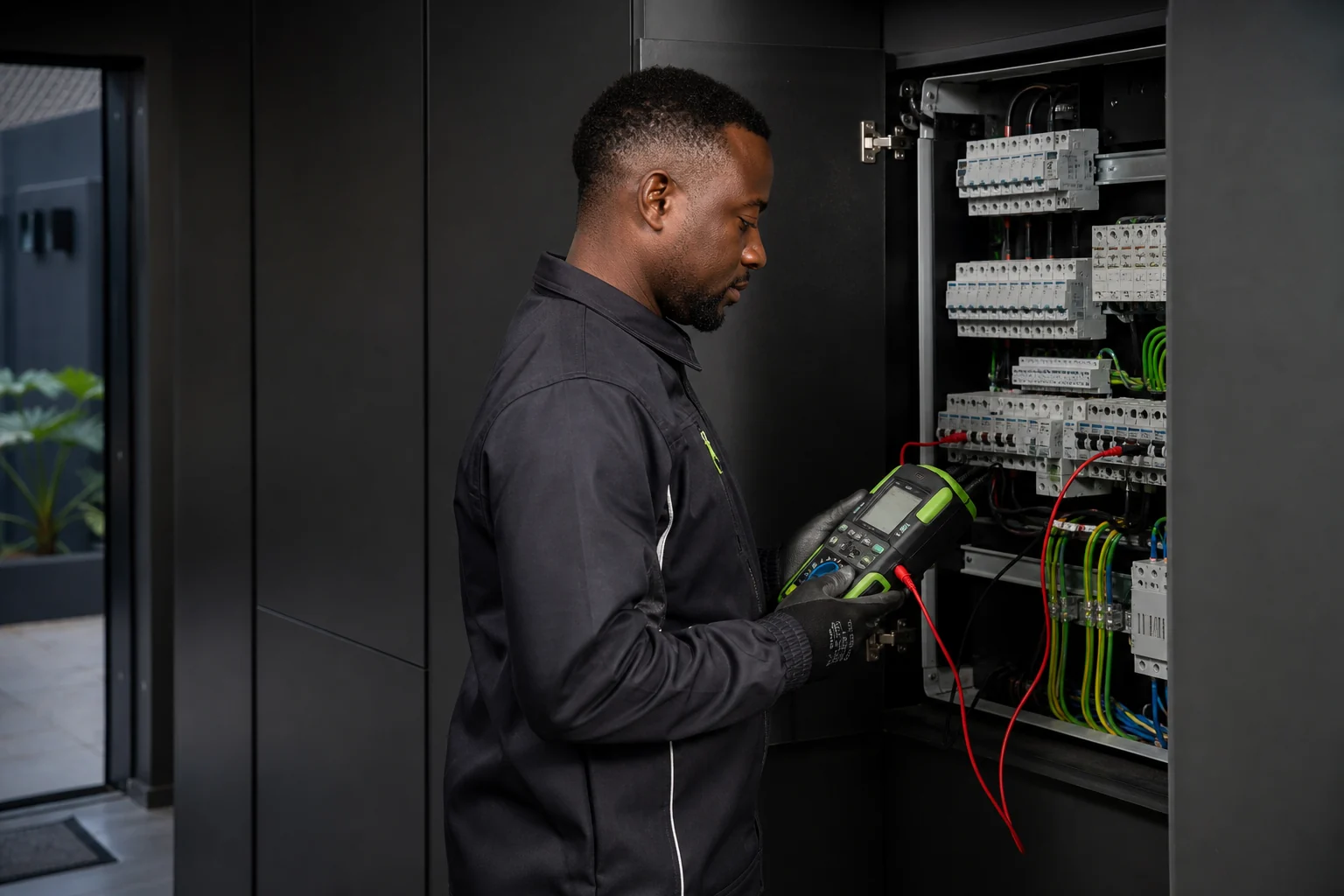
An electrical Certificate of Compliance is not a product that can responsibly be promised before the installation has been inspected and tested. Under South Africa’s Electrical Installation Regulations, a certificate is issued by a registered person and is accompanied by the required test report. The decision therefore begins with the actual installation, its condition, its history and the results recorded on site—not with the property price, transfer deadline or an assumption that a previous certificate still describes every later change.
This guide explains the inspection process at a practical level for homeowners, sellers, landlords, buyers, trustees and property professionals. It does not reproduce a paid technical standard or provide instructions for live electrical work. Instead, it shows what evidence an inspection may need, why the exact test sequence depends on the installation, which items commonly delay certification and how to prepare access without attempting unsafe do-it-yourself checks.
01
The certificate follows the evidence—not the other way around
Regulation 7 states that the user or lessor must have a valid certificate for the electrical installation, subject to the Regulations, and that it must be accompanied by a test report. Regulation 9 allows a registered person to issue that certificate only after satisfying himself or herself through inspection and testing that the relevant requirements are met. If a fault or defect is found before issue, the registered person must refuse to issue until it has been rectified.
That distinction protects the owner as much as the practitioner. An inspection can result in certification, a defect list, a request for access or information, or an urgent safety action. A quotation for remedial work is not proof that the whole installation has passed, and payment for an inspection cannot control the technical outcome. The correct output is the one supported by the installation and its recorded results.
- Electrical COC and property transfer guide — The broader seller, buyer and transfer workflow.
- Property-transfer COC documents checklist — Records worth collecting before attendance.
02
First define the electrical installation and the certificate boundary
The Regulations define the electrical installation broadly from the point of control towards the points of consumption on the premises, while excluding supplier machinery and certain other systems. On a simple home that boundary may still include a main board, final circuits, outbuildings, fixed appliances and later alterations. On a sectional-title or commercial property it may meet common-property boards, landlord distribution, tenant installations, generators, solar systems, electric fences and specialist machinery.
Before testing starts, the registered person needs to know which supply and portion of the property the requested certificate must describe. A cottage, gate motor supply, pool equipment, borehole, external lighting, workshop, inverter changeover or second distribution board can be missed when the instruction says only “inspect the house”. Missing access does not make the omitted area compliant; it makes the inspection incomplete.
- Property address, unit number and the person authorised to provide access.
- Location of the point of control, main board and every downstream board.
- Outbuildings, cottages, garages, pumps, gates and fixed outdoor equipment.
- Solar, inverter, battery, generator or changeover equipment connected to the installation.
- Recent additions, renovations, kitchen changes, air-conditioning or new fixed appliances.
- Shared or landlord-controlled equipment that may sit outside the private certificate scope.
03
A visual inspection tests the installation story against what is present
Visual inspection is not a quick look for neat wiring. It checks whether accessible equipment, identification, enclosures, conductors, protective arrangements, points of consumption and environmental conditions are consistent with the installation being assessed. It can reveal missing blanks, damaged accessories, exposed parts, unsuitable equipment, moisture, heat damage, poor access, incomplete labels, altered circuits or work that does not match the earlier records.
The inspector also considers whether equipment appears appropriate for its location and use. A socket near water, outdoor equipment, a metal water-pipe bond, a ceiling-space joint or a changeover arrangement creates different questions. Some observations lead directly to a defect; others determine which instrumented tests or safe isolations are needed next. A tidy distribution board cannot prove the condition of concealed wiring, and an older board does not fail merely because it is old.
- Board enclosure, blanks, access, main isolation and circuit identification.
- Visible conductor condition, terminations and signs of heat, corrosion or damage.
- Socket outlets, switches, luminaires and accessible fixed-equipment connections.
- Earthing and bonding arrangements visible within the inspection scope.
- Special locations, outdoor equipment and exposure to water or mechanical damage.
- Later alterations and interfaces with backup-power or generating equipment.
04
Instrumented tests answer different safety questions
No single meter reading can prove an installation compliant. The registered person selects and records tests appropriate to the installation, supply arrangement and work being certified. Some tests require circuits to be isolated; others assess conditions with the supply present under controlled procedures. Occupants should expect planned interruptions and should not open boards, remove accessories or attempt to imitate the tests before the visit.
The results must be interpreted together. For example, continuity evidence supports the integrity of protective paths, while insulation resistance looks for unwanted leakage between conductors. Polarity confirms that conductors and devices are connected in the intended relationship. Earthing and protective-device evidence help show whether a fault can be cleared as designed. Each answer matters, but the installation verdict comes from the combined inspection and test report.
Continuity of protective conductors and bonding
Continuity testing helps establish whether the earthing and bonding paths included in the scope are electrically continuous. The practitioner must identify the correct conductors and account for parallel paths; a casual resistance reading without the circuit context can be misleading.
A conductor that looks connected at one end may be loose, broken, diverted or absent elsewhere. That is why the result belongs in a controlled test sequence rather than a visual assumption.
Insulation resistance
Insulation resistance testing looks for unintended current paths between conductors and towards earth. Connected electronic equipment, surge devices, lamps, controls and backup systems may affect how the test is planned, so the practitioner first establishes what can safely remain connected and which portion is being measured.
A low or unstable result is a starting point for isolation and diagnosis. It does not automatically identify one accessory, cable or appliance without further sectional testing.
Polarity, earthing and protective-device operation
Polarity checks help verify that switching and connections occur in the intended conductors. Earthing and fault-protection checks relate the supply, protective conductors and devices to the installation. Earth-leakage protection is assessed as part of that wider arrangement; pressing a user test button is useful routine awareness but is not the complete verification undertaken for a COC.
Where relevant, the registered person records the required values and device information on the test report. The exact tests and acceptable results depend on the applicable standard, the installation type and the certificate scope.
05
The board, circuit protection and fixed equipment must agree
A circuit breaker is not assessed in isolation from the conductor and load it protects. The inspector may need to reconcile protective-device ratings, conductor information, circuit identification, isolation, earth-leakage protection and downstream equipment. Replacing a tripping breaker with a larger one is not a compliance shortcut; it may allow current the circuit was not designed to carry.
Fixed equipment also needs a clear boundary. Geysers, stoves, pumps, air conditioners and gate motors can involve isolators, local connections and specialist equipment internals. The premises installation may reach the supply terminals while manufacturer controls sit in a different technical scope. The certificate and report should be read for what they cover, not treated as a guarantee for every appliance or future failure.
- Distribution-board warning signs — Heat, odour, noise and damage that deserve attention before an inspection deadline.
- Solar, inverter and battery COC guide — How alternative-energy additions change the records and inspection scope.
06
Why an installation may not be certified on the first visit
A first inspection can reveal defects that are visible immediately, conditions that only appear in test results, or missing access that prevents the registered person from completing the assessment. Common groups include damaged or exposed equipment, unsuitable protection, broken protective continuity, poor insulation resistance, incorrect polarity, inadequate identification, incomplete isolation and unrecorded alterations. The finding must still be specific to the actual property rather than copied from a generic list.
If the registered person considers a fault or defect an immediate danger, the Regulations require urgent protective action, including steps to disconnect the affected supply or circuit and notify the user or lessor. Less urgent defects still have to be rectified before the certificate can be issued. The useful outcome is a clear defect record that identifies the location, evidence and required next decision without pretending every defect has the same cost or urgency.
- The board, circuit, room or item concerned.
- Whether the finding came from inspection, a recorded test or missing access.
- The safety or compliance issue in plain language.
- Any immediate isolation or temporary control already applied.
- The remedial scope that requires authorisation.
- What must be retested or re-inspected before certification.
07
Prepare access and records—not DIY electrical work
Preparation reduces delays when it helps the practitioner reach and identify the installation. Find earlier certificates and test reports, clear safe access to boards, provide keys for outbuildings and advise occupants about likely interruptions. List additions made after the earlier certificate and identify solar, inverter, generator, electric-fence or renovation contractors whose documents may be relevant.
Do not remove board covers, tighten terminals, replace protection, bridge earth-leakage devices or open supplier seals in an attempt to make the property “look ready”. Cosmetic work can destroy evidence or introduce new faults. Appliances and sensitive equipment should be managed according to the practitioner’s pre-visit instructions, because the required isolation and test plan depends on what is connected.
- Confirm the address, access contact and occupied areas.
- Provide all available CoCs, test reports and alteration records.
- Unlock garages, cottages, roofs, plant rooms and external boards where safe.
- Identify tenants, alarms, pumps, gates, refrigeration or IT affected by isolation.
- Keep children, pets and unauthorised people away from the work area.
- Allow time for findings and remedial planning rather than promising a same-visit certificate.
08
Close the loop with repairs, retesting and a complete handover
After defects are authorised and rectified, the affected work must be inspected and tested as required. A practitioner may need to repeat earlier tests because a repair can change the installation conditions. Keep the defect list, approved scope, invoices, test evidence and certificate together. The certificate number and attached test report belong to the same compliance record; separating them removes important scope and result information.
Later additions or alterations do not simply inherit the old certificate. Regulation 7 requires a certificate for at least the addition or alteration where work has changed an installation that already had a certificate. Owners and managing agents should therefore maintain a timeline of electrical changes rather than wait for the next sale to reconstruct years of work from memory.
- Electrical COC cost guide — Separate inspection, defects, repairs and certification when comparing scope.
- Centurion electrical service area — Regional context supporting observed Centurion compliance searches.
09
Use the official legal and standards trail
The Electrical Installation Regulations are the legal starting point for responsibilities, electrical-contractor registration, certificates and registered persons. They incorporate health and safety standards, including SANS 10142-1 for low-voltage installations. Standards can be revised, and the installation history affects how current requirements are applied, so a web summary should never replace the documents and the registered person’s assessment.
The Department of Employment and Labour reiterated in October 2025 that a registered contractor may issue a CoC only after proper inspections and tests. That reminder is especially relevant when a transfer deadline creates pressure for a paper-first outcome. Keep the official sources with the property file and confirm current revisions for the actual scope.
- Electrical Installation Regulations, 2009 — Official Department of Employment and Labour regulations.
- Incorporation of electrical installation safety standards — Official notice incorporating SANS 10142-1 and related standards.
- Electrical Installation Regulations explanatory notes — Official explanatory guidance, including the installation boundary.
- Department reminder on COC responsibilities — Official compliance notice published in October 2025.
FAQ
Questions readers also ask
What does an electrical COC inspection test?
The inspection combines visual verification with appropriate recorded tests for the installation and scope. These can include protective-conductor continuity, insulation resistance, polarity, earthing and protective-device evidence, together with board, circuit, fixed-equipment and alteration checks. The registered person selects and interprets the required tests.
Does an electrical COC cover appliances?
The certificate relates to the electrical installation defined by the Regulations and the scope recorded in the certificate and test report. Portable appliances and specialist equipment internals may fall outside that boundary, while fixed supply and connection points may be relevant. Read the actual scope rather than assuming every appliance is certified.
Can a property fail an electrical COC inspection?
The registered person may identify faults or defects and must refuse to issue the certificate until they are rectified. The practical output is normally a defect record and remedial pathway, not a consumer-style pass sticker detached from the test report.
How long does an electrical COC inspection take?
There is no responsible universal duration. Property size, number of boards and circuits, access, occupancy, connected equipment, alterations, backup systems and findings all affect the inspection and testing programme.
Should I repair visible problems before the inspection?
Arrange competent electrical work for known hazards, but do not open boards or attempt unverified DIY repairs. Tell the practitioner what changed and retain the work records so the repaired area can be inspected and tested within the correct scope.
Is the certificate valid without the test report?
Regulation 7 states that the certificate must be accompanied by the test report in the approved format. Property owners should retain the certificate and its associated test report together.